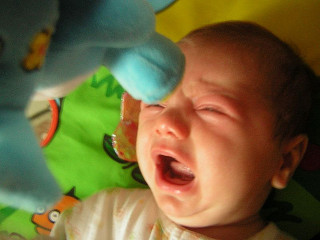










Intuitively and instinctively, the cry it out (CIO) method (also known as sleep training or ferberizing or controlled crying) of getting a baby to sleep is not something I ever felt comfortable with. And as I did research on infant sleep, I learned about what normal infant sleep is and I also learned more about the reasons why the CIO method is harmful. There are numerous scientific and emotional reasons why we have chosen not to let our babies cry it out, which I have summarized below.
1. Cry it out can cause harmful changes to babies’ brains
Babies cry. They cry to let us know that they need something. And when we don’t respond to those cries, it causes them undue amounts of stress. Science has shown that stress in infancy can result in enduring negative impacts on the brain. Prolonged cries in infants causes increased blood pressure in the brain, elevates stress hormones, obstructs blood from draining out of the brain, and decreases oxygenation to the brain. Excessive crying results in an oversensitive stress system (likened to a faulty burglar alarm in one book) that can lead to a fear of being alone, separation anxiety, panic attacks and addictions. Harvard researchers found that it makes them more susceptible to stress as adults and changes the nervous system so that they are overly sensitive to future trauma. Chronic stress in infancy can also lead to an over-active adrenaline system, which results in the child using increased aggression, impulsivity, and violence. Another study showed that persistent crying episodes in infancy led to a 10 times greater chance of the child having ADHD, resulting in poor school performance and antisocial behaviour. However, if you consistently soothe your child’s distress and take any anguished crying seriously, highly effective stress response systems are established in the brain that allow your child to cope with stress later in life.
2. Cry it out can result in decreased intellectual, emotional and social development
At an American Academy of Pediatrics meeting, infant developmental specialist Dr. Michael Lewis presented research findings demonstrating that “the single most important influence of a child’s intellectual development is the responsiveness of the mother to the cues of her baby.” More specifically, other studies have found that babies whose cries are ignored do not develop healthy intellectual and social skills, that they have an average IQ 9 points lower at age 5, they show poor fine motor development, show more difficulty controlling their emotions, and take longer to become independent as children (stay clingy for longer).
3. Cry it out can result in a detached baby
Researchers have shown that although leaving a baby to cry it out does often lead to the cries eventually stopping, the cries do not stop because the child is content or the problem has been alleviated. Rather, they stop because the baby has given up hope that a caregiver will respond and provide comfort. This results in a detached baby. Detached children are less responsive, appear to be depressed or “not there” and often lack empathy.
4. Cry it out is harmful to the parent-child relationship
A child that is left to cry it out is less likely to turn to the parents in times of need. Being attended to as a baby is the most basic of needs and if a child learns at that point that she can count on her parents to respond to her needs, then she will also turn to them later in life when she needs their support. But I worry that if I leave my children to cry it out, then they will not see the point in reaching out to us if they have problems later in life and could try to deal with serious issues like bullying, drug addictions, teenage pregnancy, gambling problems, or flunking out of school on their own or turn to peers. Unfortunately, those problems are often too big for a teenager to be left to deal with alone or with peers and it can have disastrous results ranging from making poor decisions all the way to committing suicide out of a feeling of hopelessness.
5. Cry it out can make children insecure
Children whose caregivers are not consistently responsive and sensitive, often become insecure. Long-term studies have shown that secure individuals are more likely to be outgoing, popular, well-adjusted, compassionate, and altruistic. As adults, secure individuals are likely to be comfortable depending on others, can develop close attachments, and trust their partners. Insecure individuals, on the other hand, tend to be unsettled in their relationships, displaying anxiety (manifesting as possessiveness, jealousy, and clinginess) or avoidance (manifesting as mistrust and a reluctance to depend on others). Parents that use the cry it out method often do so because they are afraid that their children are becoming too dependent. However, an abundance of research shows that regular physical contact, reassurance, and prompt responses to distress in infancy and childhood results in secure and confident adults who are better able to form functional relationships.
6. Cry it out often doesn’t work at all
Some babies will not give in. They are resilient or stubborn enough that they refuse to believe that their parents could be so cruel as to leave them to cry to sleep. So instead of whimpering a bit and then drifting off to sleep as some supposed sleep experts would have you believe happens, they end up sobbing and sobbing and sobbing for hours on end. Some end up vomiting. Many end up shaking so hard and become so distraught that once their parents realize that CIO is not going to work, the baby is shaking uncontrollably and hiccuping, too distressed to sleep and too distraught to be calmed down even by a loving parent.
7. Even if cry it out does “work”, parents often have to do it over and over again
I can’t imagine putting my child through one or several nights of inconsolable crying to get her to go to sleep and I certainly can’t imagine having to do it over and over again. However, that is the reality for many parents. I hear people tell me that they always let their child cry for thirty minutes to go to sleep. Or that they have to start the CIO sleep training process all over again after each round of teething, each growth spurt, each developmental milestone.
8. Cry it out is disrespectful of my child’s needs
So-called sleep trainers will tell you that after a certain age, babies do not have any more needs at night. Some claim this is after a few short weeks, others after a few months, others after a year. Regardless of the age that is assigned to that message, to me it seems wrong. I’m an adult and yet there are days when I need someone else to comfort me. If I’ve had a really stressful week at work, if I’ve had a fight with someone that is important to me, if I’ve lost a loved one, then I need to be comforted. But how would I feel and what would it do to our relationship if my husband closed the door and walked out of the room and let me “cry it out” myself? I’m an adult and yet there are nights when I am so parched that I need a glass of water or I am so hungry that I need a snack. I’m not going to die if those needs are not met, but I am going to physically uncomfortable and unable to sleep soundly. If I were to let my child CIO, it would be like saying that his needs are not important and that to me is disrespectful. To quote Dr. William Sears on the sleep trainers, “Parents let me caution you. Difficult problems in child rearing do not have easy answers. Children are too valuable and their needs too important to be made victims of cheap, shallow advice“.
9. Deep sleep from cry it out is often a result of trauma
Babies who are left to cry it out do sometimes fall into a deep sleep after they finally drop off. And their parents and sleep trainers will hail this as a success of the CIO method. However, babies and young children often sleep deeply after experiencing trauma. Therefore, the deep sleep that follows CIO shouldn’t be seen as proof that it works. Rather, it should be seen as a disturbing shortcoming.
10. Our World Needs More Love
Rates of depression are skyrocketing. Violent and senseless crimes are on the rise. As human beings, we need to spend more time being there for each other, showing compassion, nurturing our children. Learning that you can’t count on your parents to be there when you need them is a tough lesson to learn that early in life and can be a root of many of the social problems we are facing today. I want to give my kids every chance possible of escaping depression and staying away from violence. And I’m convinced that nurturing them and responding to their needs at night, as I do during the day, is the first step in the right direction.
Those are our reasons for not using the cry it out method. What are yours?
Do you need some gentle sleep tips? See Gentle Baby and Toddler Sleep Tips
Sources:
The following sources were used in the development of this post:
- Dr. Sears – Science Says: Excessive Crying Could be Harmful to Babies
- Margaret Chuong-Kim – Cry It Out: The Potential Dangers of Leaving Your Baby to Cry
- Paul M. Fleiss, M.D., M.P.H, F.A.A.P – Mistaken Approaches to Night Waking
- Australian Association for Infant Mental Health – Position Paper 1: Controlled Crying
- Alvin Powell – Children Need Touching and Attention, Harvard Researchers Say
- Pinky McKay – The Con of Controlled Crying
- Linda Folden Palmer – Stress in Infancy
- Gayle E. McKinnon – CIO? No! The case for not using “cry-it-out” with your children
- Macall Gordon – Is “crying it out” appropriate for infants? A review of the literature on the use of extinction in the first year
- Elizabeth Pantley – The No Cry Sleep Solution (book)
- Katie Allison Granju – Attachment Parenting (book)
- Dr. William Sears – Nighttime Parenting (book)
- Margot Sunderland – The Science of Parenting (book)
Note: Please note that not all of these sources look specifically at crying it out. Some of them look at the risks of excessive crying in general. It is my opinion that excessive crying is excessive crying, whether it happens at night or not. Also, as I discussed in my follow-up post Cry it Out (CIO): Is it harmful or helpful? and Another Academic Weighs in on CIO there is no evidence that cry it out is safe, despite what its supporters will tell you.


{ 46 trackbacks }
{ 160 comments… read them below or add one }
Fantastic post! What an incredible summary of the research on CIO.
By the way, thought you might be interested in this research paper on the biological and anthropological bases for AP practices. It’s really incredibly thorough:
http://www.epjournal.net/filestore/ep05102183.pdf
Carla
Thanks for sharing that article Carla. I’ll have to take some time to read it in detail.
hey phdip,
curious – did my FB status prompt you to write this? (was something like “…is so glad he let kid cry himself to sleep so long ago”) cuz if it did, good! You have excellent points and if it helps ensure more children are well-adjusted in the future than may be negatively affected by same advice, so much the better!
now, i’d like to put my own nickel in (time to get rid of the penny). i see a lot of arguments against CIO based on fear and insecurity (which is interesting in itself but I won’t go there right now). I agree with many of your points, but some – like let your baby CIO and he’ll end up killing himself later – are a bit over the top. It took a few days of our kid crying himself to sleep before he started singing or chatting or happily role-playing himself to sleep – and now, the routine leading up to bedtime is so much fun (a few books on the potty, brush the teeth, read another book, a final trip to the potty, turn out the lights, start twinkle twinkle, ok another trip to the potty if you must but no piggy back this time, restart ‘TTLS’ and he’s tucked in for the night).
I think the point I’d like to make most is that letting kid CIO does NOT mean you’re distant from him/her – if he calls (insistently enough), we’ll visit to make sure he’s ok and hug him over the rails as long as it takes for him to settle down. If he’s ever hurt or upset, we acknowledge/validate the state he’s in and hold him close until he knows he’s going to be ok.
I think the research you’re referencing has a bias – insofar as those parents who let CIO are more probably the same parents that neglect their kids 24/7 and raise them in an unwholesome environment – that surely has more to do with long-term emotional distress than whether you let CIO a few days now and sometimes again.
My comment above on FB was prompted by friends whose kid is SO entirely dependent on his parents to sleep at night, that he is depriving them of their couple time and their desperately needed sleep, and as a result, they are constantly frustrated, at odds with each other, and left feeling helpless and misunderstood and “joke” about divorce. Is that a wholesome family environment? I hardly think so.
It is therefore, like everything else, a matter of maintaining a healthy balance, a middle ground that works well (or at least well enough) for everybody. And if that requires a few bouts of CIO and him learning that sometimes you have to look after yourself first to look better after others later, then I think that’s important to acknowledge. Wouldn’t you agree?
Hi crammer,
Nope, it wasn’t your FB status (I didn’t even see that!). Goodness, that would have been awfully passive aggressive of me if that had been my reason.
In any case, I wrote it for a few reasons:
1) There is a lot of research on this topic out there, but I hadn’t seen it summarized well in one article before. I posted the links to those studies and articles on my FB profile a while back, but then later took the time to review them all again and write this summary.
2) Both IRL and on a message board that I moderate, I see a lot of parents that are being told by others that their baby must sleep through the night (as if it were a developmental milestone) and that they must let them CIO to achieve that. In a lot of cases, those parents feel instinctively that it is not something they want to do, but feel so much outside pressure to do it that they give in. Or there are moms being pressured by their husbands to give it a try and they just want some research to show them to support their decision not to do it. In any case, I wanted to confidently present OUR reasons for OUR choices and also arm those that feel that they need to justify their choice not to CIO with some information to help them do so.
3) If someone is on the fence and not sure what to do, maybe this info will help them.
In any case, your comments are interesting and I want to reply in more detail, but I have to work now….I’ll get back to you this evening (after I parent my child to sleep….).
You said: I agree with many of your points, but some – like let your baby CIO and he’ll end up killing himself later – are a bit over the top.
My reply: To be fair, I didn’t say let your baby CIO and he’ll end up killing himself later. I said that was one extreme in the range of possibilities. (“Unfortunately, those problems are often too big for a teenager to be left to deal with alone or with peers and it can have disastrous results ranging from making poor decisions all the way to committing suicide out of a feeling of hopelessness.”). Some human beings manage to deal with extreme pain and suffering (war, hunger, abuse, etc.) and still come through it with a smile. But other human beings, for whatever reason, are more fragile and have more difficulty coping. As a result, I think that some babies will be able to pick up and move on easily from being left to CIO while others will become more withdrawn. Some kids are bullied and escape unscathed, while others are scarred for life. I don’t know which way my baby’s brain is wired, so I err on the side of caution and make sure that she knows that we will always be there for her. We will give her tools as she grows older to deal with problems on her own, but I will not teach her the lesson that we won’t always be there by letting her CIO.
You said: I think the point I’d like to make most is that letting kid CIO does NOT mean you’re distant from him/her – if he calls (insistently enough), we’ll visit to make sure he’s ok and hug him over the rails as long as it takes for him to settle down. If he’s ever hurt or upset, we acknowledge/validate the state he’s in and hold him close until he knows he’s going to be ok.
My reply: You’ve chosen a modified version of CIO that is certainly more responsive than what a lot of people do. I know of people that put their baby to bed at 8pm and don’t go back into the room until 8am, no matter what. I still wouldn’t be comfortable using your approach, but I can see that it is a better alternative to what a lot of people are practicing.
You said: My comment above on FB was prompted by friends whose kid is SO entirely dependent on his parents to sleep at night, that he is depriving them of their couple time and their desperately needed sleep, and as a result, they are constantly frustrated, at odds with each other, and left feeling helpless and misunderstood and “joke” about divorce. Is that a wholesome family environment? I hardly think so.
My reply: We all have our limits as parents. Personally, I am able to say “this too shall pass”. I recognize that my kids will only be small for a few short years and I’m willing to put aside some of my own needs and wants to give them the best start in life. We had the advantage of 10 years of couple time before we had kids and I know that our marriage is resilient enough to withstand a few years where nighttime parenting might need to cut into our couple time. But if someone else is on the verge of having a complete breakdown, is at extreme risk of neglecting or abusing themselves or their kids during the day due to nighttime problems or feels that their marriage is going to fall apart, then they need to do something about their sleep situation.
However, I don’t think that CIO needs to be the solution. There are so many other things that people can do (The No Cry Sleep Solution is a great book full of suggestions). Not every solution is going to work for every child or every family, but I think there is a route to better sleep for everyone that doesn’t involve CIO. In our case, I know that a couple more hours of exercise and fresh air each day makes a world of difference in my son’s sleep and is good for him too.
… and since what goes around comes around, if all other things are equal, if its good for your son it’ll be good for everybody. Isn’t that what we all strive for!
Exactly! Thanks again for stopping by and commenting….
What if you’re a working mother and your baby will not sleep unless she is breastfed…and even then, will not fall into a deep enough sleep to get her to her crib before she wakes? We’ve tried CIO for the past few days and my wife hates it, but our baby will actually fall asleep. We’ve been having her get in bed with my wife and lay down and nurse. After 30 minutes or so, she’ll fall asleep for 2 hours (maybe). She has also been sleeping in our bed most nights and nursing between naps…
any advice….my wife heads back to work in 5 weeks and our nanny is expecting a baby in 4. Our nanny can’t exactly nurse our baby to sleep; this is why we are trying CIO to get our daughter to sleep. Our daughter is 11 weeks today.
thanks
I’m a working mother too, which is exactly why I co-sleep. It means that I can nurse at night without having to get out of bed and it also gives me more time to connect with and be close to my baby, who I miss so much during the day.
At first, I didn’t find that I necessarily slept more while co-sleeping but with time as the baby got older and as I got more used to it, I found that I hardly needed to wake at all to feed the baby. And sometimes my kids even latched themselves on and helped themselves while I continued to snooze.
Incidentally, both of my kids slept much longer stretches right next to me than they would if they were sleeping on their own. Both of them also fell into a pattern of sleeping through the night most of the time while being in my bed, but would wake fairly easily if I wasn’t there.
I would suggest getting the No Cry Sleep Solution. It has great suggestions for improving a baby’s sleep without crying and has ideas for both co-sleeping or crib sleeping. Crib sleeping was never really a good option for us, but if that is your preference, the book might be able to help.
My husband and my mom care for my kids while I am at work. Sometimes a bottle works to get them to sleep. Sometimes rocking them. Sometimes a walk in the stroller or the sling. There are lots of ways to get a baby to sleep without crying.
I hope you find something that works for you!
Let me know if you have any follow-up questions…
Great summary! Here are two related articles from the Natural Child Project site:
A Baby Cries: How Should Parents Respond?
http://www.naturalchild.org/jan_hunt/babycries.html
Ten Reasons to Respond to a Crying Child
http://www.naturalchild.org/jan_hunt/crying.html
They also have a bumper sticker “Teach babies love – answer their cries.” I think that says it all!
Jennie M.
Amen Amen Amen!!!
I’m always confused when I read women’s posts that say “I hope I don’t have to CIO”… doesn’t that mean that deep down, somewhere, they know this is not the right choice to make?
Yup…. I have children as old as 15, and I can tell you none of them have cried longer than it ever took me to drop what I was doing to hold them. What a loving gift to give a child!
You know, I’m really conflicted right now about CIO. My 5-mo old wakes up every 40-mins to an hour all night. He tosses and turns and fusses and wakes up every 20 mins or so from 3:30-5. The longest he’ll sleep is two hours. He is so exhausted he’ll wake up if I so much as rustle the sheets.
Yes, he’s in my bed. We also use a co-sleeper but it’s very difficult to get him into it w/out waking up and starting the screaming all over again. And, FWIW, I breastfeed on demand and nurse him to sleep. And yes, we have a routine, etc. etc. Yes I “wear” him. Yes I read No-Cry Sleep Solution and no it hasn’t worked for us and yes I’m really following it.
Now, while I appreciate a mother’s disinclination to CIO and am more against it than for it, I find these “scientific” sources–that you and other CIO-opponents use–to be dubious. If you’re going to list Sears as a “scientific source,” then why can’t someone list Ferber or WEissbluth as a source?
Also, there are lots of logical flaws in the “scientific” connections between studies and the implications for CIO. For example, this study is often cited: “Infant developmental specialist Dr. Michael Lewis presented research findings at an American Academy of Pediatrics meeting, concluding that ‘the single most important influence of a child’s intellectual development is the responsiveness of the mother to the cues of her baby.’”
Sure! Of course! No sane person would argue that or any of the other studies SEars cites.
But were these studies directly dealing with babies crying at night for one or two nights? No. And of course a baby whose cries are habitually ignored is going to have increased stress, trauma and poor development. That’s pretty obvious. But is this research, and the other research cited by Sears, directly speaking to CIO? No.
I’m not defending CIO, per se, I’m just asking that we be intellectually honest in these discussions.
Say there was a study done on people who are traumatized by living in war zones. And one particular study shows that people who live in these war zones have increased levels of stress. Any time one of these people is exposed to very loud noise, the noise triggers a severe anxiety attack.
Would it be fair to say, Loud noises trigger severe anxiety attack? No–because you’re leaving out an essential piece of the equation. Same with these studies that are often used to “prove” how harmful CIO is.
What about a mother who is so exhausted because she’s been guilted into thinking that CIO is going to irreparably harm her child that she hasn’t slept for more than 40 minutes for months. She is so tired she can barely play with her child all day. She is so depressed and exhausted she can’t eat properly. She argues with her spouse. She falls asleep while her baby stares at the ceiling fan in bed next to her despite her best efforts to stay awake. She’s so exhausted and numb that when he baby does fuss during the day she can’t even respond right away.
Are you really telling me this is better for a child’s development than “controlled crying” for a few nights? Sure, I know. It doesn’t work all the time. And no, it’s not a great solution. It sucks. And I’m sure many many parents only turn to CIO because they are at the end of their respective ropes.
It’s easy for some moms to look down on other moms who have to turn to CIO. Maybe their babies only wake up 4 or 5 times a night. Maybe they are able to let their husbands get the baby to sleep so they can nap.
It’s not such an easy decision. I of course think moms shoudl try all of the other options before turning to CIO. But A) sometimes it seems to be the lesser of two evils. and B) I wish people would think about the logical connection between “studies” and their parenting practices before demonizing others.
Meghan -
Comment 17 provides a link to today’s post which is my attempt at being intellectually honest about this stuff.
With regards to the rest of your comment, I do feel for you. It does sound like you are sleep deprived and I remember being there sometimes with my son. As I said in Comment 8, “If someone else is on the verge of having a complete breakdown, is at extreme risk of neglecting or abusing themselves or their kids during the day due to nighttime problems or feels that their marriage is going to fall apart, then they need to do something about their sleep situation. However, I don’t think that CIO needs to be the solution.”
You say that you have tried the No Cry Sleep Solution and it didn’t work for you. Does that mean that you did the logs for 3 days, chose your solutions and implemented them for 10 days (and continued the log) and saw no improvements, made some adjustments and chose different strategies and did it for another 10 days with no improvement at all?
The NCSS is a gradual process. By being consistent with the strategies that you’ve chosen, you will see incremental success. It isn’t an overnight solution and the “plan” needs to be adjusted over time. You also need to account for things like teething, developmental milestones, growth spurts, etc. impacting the process.
Meghan, I know this is hard. See if you can get some help from someone during the day sometime so that you can get some extra sleep. Try to get out and get lots of fresh air (if you put your baby in a sling or stroller, maybe he’ll go to sleep and you can have a “break” too – mine both took some of their best naps outdoors).
Thank you for this webpage.
I’m so glad I’m not the only one that thinks this is too much for a child to handle – despite the fact that almost every mom I know has done this.
I’ll share my story.
Just like Meghan (above), I was extremely sleep-deprived, going through post partum depression, and desperate for some hours of sleep; so finally we agreed to do the cry it out method. Surely, if I got some sleep, I’d be a better mom.
For one month we heard our baby scream when bed time came. Not cry; scream.
By the second week, I was hearing him scream (in my mind) during the night, although he was deeply asleep. He slept the first 5 days through the night; after that he was waking up again. (So, no different than before)
According to the book we were following, we were not to respond for 10 minutes if he woke at night. One night his room was so hot because the temperature rose, and we didn’t know about it. He was sweating extremely by the time he had screamed for 10 minutes.
By the last week, I was hating bed time so much. Then while our son cried and screamed, my husband and I were almost at each other’s throats. During the day our baby was witnessing our arguments.
We gave up.
And our baby has become more whiny, more aggressive, and fears more the unknown – he used to explore the world more.
We were desperate and believed that Weissbluth was correct that every baby can sleep.
As a happy ending, our little one is back to himself. It took a few months. That’s my story. Thank you.
Some contrary opinions that are quite critical of the science behind many of the anti-CIO arguments you might be interested in:
http://mainstreamparenting.wordpress.com/2008/06/25/of-sources-and-straw-houses-the-annotated-dr-sears-handout-on-cio/
http://mainstreamparenting.wordpress.com/2008/01/23/when-proof-is-not-proof-apnp-research/
As I said in my comment on your other post, I also think you are missing an important part of the equation – the detrimental effects of sleep deprivation on parent and child. Is 2-3 nights of attended crying, resulting in good sleep for everyone, really going to be that much worse than months or years of no one getting enough sleep? Some will say of course the crying is worse; all I know is that my then 7 month old became a completely different baby after 2 nights of us using the Ferber baby. She went from crying, cranky, and barely sleeping at all, with HUGE bags under her eyes, to a happy baby who almost never cried. The change was amazing, and it appeared to all have to do with her finally getting enough sleep.
Not sleeping was having a seriously negative effect on my baby. CIO fixed that. Co-sleeping made it worse. Everything else we tried failed.
@Egrrrl
As I said in reply to your other comment, if you do have to resort to some sort of crying approach because you’ve tried everything else and are still sleep deprived, then that is your choice, but I don’t think you can assume that there is no harm at all.
If my child wouldn’t eat anything but pop tarts, then I would feed him pop tarts rather than having him starve and sure he would look healthier and happier than when he was eating nothing, but I wouldn’t pretend that it was a healthy diet and that it was having no ill effects on his health.
My other post on this topic was a reply to “critiques” like the ones you listed, so I won’t rehash that here. Lets just say I’m glad I don’t have to justify being a “mainstream parent”, I’m glad to be an attached parent instead.
This was a great posting. I don’t understand why people have children if they aren’t willing to take the steps necessary to have a happy baby. Of course infants are “needy”, they are babies! Ignoring a crying baby and emotionally stunting their growth early on is just poor parenting. It’s that simple.
I usually try not to be judgmental, but it’s pretty clear to me why we have so many “messed up” children in this world.
Infant experiences are a lot more far reaching that most people would think.
@joshua
Ok, so in the interests of coming back to reality, let’s just identify here and now that your comments:
“Ignoring a crying baby and emotionally stunting their growth early on is just poor parenting. It’s that simple.
I usually try not to be judgmental, but it’s pretty clear to me why we have so many “messed up” children in this world.”
are the most foolish I’ve read through this and the other post. These are ridiculous comments, and I’m sure phd will agree with me. In fact you’ve tainted a level-headed and lively discussion.
So, in the interests of keeping the discussion going, hopefully my post will ward off the ire of many parents who read these articles because they need help and assistance, then come across your post blaming the world’s problems on parents who try/do CIO.
No, I’m not a fan of CIO either, but you need to get a grip.
My 6-month old wakes every hour or two in his crib OR when he’s next to us. My husband and I sleep on a futon matress on the floor in his room so we can tend to his cries as soon as possible. We reject the CIO method, we’ve tried the Pantley way (to the letter, and no, it did not work), and we’re just wondering what DO we do? He hated the car seat and the stroller for five months, which made the simplest of chores out of the house a nightmare, but he’s better in both places now. Is it possible for a high-needs/previously colicky/non-napping baby to simply MATURE into better sleeping patterns?
@ Krista
One of my kids has always been high needs and a bad sleeper and the other one is easy going and a good sleeper, so I have had the opportunity to experience both.
We went through some really awful periods with my son sleepwise, where it seemed like he was nursing all night long. The No Cry Sleep Solution (NCSS) helped to improve things somewhat, but wasn’t a perfect solution.
In the section on improving mom’s sleep, NCSS talks about the importance of exercise. However, this isn’t mentioned anywhere as a solution to improving the baby’s sleep (that I could see/ recall). It is mentioned briefly in the NCSS for toddlers and preschoolers.
Ironically, exercise and fresh air turned out to be THE most important things in encouraging better sleep for our son. I think this is common in high needs kids. They have so much energy and need an outlet for it. I thought our son was getting plenty of time outdoors and time to exercise (2 hours or so per day), but when we doubled or tripled that, his sleep got so much better!
Obviously a 6 month old can’t run around outside, but getting out in the fresh air and being given the opportunity to move around and explore in the outdoors as much as possible can really make a difference.
That said, to answer your question about whether it is possible for a baby to simply mature into better sleeping patterns, I think some part of being a good sleeper does just come with time. But part of it is creating a healthy sleep environment for the child. That includes good nutrition (food sensitivities or allergies can often contribute to poor sleep), lots of exercise and fresh air, no TV or at least no TV in the evenings, regular bedtime and calming bedtime routine, sleep space that is the right temperature, comfortable but firm, free from clutter and free from environmental pollutants/allergens.
How kind of you to take the time to reply to my question, and so quickly!
Thanks for the advice. He has some good nights, but the bad ones just make me feel so sad for him. Never mind me – I’ve accepted that being a mom means being there for my child – day or night. And I don’t intend to sound like a martyr. That’s just the way it is. I go to bed when he does around 7:00, so I’m getting my rest!
Your suggestion to try the outdoors approach was a “well, yeah, duh!” moment for me. When our son was at the height of his colic, he’d cry, no, scream, solidly from 3-7pm (and various other parts of the day). One day we walked outside with him, and he stopped crying! It didn’t always work that easily, and with winter in Wisconsin on its way, we won’t always have the option, but something as simple as fresh air and a change of scenery may just be the trick to better sleep. After experiencing a baby with colic, when all our desperate and persistent attempts to nurse him, cuddle him, rock him, sing to him, failed, I cannot just walk away when he’s crying. Now that Jude cries less, there is no way I’d go back to hearing him cry without responding. We’ll keep on trying!
Great post. Thank you for the great info and excellent research. Also seems to be a lively discussion in these comments, which is a good reminder that every child is different, and what works for some will not work for others. It’s so important for parents to be in tune with how their child acts, even if it is sometimes at the expense of expert opinion. But I also think that babies are more resilient than we think sometimes–we’re fortunate to have a very sootheable kid (knock on wood!), but parents should not feel bad if their kids may need a little bit of a cry now and then.
hi
could i copy and paste your article to my blog. am against controlled crying and would like to refer to your article. will provide link to ur blog of course
@francesca
Thanks for your interest! I would prefer that you link to it rather than copying the whole thing. Maybe list the 10 reasons without the full detail and then refer people over here?
Here are the 10 reasons in short form:
1. CIO can cause harmful changes to babies’ brains
2. CIO can result in decreased intellectual, emotional and social development
3. CIO can result in a detached baby
4. CIO is harmful to the parent-child relationship
5. CIO can make children insecure
6. CIO often doesn’t work at all
7. Even if CIO does “work”, parents often have to do it over and over again
8. CIO is disrespectful of my child’s needs
9. Deep sleep from CIO is often a result of trauma
10. Our world needs more love
I’ve already posted a long comment on the other post, at http://phdinparenting.com/2008/08/11/cry-it-out-cio-is-it-harmful-or-helpful/#comment-996, explaining some of my objections to this post. (Thanks for replying, Annie; I’ll try and respond to that as soon as I can. Which should be, um, about three months at the rate I normally find time to write things…) However, I know not everyone will read that post, so I do want to say this here as well:
*None* of the studies cited or referred to in this post is into effects of controlled crying or sleep training. The three studies that have been done into psychological effects of sleep training showed either no effect or beneficial effects. Despite what Annie says, the available scientific evidence does not support any of the claims she’s making here about supposed harms of sleep training.
There is certainly evidence that children who experience *long-term* neglect or unresponsiveness on the part of their parents are likely to suffer harm as a result, but that doesn’t mean we can assume that sleep training has the same effect. I’ve often likened it to research into nutrition – we know that children who *regularly* get too little to eat suffer long-term ill effects and that the result can even be fatal. But that does *not* mean that a child is going to suffer the same kind of ill effects if you’re sometimes half an hour late with his dinner or tell him he can’t have a biscuit every time he wants one; and it wouldn’t be good science to claim that that was the case.
Of course, lots of people prefer to err on the side of caution and try to avoid ever leaving their baby alone crying for any reason anyway. If that’s how you feel, then good for you! I’ve also aimed to use gentle methods with getting my children to sleep where they worked (in some cases they didn’t, but that’s another story), for the simple and obvious reason that it’s more pleasant for all concerned. But it is not true to say there’s scientific evidence that the Ferber method is harmful. By all means believe that it *might* be harmful, but it isn’t accurate to claim that the research supports this; and I don’t think it’s responsible to mislead parents in the way that this article does.
Annie, one last thing here. In Comment 21 above, you state that you’re glad to be an attached parent ‘instead’ of a mainstream parent. Did you really mean that the way it sounded? Because it sounds to me as though you’re trying to claim that ‘mainstream’ parents (what a vague term!) aren’t attached to their children. Attachment has nothing to do with how mainstream you are. I find your comment quite offensive to the millions of wonderful, caring, responsive parents out there who are just as likely to have strong attachments to their children as you are despite not making the same choices as you about every detail of their lives and parenting practices.
@ Sarah V
Thanks for your comment. Most of what you raise above, I addressed in my follow-up post and yours and other comments on that post: http://phdinparenting.com/2008/08/11/cry-it-out-cio-is-it-harmful-or-helpful/
With regards to your last question on attachment parenting versus mainstream parenting, I decided to address that in today’s new post: http://phdinparenting.com/2008/11/16/what-is-attachment-parenting/
Thanks for the article and the list of reference material. Not that I was considering CIO with my son, but I am going to send this to anyone who tries to pressure me to do so.
If someone wants to do this with their own kid, okay…I mean, go for it, but don’t push it on me. K? K.
You might be interested in my recent work evaluating the research literature that underpins CIO. In short, I found that most of the research on CIO has not been conducted on infants, but on toddlers and preschoolers and virtually no research has been conducted on infants under 6 months. Further, the majority of the research only looked at whether or not the intervention “worked” (ie. did the child stop waking and crying). Only 3 studies with some infants looked at their behavior after the intervention. These three used a scale that is outdated and had never been thoroughly validated. I’ve put this summary, as well as a copy of the poster I presented at conferences on my website.
@Macall – thank you for your comment and for providing another wonderful resource for my readers on this topic: http://www.infantsleep.org/
Oh, I agree. I agree. I was just thinking today that I don’t think Ivy has even cried a total of 10 straight minutes since she was born. I feel this is how she communicates with me. I know her so well I can anticipate her needs before she needs to cry. I could go on and on-
Steph
As a pediatrician who was frustrated by how many parents failed to find help using CIO, I did extensive research and even have published an ebook about this important subject (When “Crying it Out” Doesn’t Work, by Mary Kathleen Fay, M.D.) I think the fundamental problem is that for CIO to work, the child must be completely healthy and sleeping normally once they fall asleep. Few doctors consider the fact that sleepless children may be suffering from insomnia as the presenting sign of a sleep disorder. Once I took information from the adult medical literature and started to apply this to my patients, I found that in virtually every case where CIO failed to work within the first day or two, the child was suffering from an undiagnosed sleep disorder, usually caused by a mild breathing problem. The symptoms I learned to look for to make the diagnosis were restless sleeping, mouth breathing during the day or during sleep, drooling during sleep and excessive daytime drooling ( a product of mouth breathing), and daytime problematic behaviors like ADD, school problems, and difficulty with discipline. These children don’t respond to CIO because they are sick and unable to sleep normally. Most pediatricians were not taught to link these symptoms to sleep disorders until quite recently, and many more in practice were never taught anything about sleep disorders, so the diagnosis is frequently missed. Instead, pediatricians lump all sleep problems together as “behavioral” and blame the parents what is rarely their fault. A t this point, most pediatricians are aware that snoring is abnormal in children and dictates getting a sleep study in a poor sleeper, but many children with sleep disorders don’t snore, just as my child never did.
If you would like to know more about this widespread problem, please check out my ebook which can be bought on payloadz.
Good luck to all of you struggling to get help. Don’t blame yourself when CIO doesn’t work. It is most likely because it is the wrong treatment, and continuing to use it will delay appropriate diagnosis and harm your child.
Even reading about the CIO method makes me upset — I couldn’t imagine putting it into practice with my own daughter.
Glad I stumbled upon this. It’s nice to know I’m not alone in this world that says “let them cry!” I haven’t done it, and I won’t do it. As my sister with a teenager reminded me, she did not have him cry it out as a baby, and she doesn’t have a teenager who can’t sleep! These precious months with my little girl are too valuable for me to fret over waking up now and again in the night to comfort her!
Thanks for your blog.
thank you for this post. i’m having a dispute about AP w/DH and his views on CIO and I just needed to be reminded of why I do what I do. My DH is all about the clinical. If our doctor or a ‘known’ doctor says something, it must be. I’m two steps from throwing a Dr. Sears book at him.
Thanks again.
This is the best concise article I have seen on this. This is one of those posts you want to print and keep a copy of on your fridge for the times your dh disagrees with your methods or a friend calls to tell you she’s thinking about cio.
In reality….I don’t believe there is one right answer. We are all different and our babies are all different. What works for you and your child, might be completely wrong for me and my child and vice versa. But I would like to share anyway…..
My wife and I have a little girl who just turned 4 months. We’ve been talking about AP vs CIO recently because our daughter wakes up 4-6 times per night. We both work (different shifts) and it is super hard for us to get up every hour to console her.
We are inclined to give the CIO method a shot because our daughter is very happy during the day and we both have a very loving and engaging relationship with her. She just struggles to sleep at night. When we go in there to console her, it doesn’t take too long to get her back to sleep. But we’ve been doing that now for a few weeks and I am 100% convinced that she has learned that she can cry and we will respond. This does not seem to help in developing her independence and ability to console herself in anyway.
As I was thinking about what we should do, I started talking to several friends of ours who have infants. I wanted to hear about their thoughts and, more specifically, how their own parents handled this when they were babies themselves.
After talking to about 10 people, one thing was clear: the people I perceive to be more self-centered, lower self-esteem and not very independent were the people who told me that their parents co-slept them and/or were big proponents of the AP method.
So, for us, we are choosing to try the CIO method for a couple reasons. First, because I believe that if you have a great loving relationship and respond appropriately to your childs needs during the day…..it won’t have a traumatic effect when you don’t respond the same way at night. I’m sure some may think it will confuse them, but don’t insult their intelligence. Second, I think that she needs to develop a strong sense of independence and figure out how to console herself and get herself back to sleep. She will have to learn this eventually. I’d rather work on it now than when she is 4 and her ability to be defiant is even more finely tuned.
I’ll end the same way I started…..there is no absolute method that works universally. I can tell you that my parents let me CIO and I am an independent, well-rounded, mature, intelligent and confident adult. That being said, I cannot personally be an opponent of the CIO method. It worked for me. If it doesn’t work for my daughter, then we’ll adjust until we find what works best for our family and the wholesome development of our baby girl.
Great information here, though. I appreciate the discussion.
@EMD
Thanks for your comment.
I don’t see it as AP vs CIO. Sure, most people that do AP do not do CIO, but being AP is a lot more than just not doing CIO. AP is an overall approach to your relationship with your child. I wrote about it here: http://www.phdinparenting.com/2008/11/16/what-is-attachment-parenting/
If you are looking for evidence beyond your 10 friends, you might want to check out this meta review of research on attachment: http://www.epjournal.net/filestore/ep05102183.pdf
I also quote some research (from that study and others) on the effects of co-sleeping in my post on the benefits of co-sleeping: http://www.phdinparenting.com/2009/01/09/cosleeping-benefits/
You can certainly make whatever decision you think is right for your family, but I think it is worth going beyond the personalities of 10 friends when assessing the benefits or drawbacks of an approach.
@EMD
Just one final thought with regards to your comment that you would rather do this now (at 4 months) than wait until she is 4 and her ability to be defiant is even more finely tuned. That is one way of looking at it. The other way of looking at it would be to say that now she doesn’t have the language abilities or intelligence to understand when you tell her why you aren’t coming back at night. When she is 4, she may not be happy if you say that you are not going to console her at night, but at that age you can expect her to understand what you are saying.
I have a very active infant who used to wake up like 8-10 times on average at night. for the first 6 months, i tried the no cry sleep solution methods but he was still not sleeping through the night. After much sleep deprivation and advice from books and my sister who implemented CIO on her son with success, I decided to let my lttiel one CIO. For the first 2-3 wks , it worked well and my baby did sleep through the night and naps were longer and more quality. However I noticed that after he reached his milestone of crawling and sitting up , not to mention teething, everything changed. He no longer slept through the night. I was told that I had to ” retrain” again, which I did for 2-3 weeks. It was really tough and a sheer TORTURE hearing him cry and i realised that he seemed to know what was coming when I put him down to bed after nursing. His cries will get louder and sometimes violent. He would twist and turn his little body in bed and at one time, he got himself caught under the crib bumper,almost suffocating himself. My husband and I were really alarmed by this and distressed and I feel totally GUILTY for putting my little one through this as he ends up sobbing terribly and unconsolable.
My conclusion is that CIO doesnt work necesarily for all babies. It didnt work for mine and I have put aside all my sleep training books. I am just going to LISTEN to my baby and RESPOND to his needs. NO MORE crying. He now sleeps with us and he sleeps through and at times gets up for a quick night nursing. He is going on to 8 months and he wakes up in the morning fresh and smiling at us.
Okay, i agree with comforting my baby to sleep, i cant have the heart to see her or hear her cry, i had seperation anxity when i was yonger and that caused me panic attacks when i got a little older, my mum didn’t use the cio method with me but i cant imagin how much worse it would have been if she did..any ways, i find myself torn because my daughter is 4months old friday and she HATES the carseat with a passion, i’ve tried toys, pacifier,bottle, i mean everything and she just ins’t happy till i take her out, hold her till she falls asleep andthan i can put her back in, she will otherwise scream and cry till she is caughing and bright red and shaking, i cannot see her that way, however a peditrican told me its a temper tantrum and if i continue to pull off and get her out it will only make it worse not to mention an inconvinece so im trying to find someone who can give me some sort of advice, i dont want to do the cio method but i cant pull over every 5 min. and its half temping to let her cio a couple times just to get over it and be able to go places!..pls help i really dont want to use this im hoping that someone can shed some light that will work for me!! thanks!
Thank you! I am a new mom, and an older mom, and CIO seems so counter intuitive. The thought of trying it makes my stomach hurt. Thank you for backing up that feeling with evidence.
Thanks for posting this and all of the articles. It’s so important to take care of a babies needs. The more people that realize this and post articles such as this the better off society as a whole will be.
Very interesting post Annie. I wonder if there has been any research done on babies that “CIO” while being “soothed” to sleep. My youngest would scream and cry while being put to sleep. I tried everything I could think of, and yet she persisted. What is the prevailing wisdom about this? FWIW, my oldest was the worst sleeper and my second was amazingly easy.
Ashley, I don’t know if you ever found a solution (or if you’ll even see this), but I have to say, I completely disagree with the pediatrician. Obviously something is bothering her about the car seat. It might just be that she can’t see you & is moving backwards, or it might be uncomfortable for her. Things that have worked for other parents: getting rid of the baby bucket & getting a rear-facing convertible seat; putting the seat slightly more upright (for older babies whose heads don’t slump forward & no more than 30 degrees), putting the radio station to static & having it the same volume as the crying, singing, trying different kinds of music, sitting in the back with the baby (obviously only works if someone else can drive
), having toys that are just for the car, only going somewhere when baby is sleepy…I’m sure there’s others, those are the most common
Thank you for this. My child is 7 months old, we co-sleep and he is a very happy baby. He sleeps wonderfully, most nights, from 9p-7a. Naps are where my difficulty has been, he would sleep next to me on the boppy on the couch where I sat next to him. I never left him alone during these times. Now, he is beginning to be disturbed with his naps mostly due to his teena ged brothers being, well, teenagers. So, i thought how am I going to get him to sleep in the crib or playyard so that He can be in a quieter spot in the house and be safe so I can use the time he sleeps to clean or sew.. or something. I was going to try CIO, because I had used it with my 16 yo son many years ago, and he is a well adjusted, emotionally healthy smart kid.. but then I realized.. his CIO wasn’t really crying, more restlessness settling into sleep as I patted his butt. So.. this child does not respond to butt patting, and sleeps on his back. Back in the day no one recommended back sleeping so my teens as babies slept on their tummies. After reading this article, I decided to try other methods.
Then what do you suggest to get my child and myself any sleep at night?????
Did you read the other post that I linked to? Gentle Baby and Toddler Sleep Tips.
I also have some book recommendations in My Parenting Library.
A quick follow-up to my post on May 1. Our daughter is now just past 8 months and sleeps through the night just fine. She first slept through the night at about 5 weeks but that only latest for about a month and then it was pretty rough for about two solid months. Hence the interest in this post and the comments made on May 1. We ended up with somewhat of a hybrid approach, I guess. She always went down just fine, but would wake up around 11 and the again around 3. We let her cry for about 20 minutes and then would go in and pat her on the back or play with her hair. We never picked her up because we didn’t want to teach the habit of crying = get picked up. This worked well for us and she eventually (after about two weeks) did not wake up any more. She has been sleeping from 9pm-7am for almost 3 months now. She has a bottle at 7am and then goes right back to sleep for another hour or so. Our method would not work for some and other people’s methods certainly did not work for us.
In my opinion, this is proof-positive that……again….there is no absolute method. Each child is eternally different. I personally slept through the night from 3 months on. According to my mom, my older brother didn’t start sleeping through the night until nearly 18 months! Crazy.
My advice to new parents is to try what seems like the best approach, but be willing to adjust your thinking and try other methods. Don’t give up!!! You’ll eventually find the solution that is right for you and your baby. Science, technology and research can most definitely support one practice over another and we should trust them (with an open mind), but when it comes to how you raise your kids…..they can’t guarantee what will work for your baby.
Excellent discussion here and certainly a topic that will perplex every new parent for as long as we’re all around on this earth.
Meghan,
I didn’t read all the replies after yours, so maybe someone already said this. Have you looked into the possiblity of your baby having allergies? Dairy and wheat especially are HUGE triggers for fussiness, and can be passed through the breastmilk. I personally know several people and have heard of many more who have eliminated dairy or wheat from their diets and seen great results in their baby’s moods and sleep.
Craniosacral therapy is another route to try. This is usually performed by a chriopractor. It helped my nephew a lot.
Personally, I’m tired of people framing this debate within the context of efficacy.
It’d be terribly effective if we tied our kids up and put them in a closet, too. Boy, think of all the cleaning we’d get done!
And if we fed them junk food, they’d finish dinner in a flash!
I also wish people would stop thinking about how to solve a ‘sleeping problem’ and start thinking about what else might be bothering their infant. If they nurse, have they tried eliminating dairy from their diet? If they formula feed, have they tried giving human milk to their infant? Temperature changes? Moving bedtimes? (That’s another peeve…I’m so tired of hearing how babies get dumped in their crib at 6PM…are ya kidding me? And then you complain when they wake up at 4am?)
Interesting reading all of this. My oldest is 4 and a half, so it’s really interesting to read this thinking of him in hindsight. He never slept through the night until he was 2, and has JUST NOW stopped screaming for me when he wakes up at 5:30 am…and has been a horrible sleeper his whole life. Anyway, I responded to him every time he cried during the night when he was an infant. (Which was about every 2 hours.) By the time he was 6 months old, I was depressed, I hated being a parent, and I hadn’t slept at all. We lived 4 hours from either set of parents in a new town and my husband was in residency and was completely unable to help; it all fell on my shoulders. I can say that the negativity and resentment that grew within me toward him made it impossible for me to be a good parent.
Here’s what we tried: We tried CIO, we tried AP, we tried Weissbluth, we even tried that crazy guy who says you should feed your kid every 3 hours only? What’s his name? Anyway, every thing you can possibly imagine. He already had about 8 hours outside every day, was extremely active and had an amazing diet of breastmilk.
Things like that just didn’t make any difference or were rather unchangeable.
What did we have to do, and what do I think some folks need to try? Make peace with the fact that he’s a crappy sleeper (just like I am…heh…) and get counseling and on Celexa!!
No really, Celexa made a big difference for me; I was able to see through the fog and see my son for the first time in a long time. Counseling helped give me a little bit of perspective; life isn’t going to be just like this forever. It’s just not.
When he turns 16, he’ll be sleeping so much that I won’t be able to wake him…until then, I’ve just had to DECIDE that I’m going to enjoy my wee-hours-of-the-morning discussions with him about dinosaurs and rocks…It’s hard, but you know what? I don’t EVER get this time back. Seriously. Being tired isn’t the end of the world…but regretting resenting your kid and not spending time with your kid when you have the chance sure sucks.
It’s just such a tough debate, because it’s about our beloved children, and (hopefully) everyone does what they think is the best thing to do. It’s also tough because every child and every family situation is different, so it’s hard to say that what work for you should work for someone else.
We’ve been non-CIO with our 9 month old, and it’s been tough, but it’s also seemed like the right thing in our case, with our child. However, I would feel really irritated if we were practicing CIO, and I read about all the harm it was causing my child — no one wants to be painted as being a bad parent! And so, it will continue to be a challenging debate. I personally find it helpful to hear stories of how other parents dealt with their babies.
@Rob: We dealt with our babies by treating them with the same respect, empathy and caring that we would want to be treated with. In terms of what we did to create an environment conducive to sleep, you can check out my Gentle Sleep Tips: http://www.phdinparenting.com/2009/02/28/gentle-baby-and-toddler-sleep-tips/
The only thing I would add to this is, to number one… I find that mothers I speak to think that I am saying ALL crying is harmful to babies and don’t seem to understand that its unattended-to crying that is harmful. When you are working hard to try and comfort your baby when they are crying, even if it isn’t working, doesn’t cause those same changes that unattended-to crying causes.
@Heidi: Yes. That is an important point. I wrote about that in my post called I’ll hold you while you cry.
Thank you for a well-written, well-researched post. Here’s my reason… if every bone in your body is telling you to go pick up your child, you should listen!
That was always exactly my reason for not letting my child cry unattended, it feels so awful to do it. Times when I could not hold them (like when we were driving and they had to be in their car-seats) it killed me to not be able to hold them. I remember times when we would be almost home and I would have to say to my husband ‘please don’t talk to me for a minute’ and then just close my eyes and plug my ears, because the baby (or babies, I also have twins) was/were crying in the back seat and it was so hard to hear, it just went against everything my mommy instincts were saying. If my body responds to the crying with such anguish and stress when I can’t pick them up, then it is obviously natural for me to pick them up every time they cry like that when I can. I could never figure out why would someone go against all their instincts because some expert says it is OK, if it feels wrong it probably is. Not like my kids never had a time where they cried a bit before I could get to them, but if you are tune with your baby then you know when it is a cry that needs immediate attention and when it can wait for a minute, and when you are in tune with your baby it seems like they don’t cry as much.
Great post. With our first we attempted to CIO based on the peds rec. We realized quickly that it went against BOTH our parenting instincts CIO. After reading more about child dev our instincts were validated.
Your post was just what I needed. I was never able to let my daughter CIO. Now, I feel some sort of pressure to let my son CIO so he can learn to fit into the nap schedule at his new childcare. It just doesn’t feel right and I feel so reassured that I am doing the right thing.
All the developmental things you noted made me think of something else – so many people remarked about my daughter being so attached or “too attached” to me. However, as she has grown, she becomes more confident every day. She started preschool last week with no tears, no fears. She knew I was coming back for her at the end of the day. “What’s the big deal?” she seemed to be saying. She is still shy but she is not clingy. At 4 she still doesn’t go to sleep on her own, but she at least starts the night in her own bed. Every day she learns new things and becomes more independent and I don’t worry at all about snuggling with her at night.
Thanks so much for this post! I’ve posted this to my facebook profile and shared with an online discussion group and what people keep challenging is “definitions”…they want to know if you’re talking about controlled crying, full CIO and what ages we’re talking about. For me personally, I just don’t agree with CIO at any age for my children. Many also conflate CIO with letting a child cry in your arms. I understand that crying isn’t the issue so much as the parental response….
Many also feel judged for having done CIO or feel that they’ve been unfairly accused of permanently damaging their children. How would you respond to that?
@Lizette:
I will not leave my children to cry to sleep alone period. Not for five minutes. Not for an hour. Not at 6 weeks. Not at 6 years.
You can read more of my posts on Cry It Out to get a more comprehensive sense of my thoughts on the issue. I agree that it is not the same as holding a crying child in your arms, as I explain in I’ll Hold You While You Cry.
With regards to people who judged or feel they have been unfairly accused of permanently damaging their children, I would say that parents are human. No parent is perfect. Anyone who thinks they are a perfect parent is delusional. We happen to believe strongly in avoiding CIO. But there are other areas where I am far from perfect. So maybe someone else has damaged their child or damaged their relationship with their child by using CIO and maybe I have done so in other ways. Also, as I explained in Cry it out: Is it harmful or helpful? we do not know which children will come through CIO unscathed and which ones won’t. Just like we don’t know which people will be able to brush off things like bullying, spanking, etc. and which ones will be damaged by it. So I’m erring on the side of caution and avoiding CIO because I can. I can choose to continue parenting my children to sleep.
Do I judge people who do CIO? I try not to. We all do things that are not ideal because we are human. But I do judge the attitude that it is a better way to parent.
Reading this, 9 years after my son was an infant confirms why I am glad I went with my instincts. My son is secure, comfy with his emotions, outgoing ands comes to me with every issue. I hope he continues this into adulthood.
I hate when parents write articles that put other parents down. Parenting is hard enough without being told that I am “disrespecting my child’s needs”. That’s pretty strong wording if you ask me! “Research” has been done on both sides of the issue, and on both sides, evidence was found to support that theory. The problem with your article is that it’s close-minded and it assumes that there are absolutes. Any parent could tell you that there are NO absolutes, every child is different and responds to their environment differently. Data is data; but judgment is something else all together.
To answer each of your points:
1. I believe there is a need to recognize the different cries a baby makes. Though I’m all for the CIO method, if I hear a cry that I know my child won’t recover from (meaning, he won’t fall back to sleep) I will comfort him. If he looks like he’ll go back to sleep, I’ll put him back down. If he doesn’t look like he’ll go back to sleep, I’ll get him up. I think there is a difference in letting your child cry and cry and cry, and letting your child cry to the point of becoming able to put himself to sleep. I cannot tell you how many moms have begged for the “trick” behind getting my son to sleep so easily. After juts a few times of CIO, I can now take him upstairs, hold him and sing all I want, put him down and walk out without worrying about whether or not he’ll go to sleep. I know he will. He’ll do it himself, without me having to rock him for hours and sneak out by army crawling on the floor (my parents had to do that with me!…HOW ABSURD!)
2. There are many cues that I attend to every day. Both of my children (daughter 22 months, son 5 months) exhibit various cues other than crying. I readily attend to those without question. My daughter, another CIO child, had NO delay in motor abilities, NO problems with attachment, and NO issues controlling her emotions.
3. My daughter is anything but detached! I’m amused at this “finding” since she is the most “there” child around and has always been extremely responsive and empathetic!!
4. The thought that a child would not turn to their parent in a time of need simply because they cried a little when they were an infant is very interesting! In my case, my toddler daughter turns to me in any time of need…when she needs someone to hold her hand up the stairs, brush her hair, kiss a booboo, swing her in the air, lift her into the car, protect her from a loud noise, sing to her through a stormy afternoon, etc.
5. My daughter is extremely secure. She’s well-adjusted and well-liked by her friends and teachers at church and her Mom’s Morning Out program! To say that she would be anything else simply because I didn’t run upstairs every time she cried is truly amazing to me. It’s as if your “research” wants to ignore all of the other ways I meet her needs throughout the day. Do those things mean nothing?
6. I loved your scare tactic in this one. Any parent SHOULD know NOT to let their child cry for hours!!!! Anyone who has read a book on CIO (“Babywise”, for example) should remember that there is no reason why a baby should cry that long. I am actually with you on this one.
7. I’ve never had to start the process over again.
8. Again, I meet my childrens’ needs day in and day out, 365 days a year. It is laughable that you accuse CIO parents of not doing so. I put my chidrens’ needs above my own every second of the day. I go without lunch sometimes I’m so immersed in playing with them, taking them on walks, reading to them, visiting family with them, etc. Simply because I have chosen to let them learn to fall asleep without my help does no negate any of that.
9. Another scare tactic.
10. I have many friends who used the CIO method years ago. Their children are not depressed, they’re quite independent, loving, and intelligent. I agree that we need to be there for our children, but we also need to know when to let go and realize that EVERY LITTLE THING we do as parents doesn’t have to have monumentally detrimental consequences. Some children may not respond to the CIO method positively – so don’t do it with them!
To conclude, I appreciate your point of view. The article was very interesting to read. I have heard it before. However, I don’t think I’ve heard such judgment from the others. I laughed when I read your respone to someone’s post, saying that you try not to judge CIO parents. However, I think that if you could take off your PhD hat for a minute and read this article as an objective parent, you would be surprised by the harsh wording and damning accusations that we are in some way ruining our children.
@Holly: If you are confident in your choices, then you don’t need my position or my approval. These are MY reasons for not doing CIO. If you don’t think it is disrespectful and don’t believe the other things written here, then by all means go ahead and parent the way you want to. Other parents make different choices and that is their prerogative. These are *my* reasons for *my* choices.
What I don’t understand in your response to my article, and in many of the other responses I’ve heard over the years, is why people see responding to nighttime needs as different from responding to daytime needs. Why is it important and formidable to do all the things you do during the day, but then not important to do the same at bedtime or at night? To me it sounds like saying, I never cheat on my husband except on business trips. Or I never hit my wife except on Sundays. Personally, I don’t think I’ve ever gone without lunch in order to meet my child’s needs. I can make lunch even while nursing a sick baby in a sling, so that hasn’t been a problem. But even if that wasn’t the case, I would rather have my child crying for a few minutes, where she can see me and be comforted by me, while I make my lunch than to leave her screaming and crying in a room by herself at night.
Lastly, this post points out what I think the consequences of CIO *can* be. It doesn’t mean that they will occur in all children all of the time. However, there is a risk of it, so I avoid it. While it is great that your kids and other kids turned out okay, that argument doesn’t hold water with me. My mom played beer baseball while she was pregnant with me and I turned out fine, but I wouldn’t get drunk while pregnant. Lots of people rode around in cars without car seats and without seat belts and they turned out fine, but I wouldn’t do that either.
In terms of harsh words and damning accusations, if that is how you read it, I’m sorry. It is something I feel strongly about and I can’t water it down without feeling that I am compromising my beliefs.
Thank you Holly for saying exactly what I was feeling while reading this article. I am a CIO parent and I was a CIO child. As a child I tested out in the 99th percentile for my age group every year. I talked at 8 months and by 10 months was using sentences. With my child it took 1 night of CIO for a while, I checked on him, and I have a video monitor I could look at….yes it broke my heart….but now I put him to bed and most nights he doesn’t cry at all and is asleep after 5 minutes…some nights he will cry for 5 minutes and then be asleep by 10 minutes.
I am with you Holly,
I have used the cry method with 2 out of 3 of my boys, though they are very different personalities the cry method has never hurt them. I am very sad to hear other moms putting down another way of parenting. I am not saying that anyone is wrong in doing things differently, this is just what worked for us. They are feed, changed, cuddled before I put them down and are now really good sleepers. My oldest on the other hand I held, rocked coddled to sleep EVERY night and when I couldnt transfer him into his bed he slept with us. This was having an impact on everyone in the house, my husbands and my relationship, my sleep amount and his sleep amount. We were all sleep deprived and cranky. It took almost 4 years to break this habit that had been formed. So there are negatives to each point of view. Now all my boys get a good nights rest and so do my husband and I and we can be more productive happy parents in the morning.
I am not saying what so ever that it is ok to let your baby/child be left uncontrollably crying to the point of vomiting or shaking and any human being should know that. When all the needs are met before putting a baby down to sleep and I am there to meet the HAPPY little one when they wake up there is no from of neglect in my mind. I have never let my kids cry for more the 5 mins when they either fall asleep on their own (with out any crying on most occasions). They are always comforted and put back to bed. It makes for a happier household.
There are many “RIGHT” ways to raise a child, every mother is different and every baby is different. There are lots of different books and opinions out there, you cant get everything you need to know out of 1 book. “It takes a village to raise a child”. You know your baby and its cries better then any one, take the advice you need and leave the rest behind. I do not believe I am in any way a neglectful mom and do not appreciate anyone else thinking or saying so, I live for my children and will do anything for them, you can ask any one I know. I am not raising a serial killer because I let them cry sometimes. My boys are very independent, happy, polite little boys, though they are not perfect they are not horrible either. There, I think I said my piece!
I would never assume to need your approval.
I’m pretty sure I never mentioned NOT meeting the needs of my children at night. On the contrary, I stated that if my child was crying in a way that meant he would not be able to CIO, I would certainly do what I could to comfort him for as long as he needed.
Your comments were not of what the consequences CAN be, they are absolutes stating that these are the consequences that WILL be…#4 – CIO IS harmful to the parent-child relationship – #8 CIO IS disrespectful of my child’s needs.
I understand that you’re doing what you can to win people to your side of the argument. However, even the most fiery of debates can be done with eloquence and mildness. “A harsh word stirs up anger, but a gentle word turns away wrath.”
@Holly: You didn’t specifically mention that you don’t meet their needs at night, but you went on at length explaining how you do meet their needs during the day and that you respond to cues other than crying. That may be true. But IMO, ignoring crying at bedtime/at night, is ignoring some of their cues. Maybe not all, but some. You are defining that it is important to respond to some cues in some scenarios, but not other cues in other scenarios. For you it may have been “a few times of CIO” and for others it is a lot more.
Amazing info! I’m only just now finding this now, over a year since it was originally posted. Thank you for taking on the bold endeavor of combating the over-use of the CIO method. So many moms out there could benefit from reading this post. I’ve shared it on my baby blog, Kid Happens. Thanks so much!
I once tried CIO because I was so exhausted of rocking and nursisng and rocking… It didn’t work at all. My baby cried for one hour and half, and if I didn’t pick her up to calm her down, she would cry for several hours. I found it so cruel. I thought I was being a terrible mother.
I still haven’t found a solution for making my baby sleep for more than two hours straight, but CIO is not for us.
I think the problem is believing that all babies will behave the same way, as if they didn’t have their own personalities. We should try to do what’s best for our own little ones.
You’re so right that all babies are different and if yours would cry for hours an hours, then NO, I don’t think anyone would suggest you let her CIO. My kids learned to CIO for a matter of minutes and then would fall asleep, waking with a happy disposition and well-rested. In my case, it worked, but they did not cry for hours and hours. You’re doing what’s best for your baby!
If your kids fell asleep in a manner of minutes then you are not a part of CIO at all. You are not what the whole conversation is about and you are not part of the cruel parents who are cold hearted enough to let their babies cry for an hour and a half. Don’t be supportive of CIO if your kids fall asleep in minutes… you end up giving support to parents to let their kids CIO for hours.
Babywise is a horrible book which has been discredited by pediatricians. Google it.
And CIO feels mean. That’s what my ped said but I didn’t need him to tell me. The idea made me sick. That was my personal feeling and my personal choice. I’m not judging anyone so why do people who do CIO get defensive?
We get defensive because people call it offensive, disrespectful, and mean. However, it worked for me and my kids, so why would someone want to diminish that? The only thing more disrespectful than CIO is when people use such strong words to put down a method that worked for me and others I know. We aren’t looking to bash the way the non-CIO parents operate! Whatever works for your child is what you should do!
And yet, people bash the non-CIO parents all the time. We hear it from ignorant pediatricians, our parents, in-laws, and society telling us, “they’ll be too dependent” and other such bologna. Seriously, it is important that people who choose to parent with respect and baby’s attachment needs in mind have some support. It can be hard to find. They need to hear, that yes, there is a *reason* it feels wrong to CIO. It is okay to feel this way; we aren’t “weak” or “letting the baby walk all over us”. We evolved to feel this way for a reason. In a society where people are reported to Child Services for sleeping with their children or nursing them past age 2, it seems laughable to say that no one bashes non-CIO parents.
Once again… your kids fell asleep in minutes… not what the typical CIO scenario is. Since you quoted the Bible… here’s one. “Even if my father and mother abandon me,
the Lord will hold me close.” Ps 27:10 CIO method lets you abandon your baby… for an hour and half at a time.
My son is 8 months old and he still usually wakes up once a night to eat. BUT, since we have always tended to him right away and never left him alone in his crib to cry himself to sleep…all we have to do is feed him and he just goes right back down! Even during the day if we put him up there for naps he LOVES going in his crib, probably because he knows he’s not being abandoned.
I am always appalled when I hear of parents doing this. I even hear of people doing it with 2 week old newborns!
If your baby is getting up at night to eat, I don’t think anyone would expect you to let him CIO! He’s still needing a late night feeding. I think if he just wanted to get up to have some play time that would be different. We have to remember that having well-rested parents to be emotionally and physically stable is also an important component of caring parenting!
@Holly: In a number of your comments here you have said “if…..I don’t think anyone would expect you to CIO”. Unfortunately, that is wrong. Maybe you wouldn’t expect that person to do CIO, but there are plenty of books, doctors, friends, family members, etc. that do suggest CIO in all sorts of scenarios.
With regards to getting up to eat versus getting up for play time:
(a) A lot of the CIO methods out there are designed specifically as a way to get rid of nighttime feeds. They aren’t only for parents whose babies want to play at night.
(b) I think that parents that want to get rid of nighttime feeds (with a toddler, not a baby) or that want to discourage nighttime play time can do it by being firm about it being time to sleep, without that necessarily meaning leaving their baby alone to cry to sleep. My kids aren’t always happy that it is bedtime, but I don’t leave them to cry by themselves. I parent them to sleep.
(c) I have a post where I responded to a parent whose toddler wanted to get up to play and go outside at night suggesting methods other than CIO: http://www.phdinparenting.com/2008/12/19/night-owls/
I love that this post sheds light on the minority of voices out there whose instincts are telling them that CIO isn’t the way. I know there’s plenty of research to support the claims of either side, but how many people read both sides of the issue? I’ve read the pro CIO information and it only served to further my disdain for the method. The right answer for our family has been one where decisions are made out of balanced research, love, instinct and intuition.
It’s doubtful letting your baby cry is the sole cause of all human insecurities, but it certainly can’t help. To me, it seems obvious that not tending to your baby’s cries would create issues down the line. It’s not like your child will say one day, “Hey mom. You suck because you let me cry myself to sleep when I was 6 months old.” But in a way, ADHD, aggression, separation anxiety, and insecurity are signs of that exact thing. Babies cry for many important reasons, including ensuring their survival. Unfortunately, in today’s modern society, it’s necessary for both parents work to support the family. Moms whose primary duty was to rear their babies have been replaced by moms who are hustling work outside the home and who thus need sleep. We are facing an time in our history where less emphasis is being placed on our families’ well-being, and more emphasis is being placed on maintaining a standard of living that requires two incomes; a “keeping up with the jones’s” scenario.
It’s worth it to ask yourself who it’s benefiting to get your child to sleep through the night. In many cases it’s for the convenience of working parents. Co-sleeping or tending to your child’s needs isn’t forever. The natural order of human development shows that babies turn into children who do eventually outgrow their parents and seek independence.
I believe that raising children requires a lot more self-sacrifice than many people are aware of or have time for or are willing to do. This is another “me” generation that is more concerned with personal interests than those of the community. Raising happy, well-adjusted children contributes to a thriving social system. Perhaps those who take issue with the intimacy and needs that babies require are most likely people who failed to have their own needs met as infants? Don’t forget that there are two sides to consider: Nature AND Nurture.
This isn’t about finding the one perfect method that will solve all of mankind’s developmental issues, because no such thing exists. This is about listening to your maternal instincts, this is about having the humility to try to live a more loving and compassionate existence, and about finding what’s best for your family based on researched information. Many moms comment about how awful it feels to let their babies cry unattended. Perhaps they should have a little more faith in their intuition. After all, mama knows best.
Amen – Mama does know best. Well put!
I went to a Dr Sears talk last night (yay for Dr Sears!) and he mentioned that there’s no data to confirm that it isn’t harmful to let a child CIO. I’m just surprised that we are so cautious about avoiding things like SIDS, allergenic foods, etc etc with our babies but (as a society) we accept something that is so obviously distressing to the child (and the parents!) because of wanting to make them “independent” or assuming that they’re not sleeping enough….we wouldn’t teach our kids ANYTHING else by making them this upset.
Just wanted to add something that Dr Sears said last night re:CIO. I’m paraphrasing:
“The parents who lose sleep because of their children now are the ones who refuse to do CIO. But it will pay off when they’re teenagers and you have good communication with them. Your CIO friends will then complain of children who won’t talk to them, won’t talk about their feelings, won’t tell them where they’re going. Unfortunately, all the sleep they got when they were doing CIO will be lost as they worry nights away about their teenagers.”
Of course, this isn’t a guarantee. But an interesting thought. My sister was made to CIO and has many issues with expressing her emotions, especially as a teen. I know of other stories (friends) who have made the same observations with themselves or siblings.
I think we are going to have to agree to disagree. I never wrote on this site with the intention of trying to change anyone’s mind, simply to put out there that CIO DOES WORK for some people. I find it amazing that all along, I’ve said it’s up to the mother to know what’s best for her child, yet those who oppose my opinion are so heavy-handed in their response to my views. It would do you all a lot of good to open your minds to the idea that not all kids are the same, not all are going to be damaged goods because of CIO, and not all are going to be saints because you coddled them every time they wimpered. Having said that, I’m finished. I hope you all enjoy your children and watch them grow into wonderfully happy, productive adults! Take care!
I don’t think anyone here argues that CIO doesn’t “work” if working means you make your kid sleep without your help…I think what most anti-CIOers take issue with is, “it works, but at what cost?” You can tell me it “works”, you can say “my kid’s fine”…but really, the jury’s out until they get older..as with other things in parenting (as PHD in Parenting mentioned – who knows what I’ve done wrong now that will sneak up on me in 12 years?). Like I said, there really are no guarantees of anything. But I will go to my child when they wake at night, at 2 1/2 she now STTN, and she did it on her OWN time and at her own comfort level. Sleep is a happy time, her bed is a safe and happy place, and it now takes 10 minutes to get her to sleep (she was previously a once per hour waker.
My parenting hours don’t end at 8pm, tending to my child’s needs and reassuring her and making her feel safe and important is NOT coddling. If she whimpers, I listen…knowing she might just resettle herself into sleep. If she calls for me I come, If she cries for me I’m there. My door is open if she wants to crawl into bed with me, and I wouldn’t have it any other way.
She shows me she’s more and more independent every day. When she’s in college I’ll fondly remember curling up together and cherish those moments when only mummy & daddy could make it better. I won’t bemoan a few months/years of interrupted sleep.
I completely agree that anecdotes will get us nowhere, and there is no way to ever *know* what caused what. Certainly there will be CIO kids that turn out super-secure and everything, and some (like my own dd) who were always responded to that still have lots of anxiety issues. My reasoning has always been, if it *feels* wrong, it most likely *is* wrong. I think babies evolved to *expect* night time company and response; otherwise, we never would have survived the hunter/gatherer stage. It think they were *meant* to freak out when left in the dark alone, and we are *meant* to feel a strong drive to respond to them. I completely believe the research that says CIO messes with their brain chemistry (cortisol, etc), but of course this will have different effects on different individuals. It is not a clear causal relationship. But when every bone in my body tells me it’s a wrong, selfish, and disrespectful to do, I have to go with my gut.
I get that not everyone agrees with what I wrote here or my reasoning, but it is completely laughable what some people will take from it. I just read a message board post that claims that I said CIO leads to drug use:
http://community.babycenter.com/post/a15270975/cio_leads_to_drug_use_in_the_future.
Um….no….I said that if you do CIO, it can harm the parent-child relationship, and if they are dealing with a problem like drugs in the future, they might be less likely to go to their parents for help. I didn’t say that CIO leads to drug use.
…and always nice to hear that I am notorious:
“Ha, PhD in parenting is notorious for that shit.”
Thanks for a good laugh this morning.
I just wanted to say thank you. Thank you for putting into words things that I could not put my finger on. Thank you for validating the nagging notion at the back of my head that said, “This doesn’t feel right…”
When my first born was almost a year old, my mother came to help me with some house work. I was almost 9 months pregnant with my second child at the time, and I had put my firstborn up to bed for a nap in the afternoon. He was not ready, and being a brand new parent all I knew was there were things I had to get done while I had the help. He started to cry, and I thought, “Okay, I’ll go back in 5 minutes to hold him and then try again…” After 5 minutes, he had started screaming. I started up the stairs, and my mother came flying out of the kitchen with the dishtowel in her hand and said to me, “STOP. You stop right there. No child ever died from crying. This is a power struggle – You go up there to him, and he owns you. You come back down here, and let that child go to sleep, or I’ll have to go.” I remember my breath catching in my throat at the thought of letting my baby continue to cry when I never had before. I listened for the type of cry he was into, the scream cry, and just knew it wasn’t right, but I felt I had no choice. I felt that if my mom left, I would never get the area for the second baby’s birth ready. I knew I wouldn’t get another chance to have help clearing away everything that had been the result of our recent move. I didn’t go up to get my baby. I think it took him about fifteen minutes to finally calm down and settle to sleep, but it was the worst fifteen minutes of my life. Worse still, a new concept was born to my new parent brain. It was “don’t listen to your innermost instincts. Don’t feel the need to be gentle all the time. Do what you must, whatever the cost.” That night, I went to put my one year old to bed at 8pm. Again, he was not ready, and it didn’t even occur to me that the trauma of the cio in the afternoon would still be with him. I laid him down where he began crying immediately, and I left. I stopped my husband from going up the stairs to get him, saying much the same thing that my mother said to me. My baby cried for an hour.
Fast forward 3 months, we started to see developmental problems. He was being overly aggressive with us – squeezing our necks with his hands when we would hug him, biting, head banging and spinning. At 18 months we were told there was a potential problem, and he had some severe development delays. At 22 months my son was diagnosed with Autism. I’m not saying that CIO caused his condition, but what I am saying is that it was the worst possible parenting method for a child who uses totally different think patterns than other children. He was already in a segregated world; He didn’t need us to put him in another one at bedtime. He experienced horrible night terrors, and was beyond consolable at times, even long after we had abandoned the method. Since this 3 month stint of cio we have not attempted it again. I will never ever use or condone the use of this method, and I would MUCH rather be one of those “absurd” parents who army crawls out of their child’s bedroom for the sake of the child’s mental safety. Just because you can not SEE the damage, like you can with a bruise or a bite, does not mean it is not there contributing and exacerbating pre-existing conditions that simply cannot be predicted. It is MY shame that I tried it at all; It is MY shame that I allowed myself to be convinced of its safety; It is MY shame that I may have deepened or worsened my son’s sense of loss and dis-empowerment, making him feel disrespected as a person at such a young tender age.
I think the entire world would benefit from taking a deep breath, taking a step back from defensive positions on controversial topics and just simply asked themselves, “Do babies, BABIES, deserve to be treated with gentleness and respect JUST during the day? Or should that be a mantra for their existence as a total experience? If a baby could talk, and said mama please don’t, would you listen then?”
BE GENTLE. BE KIND. You don’t know how you will grow to regret your decisions, when those are options you are not utilizing. When my father was 6, his brother died of SIDS. They didn’t recognize shaking a crying baby as a danger back then; In 50 years, we now recognize and cringe at the notion of “Shaken Baby Syndrome”. 50 years from now, will there also be pamphlets available about the mental and emotional dangers and damages that result from CIO? Just in case, it’s a practice I for one will never be a part of again.
What are your thoughts on crying in a carseat? I have relatives that I rely on for support (giving me some time for self-care) and in order to keep PPD at bay (had it last time, seeing hints of it this time) we need to get out at least once a day (not to mention getting some social time for my toddler). Thing is, my second DD is only 6 weeks old and many times getting from A to B she will cry in her carseat. I feel awful about this, and if the trip is long (30 – 45 minutes like it is to my Mom’s house) I’ll stop midway, nurse and start up again. This doesn’t always work.
I feel like I’m already making my 6 week old CIO, she can’t possibly understand that Mommy needs to get us here or there safely….
Went through some screaming in the car today and thought of your blog…thoughts?
@Lizette:
The car can be tough when your little one doesn’t like it at all. Long car rides are the reason that we decided to give our kids pacifiers. If it weren’t for the car, I don’t think there would ever have been a need. But I can’t drive and nurse at the same time, so out came the pacifier. But in addition to that, we use a mirror so that the baby can see us, we talk to the baby, put on kids music (Sesame Street, Elmo’s song in particular, worked wonders for both of our kids). While I don’t like crying in the car and do what I can to avoid or minimize it, the big difference for me is that my baby knows that I am right there in the car. But it is tough…
My son hated the carseat too, for his first year especially. And I felt the same way about him in the carseat as I (and phdinparenting) feel about crying it out–that his crying was a signal that he was distressed. Twice he cried so hard he vomited, while I was on the freeway so couldn’t stop, and it still makes me feel awful to think about. So I started avoiding drives unless someone else could do the driving and I could be in the back seat with him. He’s finally to the point where he’s fine in the car. But I feel for your dilemma, Lizette–it’s such a hard thing to be isolated, especially when depression is a factor. When I had to drive with my son I would stop the car multiple times and comfort him, I’d sing the whole time, I’d try to reach one hand back so he could feel my presence. If I were you I’d scour the internet for other suggestions and try everything. Maybe something out there will comfort your daughter in the car, because your sanity is also important (and important for your daughter’s health and happiness). Good luck.
So basically, this Dr. Sears is saying that not using the CIO method means you have better communication with your kids when they are teens. Any proof for that? I’m 30, and 1 of 4 kids my parents have. They let all of us CIO (within reason) and we all have and always have had great open communication with both of our parents.
There are so many other factors that determine your relationship with your kids. Letting your infant/toddler cry seems fairly insignificant compared to other elements of the parent/child relationship:
- Are you involved in their free time, school, hobbies?
- Do you have regular playtime with them, with no distractions?
- Are you constantly teaching them, helping them experience the who, what, where, why and hows of life?
- Do you challenge them to think critically and form their own opinions?
- When they ask a question, do you stop to answer or just give the “just because” type answer?
Your communication with your kids is dependant on them trusting you and feeling comfortable with you. That relationship forms over time and is your responsibility to nurture. Don’t simplify that relationship down to whether or not you let them cry-it-out as an infant/toddler. It is only one tiny piece of the puzzle.
At the end of the day, everyone has their own parenting style, whether it’s their own, something they read in books/internet articles or a hybrid of the two. There are benefits and drawbacks to every method. Do what feels right for you.
Eric (a living example that CIO is not evil)
After reading some of the judgemental, absolute almost mean spirited comments from *some* the anti CIO crowd, I feel I need to weigh in. Every child and every family is different so different things work for different families. Sometimes after you have adressed their needs, comforted them and let them know you are there, it becomes necessary to let them cry (for a reasonable amount of time that is). We tried several other ways with my son and this was a last resort. We believe that the marriage bed is sacred and special and so we do not cosleep except on rare occasions. To us, our marriage must be healthy first and foremost for us to raise a healthy well adjusted child. It only took a couple of times and now he sleeps wonderfully and is very a very social, healthy, well adjusted, 2 year old who loves and is very attached to his mommy and daddy. Even during the day sometimes we had to let him cry once his needs were met. As much as we all want to, we are not going to be able to shield our kids from every little disappointment and negative emotion they will experience as they grow, nor is it always healthy to do so, especially when they are older but we can build strong relationships with the and teach them to objectively deal with the world around them and still thrive. The way to do that depends on the family and what works for them. So while, you emphatically state that these are the reasons “YOU” do not practice CIO, you go on to post all of these one sided absolute statements that leave no room for dissent. Oh, you can diagree, but if you do you are going against the “research done by the experts” and of course THEY are ALWAYS right! I don’t disagree that they make some valid points and that is what works for some children and their families BUT there is more than one way to raise and child and children are absolutely garanteed to be condemned to a life of hell and misery because a parent may choose to do it another way. Yet, most of those have diagreed have done so respectfully and encouraged parents to do whatever works for their family. Is it too much to ask for the same courtesy?
@Rochelle:
I am not trying to shield my children from every negative emotion, but I will be there to help them work through those negative emotions until they learn to do so on their own. I won’t force them to do so on their own. Whether at night or during the day, if they need to cry, they can cry. But I will be there with them to console them and help them express what they don’t yet have the words to say.
You say, “once you have addressed their needs, comforted them and let them know you are there, it becomes necessary to let them cry” [alone I assume]. That is where I disagree. You felt that in order to meet your conditions of having your baby sleep where you wanted him to sleep and when you wanted him to sleep, you needed to do that. However, that was about your needs. I’m not saying that parents needs are worth nothing. They do need to be met too. But you did have a choice and you made a different choice than I would make because I believe the things that I wrote in this post. If you do not, then I will respectfully encourage you to do whatever works for your family and hope that I am wrong.
Except for particular babies, CIO works.
I doubt many people are aguing against that.
But as a humane society, we don’t make choices based on what ‘works’ we make choices based on what is respectful and good for the well being of our children.
It would work really well if we tied them up and put them in a closet. Boy, we’d get a lot of cleaning done!
It would work great if we dosed them with Benadryl whenever we were tired of picking up after them!
It would work if we fed them crap so they’d eat.
Lots of things ‘work.’
Yes Jessica and others, but again that is YOUR opinion that CIO is disrespectful to the child undermines communication and is in essence abandonment. You DO NOT live in my household, know nothing about me and are NOT raising my child so please state you opinion but keep you judgment to yourself. This has nothing to do with feeding kids crap or giving them Benadryl or tying them up and putting them in a closet so we can get the cleaning done. I don’t even know why you brought this up. What it IS about is different styles of parenting. There is no one “RIGHT” way to do things and letting children cry (within limits after their needs are met is NOT the same as abuse or abandonment as you are trying to make it out to be. I would never tell YOU not to do the things you are doing based on one person’s school of thought especially if I did not know anything about you. You are not going to change my mind on this so just stick what what you believe in and RESPECT what I believe in.
@Rochelle: Is there a clear line between stating an opinion and judging others? If there is, I haven’t found it. Opinions on what constitutes judgment ranges from “By defending YOUR parenting priorities, you are attacking mine!!!” all the way to actually calling someone a bad mother. Where do you place the line between opinion and judgment?
I think the line moves according to the person on the receiving end. It’s all in how that person reads/hears it, and may even be different depending on mood or any number of other factors.
The responsibility often falls to the writer/speaker to be non-judgmental, but I think it’s an impossible task to say something that will offend absolutely no one.
Wow.
Just…wow.
Let me say this…my 13 year old is a well adjusted, happy kid who I allowed to CIO. He was an easy baby but went through a rough patch around 2 m old where he would cry, like clockwork, every night from 11 pm-2 am. Nothing worked. No amount of holding, walking, bouncing, singing, NOTHING.
At one point I was just frazzled, feeling like a rotten parent and so frustrated that I just laid him down and walked away because I couldn’t take it anymore. He went to sleep.
We finally began just put him in his crib at that time and leaving him. At first it felt cruel and weird, but after awhile he finally stopped crying in the evenings altogether. We found out later that he was very sensory sensitive, and just needed the QUIET SPACE and no stimulation to calm down. WE were the reason he was crying!
My son and I are very, very close and his bit of crying it out never hurt our relationship at all.
My opinion is every situation is different. What works for one baby/Mom doesn’t work for another. Unless you’ve walked in their shoes, you have no idea.
I know you may not see this, as your post was months ago, but:
My oldest daughter was exactly the same way – right down to the “like clockwork” crying (11pm-3am). I tried walking her (post-c/s – that was fun), singing, bouncing, nursing, etc. My husabnd ended up taking her downstairs and bouncing her on his knee for hours every night, just so I could recover from surgery. (This started when she was just a couple days old.)
And, one day, my husband had to put her down in the playpen, whlie he used the bathroom. He came out about 3 minutes later, and she was asleep. Much against my better judgment, I tried it…and noticed that as soon as I left the room, her crying began to wind down. If I stayed there, my simple presence overstimulated her. She simply could NOT wind down and fall asleep, until *extreme* exhaustion took over, if there were people around. So, as soon as she started crying in that way, we’d put her down and leave the room. She got a lot more sleep that way. (We had similar problems with breastfeeding, as she’d get really wound up while nursing, too – way too overstimulated to peacefully nurse – and was always breaking off and relatching.)
However, I don’t happen to consider this approach to dealing with a very sensory sensitive child to be CIO. CIO is about not responding to the child’s cries, in order to teach them to self-soothe (usually with a lot of rot about making them be independent – because a child who can’t yet sit up, crawl, walk or feed him/herself is dependent…they just are). Removing the source (oneself) of over-stimulation from a highly sensitive child is about responding to their need for a non-stimulating environment. I don’t know about your son, but I do know that my daughter’s cries would *immediately* begin to subside, once the door was closed (provided we hadn’t inadvertently tormented her into a massively overstimulated state). Her needs were being honoured, not ignored. The whole point of CIO-style sleep training is to teach the baby that their cries will be ignored, and they may as well give up (never phrased that way, but even people who practice CIO say that, in other words). This simply does not apply to a baby who ISN’T CRYING OUT OF THE NEED FOR A RESPONSE in the first place.
I’ve talked with people on both sides of the CIO issue who say what I did was CIO. I disagree. And, I don’t think CIO is healthy.
I’m curious to know what pro-CIO-ers think not having your child CIO entails. Some I’ve come across mention how co-sleeping doesn’t work for them. Others have mentioned how on the verge of mental collapse they were. Not having your child CIO doesn’t mean you need to co-sleep and it doesn’t mean you must go insane. It means you utilize other, less extreme (shall I say) ways to create harmony in the home.
I learned several non-CIO techniques from the book “The Aware Baby” that might be of interest to some of you. Here’s what I took from the book:
-Until babies master language, they express themselves through crying. This is their way of communicating their individual needs, and they should be listened to.
-Sometimes, our society does not place enough importance on allowing babies and children their say or entitling them to their emotions. As a result, some babies are not able to fully release pent up tensions, frustrations, traumas etc. through crying in a safe, loving, understanding environment and so tension builds.
-When a baby has pent up emotions, distracting them from their feelings through food, rocking, entertainment etc. does not make their emotion go away. It only stuffs it down. In some cases, all the baby needs to do is have a good cry while being held and nurtured and allowed the space to cry.
-If the LO is in good health (meaning the crying is not due to a disorder or some sort of physical pain) and if all of his other needs are met: he is fed, changed, does not need soothing or entertainment, try holding the LO in a loving embrace and allowing him to just cry while you validate his feelings and let him know you’re there.
-How many of us would have liked/would currently like, a listening and loving shoulder to cry on? Or if you do have such a shoulder to cry on, don’t your LO’s need and deserve the same thing?
-Give the process time. If the LO had a traumatic birth, is a highly sensitive person, is overstimulated easily, is understimulated, or has experienced some other form of hurt (been bullied, seen his parents fight, etc.), undoing that will probably take more than one try.
-Some, not all, babies really need a healthy release of energy too. Get them out into the sunshine. Let them run around, or if they’re still babes in arms, stroll them around and let them check things out. Being cooped up in the house all day will make anyone coo coo.
I utilize this method with my four month old and he goes right to bed at the same time every evening, sleeps 4-6 hour stretches, wakes only to eat and then goes right back to sleep, is confident enough to play by himself for long periods, and is complimented as a very calm and present baby who seems wise beyond his years.
Lainya,
Thank you for at least being respectful. You are one that I do not mind having an intelligent conversation with. Personally I would prefer not to be labeled. People who are being referred to as CIO advocates are loving caring parents who have usually read lots of books and tried a myriad of things before allowing a child to cry. We are talking just a few minutes and not several hours as some have sensationalized this whole issue. Just like there are a number of variations with your particular philosophy of parenting, there is a wide range of variation and diversity of responses to a child’s crying on the other side of the coin. Do not demonize (not talking about you) the other side if you do not know their story or what they are actually doing. FYI, our son did cosleep until the age of 4 months due to reflux. After 4 months we moved hm to a cradle next to our bed. At 6 or 7 months (when he started getting too big for the cradle) we tried him in the crib in his room for short stretches at a time until he started to sleep at least for most of the night. Teething pain woke him up crying pretty frequently some during that time. So we got some all natural teething tablets and my husband and I took turns comforting him and giving him the teething tablets. We got through that and he was sleeping pretty well, but then at about 12-13 months he just started waking up and crying. Again, my husband and I took turns getting up to comfort him and take care of his needs ( I breastfed for 25 months). Sometimes we would sit and rock him for a while, we tried soothing music in his room, yes we put him in our bed some but none of us slept very well including him (he would wake up cranky). I took him to the pediatrician to make sure there were no physical problems. He checked out fine. No medical problems and no more reflux. Since I am a chiropractor, I made sure he was adjusted. We did warm baths and massages at night before bed. I always prayed with him before we went to bed and prayed for a sweet sleep with no nightmares or night terrors (which can happen with toddlers as well as adults). And yes, we did take him outdoors a lot to let him play and expend energy (we live on 2.54 acres). Still he would only sleep for a couple hours and wake up screaming. As long as we were in there with him, he would be fine and dandy but as soon as I would put him down again he would cry. I knew he was sleepy because he would sleep with us holding him. Those were several weeks of extreme frustration and exhaustion for our family. We were sleep deprived from getting up so many times and it was starting to cause problems in our marriage. I felt so alone because we have no family close by and even started doubting myself as a mother. Finally we decided that after we had done the best we could we would have to just let him cry and eventually he had to learn to fall asleep on his own. Now before anyone shoots me with fiery darts, let me explain how we did it. The first time he would start crying one of us would go and hold and comfort him. Then we would tell him “Ok, mommy and daddy need to get some sleep now and so do you. I am going to lay you down and I want you to go back to sleep. You are safe. Mommy and Daddy are right in the next room.” If he cried again we would wait about 5 minutes and then get up. This time we would not pick him up but just stand in his room and comfort him verbally. If it happened again, one of us would just stand outside the door so that he could see us (we would not go into the room) and verbally comfort him. After that we would allow him to cry himself to sleep which only lasted at the most 10 minutes. Then he would go on to sleep and would awake bubbly and cheerful in the mornings instead of cranky and we were happier too. It only took a couple times of doing that and he started sleeping all night and falling asleep on his own although I still hold him and rock him every night before putting him to bed even at 2 years old. Up until 4 months ago, I still breastfed him before putting him down for the night. We also read stories and say prayers at this time. It is a special time and I make sure he knows that he is loved but WE not he run the household and determine what time and where he sleeps. This is not a bad thing and it is not disrespectful to his needs. We ARE the parents. He is a very loving, social, and intelligent toddler (knows most of the letters and colors and can count from 1-20) so it did not hurt him to cry a little bit. So before you think the worst and judge someone because they are not doing what you are doing, find out what they ARE actually doing and even if you do not agree, respect their role as a parent who is not perfect and is still learning just like you.
Really excellent, thank you, spreading it around.
I appreciate your post Rochelle because, for some time now, I’ve been meaning to point out that each method has its various extremes and that there are shades of grey in between. I’m sure there are pro CIO-ers who would disagree with each other and that there are anti CIO-ers who could find ways to disagree. Your story exists somewhere in the gray area as it shares a less extreme example of having your child CIO.
It wasn’t ever up for debate, but I believe you have shed adequate light on your loving parenting. It sounds like you put some thought into it and tried a less harsh form of CIO. Not everyone out there puts this much thought into it though, and those are the people I really wish to reach.
We’re all trying to be the best parents we can be, and how we go about doing that won’t always be the same. Not only is every child different, one from the next, but every child goes through different changes as he traverses the various stages of development. I’m personally well aware that my 4 month old won’t always have the same sleep patterns or same disposition as he does right now, and that I’ll have to adjust as necessary. CIO still isn’t for me though.
Lastly, I must say, this discussion reminds me that, when using such an informal and immediate platform such as a computer to communicate, it’s best to remember that there is a human being on the other end. This is easier said than done. I have had my moments on comment boards touting my beliefs against the CIO method and I have, I’m sure, come across as judgemental and have done my fair share of labeling. It’s not to be hateful, it’s just that it’s an issue that concerns me very much. I have a bleeding heart that feels the pain of others. When I think of a baby crying alone, I think of how scary and sad the poor little one must feel. Compound my emotions with the research I’ve read about human development and attachment theory and I’m just rearin’ to share that knowledge and be that voice for the babies who can’t speak for themselves.
I think from now on I’ll pose more questions as to the way people are using the CIO method before I assume they’re at the extreme. This way I can pose my response in a way that proves more effectively targeted and in a way that doesn’t close people off to my message.
Let me respectfully say shame on you “phd” for vilifying and scaring well intentioned parents and the real research done by real medical professionals that we base our sleep strategies on. I came across your post not knowing your credentials (or lack of them) and read your outrageous claims one after the other in David Letterman style (a top 10 list, really?) and was immediately terrified that we had taken the wrong path with our daughter and set her up for failure for the duration. Upon further reflection however, I realize your arguments are very thin, speculative and reaching hard to connect nearly every problem a person can have with only one aspect of their upbringing.
I think this is a terrific topic of debate for parents and science in general, but it would be much better if it were done in a spirit of critical insight and understanding rather than your brand of intuitive guesswork and holier-than-thou judgements.
@Joe: What real research by what real medical professionals are you referring to?
Im not a doc, Im not a researcher but I am a mommy. Theres no need to parent bash here…we can all find studies ect to counter each side. Personally when my daughter cries it means she needs me. I AM HER SOUL provider, IM HER protector, i grew her in my body to love and care for her, why in the heck wouldnt i want to hold her when shes crying??? Shes not old enough to be spoiled or bratty so i dont need to teach her a lesson by “crying it out”….. PERSONALLY, every family has to do what they have to do to survive. Im not a perfect mom but i strive to be perfect to Ava. I would hope that everyone on this website realises that not all household are not ran the same way, BUT remember your child is a product of YOU and what YOU TEACH them from day 1 is what they will be. Their brains and emotions and personalities are being developed while you let them “cry it out”…. how do you think that development works when the babys crying its head and lungs to exaustion? No one should judge each other here just state the facts right? Heres a fact, My daughter had colic until she was 6 months old and i never let her cry herself to sleep, i bought a very comfy rocker and rocked my princess until she fell asleep calmly, not in rage, even if i only got 3 hrs of sleep, it was worth it to me. Maybe other parents cant afford the time or effort but remember your job is to be a mommy or daddy…. work comes second in life, dont just put your kid in the crib to cry it out because YOU have to get up early…cry me a river… get over not getting any sleep and soothe your baby!!! I hope everyone reading my post finds the best method for their child
I commend the people here for carrying on such a lively debate, and on a much neded topic.
I, am not a parent. I am eldest sibling to what amounted to a small army of kids, in a nearly constant absentee parent household.
While I think innovation and discovery are important things in general, I feel it necessary to point out that this so-called “method” is really a method at all, it is inaction.
I always smile to myself when some study, some group of doctors, or some institution come up with some newfangled, whiz bang revolutionary method of child rearing that has never been done before, (It usually has) and then watching modern day parents, always seeking a panacea for their need for more time and convenience hop on board by the millions.
An example of this happened in the 40′s as well when milk and bottle companies spread rumors that breast feeding was actually harmful to infants, and millions of gullible moms fell for it, with disastrous consequences socially, and medically.
This “cry it out” method is yet another gimmick, and I hate to break it to the ones here advocating it’s use, but I must state quite clearly: you have not discovered the Rosetta stone.
Since our early origins as a species, human infants have used crying, to inform, to alert, at communicate, and to signal their needs.
Now suddenly a doctor comes along after 50,000 years of successful human biological and social adaptation and says “you don’t have to do anything” and bingo. we have droves of parents, once again more than willing to dispense with thousands of years of common sense, and with personal responsibility at the drop of a hat, and all in the name of convenience.
I can tell you this.
The ones here who really need to CIO, are the parents who hop on these fads, in the name of modernization and personal ease, at the expense of their child’s proper, (and sometimes tedious) development.
So, um, yeah.
If you cannot deal with the responsibility of a crying child, and all of the developmental challenges that come with this awesome responsibility, then don’t have a child. and if you need more time for yoga, television, romance, work, and personal pursuits, that maybe you should re-consider having a child at all.
P
THANK YOU FOR THIS!!!!! This article has really effected me today and i was thinking, when we cry…REALLY cry…its for pain or hurt right? And what do you we do?(most of us) We turn to the ones who love us for support….as we should do for our children when they cry…WOW its a freakin miracle right?
In total agreement with the idea that technology and the medical community often give us “permission” to ignore our instincts, usually with terrible consequences. I wonder what will be said about CIO in 50 years once its longterm effects are known.
As a writer for a natural parenting blog which advocates attachment parenting and a new mother: I felt compelled to leave a comment. I do agree with the consequences of the CIO and am pretty much anti-CIO. I remember my dad, who is a military man, telling me when my daughter was about six weeks old that she was old enough to be in her own crib and we shouldn’t pick her up when she cries, this was her way of controlling us. I gently told him that we are doing it differently because research has shown that it could be emotionally and mentally harmful to the baby. He, in a rare instance, didn’t judge or criticize but accepted our way of parenting. This was never brought up again.
We held Layla for hours when she would not sleep, carried her in a baby carrier until she did, co-slept with her until she, not us, refused to sleep in the same bed. She is now a very healthy 18 month old toddler who is fearless, confident, and happy. But this was of course without up and down. Although for the most part we did all that we could to help her sleep; sometimes just letting her cry for 15-30 minutes helped her fall asleep faster than us holding her and carrying her for hours. Infact, sometimes I felt that it frustrated her more. So while I am not a big fan of CIO, especially in the first six months of the baby’s life. I do believe letting the baby cry themselves to sleep does help them sleep better.
And to be honest, a mother who is about to snap for lack of sleep and frustation of not being able to put her child down could be far more dangerous than putting the baby down and letting the little one cry for awhile. I think we all forget, how incredibly demanding that first year is and when a new mother is scared into “must never let the baby cry” which I felt some CIO people were about. Even Dr. Sears, who is probably the most notable anti-proponent of CIO conceded that there are times when a baby needs to cry.
SO the great disservice that most Anti-CIO people have is the extreme view of how the baby should NEVER be left alone to cry which I think is a bit inflexible on the whole parenthood thing. One thing I learned as a mother is that you have to adapt to a situation. Sometimes they do need that extra cuddle, hold time, love, attention, but sometimes they do want or need to be left alone and vent out their frustration. So perhaps when people are saying, “you are being judgemental and I know my child best” I think they are saying, give us the flexibility to parent with our instinct and with flexibility. We all have own experience as a mother and each child is different. So while I do agree that extended CIO can cause emotional and mental shutdown and there has been sound research on that; we should perhaps offer it in a more gentle way… especially to the new mother who need that understanding most.. letting them know that putting that baby down for awhile will not cause irreversible brain damage, which quite frankly, is what some CIO people do.
Susie
I appreciate you gentle and understanding wisdom on this subject. Your approach sounds pretty close to ours. Thank you for being a calming voice on this very volatile subject. No parent is perfect but I think we all are trying to do what is best for our children and other family members. You make a good point. During my natural birth classes they were pretty much attachment parenting advocates (within limits) but they showed balance by saying that sometimes after you have done everything to calm and comfort a crying baby to no avail, if it you gets to the point where you are frustrated to the point of snapping and possibly harming the child, it is better to put him or her down step back and possibly call for help (grandparents, trusted friends) if available. Shaking a baby is a horrible tragedy that can cause certain brain damage and often death whereas letting the baby cry for a few minutes (not hours) while you get your bearings or call for help, will not hurt the child. Many of these parents were very loving and caring but out of extreme exhaustion, frustration, and the rigid belief that a child should NEVER be allowed to cry they get to a breaking point. I say follow your instincts. Hold, love, cuddle and comfort according to your child’s needs but realize you limits and allow for flexibility and for your child to express his/her OWN frustration at times, and take care of yourself also so that you can safely care for your child. Don’t be afraid to ask for help.
@Rochelle: I absolutely agree that people should step back and leave the baby to cry for a few minutes if they are otherwise at risk of harming the baby. I also agree with asking for help. What I don’t agree with is a premeditated decision that you are going to let your baby cry to sleep for X number of minutes or indefinitely. I think when we have the benefit of advance planning, we also have the benefit of thinking of alternatives and coping mechanisms. So while I don’t agree with leaving a baby to cry as a sleep training method, I do agree with leaving a baby to cry in order to regain your composure. Very different things, IMO.
As a follow up to some of the comments here about opinions versus judging, I wrote a new post called “Don’t Judge Me”. You can read it here: http://www.phdinparenting.com/2009/09/26/dont-judge-me/
I am surprised at the lively debate that is going on about this topic. This is something that tugs at the heartstrings of all parents. I personally wont let my child and will never attempt again to let him cry himself to sleep. I tried it before upon peer pressure and strong recomendation of the pediatrician who told me that I had to ” do it over and over again to ‘break the child’s habit of waking up. I thought that was so harsh and insensitive an approach. My son cried for 20 -45minutes until my head was pounding and he finally threw up all his dinner. I felt so sick at what I saw, went over pick him up and brought him to my bed. Some parents have told me to feed them a smaller dinner so that they wont puke while crying it out and if they did, just clean up the puke and put them back to cry again. I have also met some whose baby cried out for 2-3 hours each day for 1 week. Now that is tough..
I am not bashing other parents who do CIO- These are all very loving and wonderful parents to their kids. You just have to find something that works for everyone. My son is 1 years old and he still doesnt sleep through the night. He wants to be nursed before he sleeps and he sleeps with my husband and myself. He is sleeping slightly better since we got back to Asia. I am sleep deprived most of the time but I try to mitigate the situation by napping while the baby naps or getting someone to help with the chores / hosuework or even baby sitting in the day while you can catch up on rest. The No cry sleep solution is a rather good book though you need time to see results. Nowadays I rest beside my son at night and gently encourage and wait for him to fall asleep on his own without the breast. He has fallens alseep on his own a couple of times.
I will not let my baby cry it out- it is counter-intuitive. The baby will wake up again anyway when he falls sick, reaches a milestone or encounters changes in environment etc.. Once after a jab, i hardly slept for 3 nights.
Then you have to start the sleep training all over again. Yes at times you have to let them cry on their own for a few mintues if you need to go to the bathroom or bathe especially when there is no other care giver but yourself. It can be very challenging but I tell myself this phase will pass.. Before we know it , he will be a young lad hardly wanting to be around his mommy but his friends.
“Even if my father and mother abandon me,
the Lord will hold me close.” Ps 27:10
I believe the CIO method lets you abandon your baby for an hour and half at a time.
I’m confused as to how Bible verses made it into the conversation, because the comments showing up in my email from this thread are not all here.
Anyway, since the Bible did get brought into it I’ll post these:
http://gentlechristianmothers.com/articles/jeri/cryingbaby.php
http://gentlechristianmothers.com/articles/jeri/gcmnurture.php
http://gentlechristianmothers.com/articles/brenda/gcmconvenient.php
This has been a lively and interesting debate to read. As always, I appreciate Annie’s straightforward, unapologetic approach tovexplaining her parenting beliefs.
If I may, I’d like to add a point to the discussion. In the phrase “cry-it-out”, to what does the “it” refer? While that answer may differ in the minds of each CIO advocate, I would assert the simple fact that only the child knows the reason for her distress – day or night, bedtime, naptime, or any time.
It doesn’t matter how lovingly you parent, it doesn’t matter how “well-adjusted” you deem your child, and it certainly doesn’t matter which expert you cite that gave you the confidence to leave your child to cry fir any amount of time.
It’s not about you. It is about the needs of your child. Babies have one principal method to communicate. If I view all cries as my daughter’s attempt to communicate a feeling or need that is both real and urgent, I will respond sensitively with my whole self, day or night. It doesn’t matter why I think she’s crying. What matters is that she is a defenseless person whose needs matter, but isn’t yet capable of meeting her needs on her own.
When I hear someone describe how being left to cry “taught” her child to “self-soothe”/sleep, I am confused. Place yourself in the mind of your child. If I am a baby crying all alone fir 1 minute or 1 hour, I imagine I would be feeling a negative emotion or need, and that I would expect the parents on whom I rely for everything to help me to meet it. If no one comes, do I think: “Oh, I have been screaming and sobbing for no reason. My need doesn’t really matter after all. I’m glad my mom taught me this lesson. I feel so much more independent”?
Clearly, none of us knows what a baby is thinking. However, I choose to see my child as a person whose needs matter, and who, if she is crying (really just communicating) requires my help to meet her needs – irrespective of the time of day or night.
I apologize for the typos. Late night typing on my phone
.
Good afternoon,
I read al the posts and for me personally I am totally against letting my baby girl CIO. I am home with her at night and I am in complete control of how she is handled and put to sleep. She usually goes to sleep between 10:00 PM and 12:00 AM and will sleep through until 5:00 AM – 6:30 Am on most nights. This is not the issue. My husband is her caretaker during the day since he doesn’t work and I am stuck at work all day (I leave the house at 7:00 AM and dont’ get home until 6:30 on most nights.) Other than the leaving her cry for 15 – 30 minutes when he thinks she is tired he attends to all her other needs. He changes her, feeds her, holds her for quite awhile. I am so scared that she is being scarred for life by this and I am helpless being stuck at work all day and feeling terribly guilty about not being able to be home for her.
Gen,
Don’t be so hard on yourself or you will drive yourself crazy with worry and possibly make yourself sick. Then you will be of little use to your child if you let your mind and your health go. After reading your post, I think you are a great and dedicated mother and from what you describe, your husband seems like a great DAD (not just caretaker) who just has a slightly different approach than you and is probably doing his best to balance the housework with giving her priority as well as attending to his own personal needs (like eating and showering). So many men in the same situation have shaken, abused, or killed babies out of anger and frustration for crying so it seems that you have a good one. I doubt if crying for a few minutes has scarred for life if all other things that she needs are in place and your husband is attentive at all other times. He is probably still attentive when she is crying but just realizes his limitations as a parent and so should you. I am not going to tell you to change your method of relating to your child. You know your child and so does your husband. I will say, that you would do well to realize that you have limitations and despite our best attempts to control every aspect of our child’s care , none of us are perfect. The blessing is that babies are not machines or robots and God has made them wonderfully adaptable. Some childen have gone through the worst possible conditions… e.g. abuse, domestic violence in the home, poor eating habits, life threatening illnesses and disabilities, natural disasters, etc. and have turned out just fine. And even if a person is scarred by bad experiences beyond their control, there is all kinds of help and people can heal and change. None of this has to do with you (you are a good dedicated mom) except that you are not perfect and that your baby is more adaptable than you think. Keep being attentive and present for her but try to relax some and rest in the knowledge that you are doing your very best and your husband is doing his very best to be good parents to her. Does your husband stay at home by choice or is he out of work temporarily and looking? You don’t have to answer if it is none of my business. I just asked so that if he is looking, I can say a prayer for him to find a good job.
I just wanted to say thank you for such a concise and well-researched article to link to (Crying it out vs. the responsiveness of attachment parenting). Saved me the trouble of writing it!
As a Doula and childbirth assistant, extended breastfeeder, babywearer, and natural and attachment method parenter, I have had alot of experience with both CIO and gentle sleep methods. I was 14 when my brother was born. He was easily disturbed and CIO worked for my mom with him. He was also sensory sensitive so the more you messed with him, the more upset he got. I had my first child at 19 and I lived at home while she was a baby. My mother always used the phrase, “sometimes you just gotta let them cry!!!” I still to this day hate when people say that to me because none of my 3 children ever responded well to me just letting them cry wether it was for sleep or anything else. My mother always acted (and still does) like I’m a hysterical parent because of the choices I make for my kids. She says I am killing myself to try to “look” like a good parent. Yes I have put my baby in their crib to cry when nothing else I have done is working because, with the experience from my brother, I know that sometimes, more stimulation means more crying, but if they have not settled down within a few minutes, I pick them up and usually by that time, they are more comforted by my touch. I have also modified several methods to make them work for us. Yes we co sleep, but usually only from 1 or 2 am until morning, because my son sleeps well in his crib (in our room) and gives my hubby and I time together and when he wakes up, I just bring him to bed and nurse throughout the early morning.
I can see both sides of the argument, and I guess whatever works for you, go for it, but for me, CIO is damaging to a baby’s nervous system if the baby is crying for an extended period of time. I am not stating that anyone is a bad parent, just that I wouldn’t do it for that reason.
Our first baby is due in a month and a half. But I have to say, reading this post again made me think of when we first got our dog! Everyone told me about how much their dogs love their crates, and I decided to try it, though my family was a dog in the bed family. Anyway, he barked and barked, cried, his little nose ran, and he wet himself. We tried to let him CIO, so to speak, or maybe “Bark It Out.” After 3 nights without sleep for us or him, we brought him into our bed and he went right to sleep. So we learned the hard way that our puppy just wanted to co-sleep. (I come from a co-sleeping family that crosses species, too.)
Though I don’t think we’ll co-sleep with our baby, as my husband can sometimes be a dangerous sleepwalker, I do plan to keep the baby in our room and pick him up/nurse on demand.
@abbie:
One thing that I came to realize when my kids were little is that they needed me to sleep with them. My husband liked to have me sleep with him, but really we didn’t need to share a bed all night long in order to be intimate. Both my husband and I have spent a lot of time sleeping with our kids in their rooms because we know that they need us when they are this little. We still have decades and decades where we will share a bed. Our kids only need us at night for a small period of time and we can manage not sleeping with each other for that time period if necessary.
All that to say that if you do find your little one needs to co-sleep, but you are worried about safety issues due to your husband’s sleepwalking, you could always put a mattress on the floor in the baby’s room and sleep there with the baby when he/she needs you.
I also wanted to comment back to Abbie… I didn’t know about co-sleeping until my boy was a month old when I learned the benefits of co-sleeping, and have been co-sleeping ever since, he’s 2 y.o. now! I wanted to say is that the baby doesn’t have to be sleeping between you two, in our bed, I’m in the middle =) And it works! We just have a bed rail on his side so he won’t fall off. I do have to craw out of bed over my husband to take a potty break at night but that is a very small price to pay to have my little one beside me. All of us got much more sleep and whenever he cries out he knows that mommy is right beside him. I do have a king size pillow between him and I just because he’s old enough to be a kicker so the pillow solves that.
I’m very glad we’re co-sleeping, sometimes it didn’t seem like a great idea, ex. when I didn’t have much space to sleep in… but all I had to do is push the boys around a bit and claim my space for the night – lol. I treasure this time very much. I love to wake up in the morning and watch him sleep with his his arms up over his head, his beautiful perky red lips and calm steady breathing (hehe), it truly is lovely.
So if you decide that you can sleep in the middle for the sake of your baby, do so, it’s really easy to do and you do get used to being sandwhiched =D Good luck in whatever you decide.
Thank you for this- it makrs it easier to tell people the reasons why in a quick easy way!! I am glad I found you
My 10 month old son does not nap, he sleeps for an hour or two each evening then wakes up and cannot be put back into his crib. It took nearly an hour on the dot to get my 10 month old to sleep tonight but here it is almost midnight and he’s sleeping. If my husband were here this never would have played out. He travels alot and I’m taking this two day stretch of him being gone to try the CIO method. I work from home part time which is becoming impossible with the lack of sleep for me and the non existant naps for my son (unless I’m holding him which makes working difficult). I’ve deciding it’s time for my rules to be the law of the house. My son slept from 8:15 PM to 10:23 PM. Once he awoke I fed him and rocked, walked him until he was asleep. It never fails that once I set him in his crib he wakes up. I even waited until he was snoring before I tried to place him in there (he has a cold which is why he snored but his waking up happens regardless of that). I’ve simply had enough of this happening every night that I had to take action. It was difficult to endure and I searched the internet for a reason to either not try or try CIO the entire hour he cried (checking in on him at 15 min intervals). Now that he’s asleep I know it was the right thing. My four year old never woke up during this process which is great but hard to believe. I know all babies are different but if my experience can help someone out there at this time of night trying to justify the CIO method, great.
@alp1118: My babies could never sleep in a crib either. Both of them would wake frequently if sleeping alone and you couldn’t put them back down, but both of them slept fine if they were sleeping with me. So we set up a safe co-sleeping environment so that everyone got some rest and we didn’t have to use any sleep training techniques that we weren’t comfortable with.
You make a good point that all babies are different, mine are as well. My first would go to sleep in her crib if I nursed her to sleep and rocked her, this one will if I wear her to sleep. I can totally understand wanting to sleep (especially when my two are sick!!!), but I guess I wonder at feeling like this is the only option. There’s a really great book out there called the “No Cry Sleep Solution” by Elizabeth Pantley and while her methods aren’t necessarily quick (which isn’t necessarily better!) they get behind the reasons baby won’t sleep and what else you can do to help them along the path.
BTW, I would read the post by Dr Mary Fay (look for it within the comments) she says many times there’s an underlying medical issue for why kids won’t sleep. If I can’t sleep as an adult I can go to a doctor and try to figure out why, as babies…they need our help to get to the WHY rather than believing it’s behavioural or a battle of wills.
I have to agree on the medical reasons for not sleeping. Some babies can have an adrenal inbalance that keeps them from sleeping long periods of time.
I guess the other ting that I felt sort of disturbed about, is that a person feels like they have to show a 10 month old “who is boss!” how can you really expect a baby to even understand that. My 10 month old is going through some sleepless nights right now, and it’s not easy, but I definitely can’t imagine “sticking the rules” to him by any means. I guess if CIO worked for you and you feel it was the “right” thing, more power to you, but I personally can’timagine listening to any of my kids scream for an hour for any reason without feeling like something wasn’t “right”.
You seem to be contradicting yourself here. You say all babies are different, but in the same breath you are telling people what not to do. I had to move my daughter out of our bed at 9 months for medical reasons and I really did not want to let her cry. I bought “The No Cry Sleep Solution” and “The Happiest Baby on the Block”. I did tons of research on child sleep. I tried everything that anyone suggested to get my daughter to sleep in her bed without letting her cry. The results? She would scream for hours while I held and rocked her because she knew I was going to put her in her bed rather than my bed. Finally, at the suggestion of my pediatrician, I put her in her bed and left her to cry for 5 minutes at a time. She cried for 15 minutes, then went to sleep and has never had another issue since (she’s almost 2 now). That 15 minutes was much less crying than we went through with any of the “no cry” methods.
Yes, if a baby is left to cry for long periods of time, it does cause damage. In my research, that amount of time has to be several hours a day for several months. No one is talking about that when they talk about sleep training. You aren’t going to damage your child by trying something for a few days. If it doesn’t work, of course you shouldn’t force it – the same goes for any method. It’s all about doing what works the best for your child.
You also say that you are happy you aren’t a “mainstream” parent because you don’t do things simply because that’s the way it’s always been done without question. But really, is it any better to refuse to do something because you read something somewhere that clicked with you and you ran with it; essentially, you are not doing something because someone told you it was wrong and you never really questioned it. How is that better? Go and actually read some of the studies that Kellymom and Dr. Sears are claiming prove their theory and you will find that those studies have nothing to do with sleep training. The study that says excessive crying can be harmful was done on colicky babies. At least do your homework before you start spouting this kind of ignorance.
Sigh:
(a) I’m not doing something because something I read somewhere clicked with me. I’m doing it because both my heart, my head, and the research I’ve done all lead me in that direction.
(b) I’m not telling anyone else what to do. I’m sharing our reasons for not doing CIO.
(c) I do believe that all babies are different. Some babies will sleep more easily than others. Some need to sleep alone, some need to sleep with their parents, some need to nurse to sleep and some don’t. Some sleep through the night when they are 10 weeks old others don’t sleep through the night when they are 30 years old. The fact that each baby is different means there is no magic approach that will teach all babies to sleep, but even if it is hard to figure out how to get a baby to sleep, I still don’t feel right leaving a baby to cry to sleep alone.
If you had really researched and not just taken another persons interpretations as the truth, you would know that there has never been a study done on controlled crying. Ever. None. Nada. I realize you aren’t telling anyone what to do, but you are spreading misinformation.
Sigh:
Actually there have been studies done on controlled crying. Unfortunately, they assessed the immediate effectiveness of controlled crying rather than long-term outcomes of it. But if you had read this post carefully, the note at the bottom, or read the follow-up posts (linked from note at the bottom of the post), you would realize that I never said there were conclusive studies specifically on controlled crying and would understand why.
None of the referenced you cited had anything to do with controlled crying so please, enlighten me and post a link to a study that has dealt with it at all. You say that there is no proof that CIO is safe, I say there’s no proof that it isn’t, so you are the one that needs to post this secret information you have.
Sigh:
My policy is that I try not to subject my kids to things that I am not sure are safe for kids.
In terms of the studies, in the post Another Academic Weighs in on CIO, I linked to Is “crying out out” appropriate for infants? I linked to a paper that reviewed all of the research that has been done on controlled crying.
So, you breastfed all of them exclusively for 1 year (yes, many doctors argue that you should not give any solids for the entire first year if life), only fed organic foods after you let them start feeding themselves at 1 year, never offered baby cereals, don’t put anything in plastic, wore your baby every minute of every day, co-slept or didn’t co-sleep, depending on who you asked, don’t allow your children to sleep on commercially produced mattresses, don’t use any Johnson’s products, etc. etc. etc.? Is it just the things you pick and choose, or is it anything anyone says could be harmful for children? Or just the things you know about that could be harmful for children? What about all those things that you don’t know about yet that you are doing wrong!?!
Most of the so called “research” from the paper that you listed was done on children with colic and the effects of excessive crying as a result, or studies of babies who are never touched or held by their mothers. Controlled crying is neither of these things. For example, the ADD and physiological responses of crying for 6-8 hours a day. Until you have read each one of those cited studies, don’t list it as a valid study. You are still just taking someone else’s word for it. You are also cheapening the experiences of those families whose children have endured colic and physiological consequences from it by using that data for your own agenda.
Sigh:
I breastfed exclusively for 6 months (I’d love to see those doctors saying to do so for 1 year…I’m hard pressed finding one that is actually up on the 6 month recommendation), fed as much organic as possible after that, don’t use Johnson & Johnson products, co-sleep using safety precautions, babywore frequently, avoided plastics and got rid of most of it as we became aware of the potential dangers, etc. I do the best I can. Sure, there may be things we don’t know about yet and there are some things that are unavoidable (e.g. there are chemicals in both formula and breast milk that there is no way to get rid of until our environment is significantly cleaned up). But with something like CIO, it is easy (for me) to say that I will continue to provide comfort to my kids at night when they need me because (a) I think it is the right thing to do and (b) there could be negative consequences to letting them cry it out.
But you are basing your opinions on something someone told you, not your own research. And you are choosing a very small fringe population of doctors to listen to instead of larger organizations like the AAP (who recommend sleep training after a certain age). I have no problem with saying “I don’t feel comfortable with CIO because it doesn’t feel right to me”, “it breaks my heart to see my baby crying”, “it didn’t work for us so we tried something else” but to imply that other people who do choose to use a method that is and has been endorsed by major medical groups are harming their children is kinda a jerk thing to do. If you are going to imply that someone is hurting their children, you should be completely sure that’s what they are actually doing. And if you spend that much time researching, when would you have time to spend with the children you are doing all this research for? Why do you feel the need to attack people’s parenting choices (because make no mistake, by saying that someone is harming their children by their parenting choices, that is exactly what you are doing) when there are people out there who are actually harming their children by starving, beating and abusing them emotionally and sexually?
Do you really believe that letting a child cry for a couple hours a night for a week could permanently damage them? If the human species is that fragile, how have we survived at all, much less become the dominant species on the planet? Certainly if it doesn’t work in that time, try something else, but you aren’t going to permanently damage a human child by letting them cry for that short of a period of time.
Sigh:
I think letting a child cry for a couple of hours a night for a week has the potential to harm their relationship with their parents, make them fearful of going to sleep, etc. I also think that we don’t know how much is too much and there is no definitive way to say that every human will be okay with being neglected for X number of minutes and every human will be damaged after being neglected for Y number of minutes. Each person is different and I’d rather err on the side of caution and would prefer that others do too. But obviously I cannot make that decision for them and although I think CIO is wrong, I recognize that other parents have the right to make their own choices.
Obviously I’m not going to convince you of anything, but I’m also not going to back down and say “OMG because she accused me of researching instead of spending time with my children I obviously need to shut up”. Give me a break. I have plenty of other posts I could point you to on my blog that outline the reasons why I write about how we can become better parents, how I feel about the “don’t judge me” requests, and so on. I would point you to them if I thought that you were actually listening and interested, but I don’t get the sense that you are. You’re obviously here just to tell me that I’m wrong and I’m not going to change my mind on this issue, so I’m going to go hang out with my kids instead of arguing with you.
I certainly am not trying to shame you into arguing less – I am just trying to point out that there has to be a line between research and actually being a parent. Where it ends for you is completely your choice.
I also don’t want you to back down in your beliefs – I just don’t like that you say you aren’t judging anyone in one breath and then in the next you say that if they do this, they could harm their children. Because really, if you saw someone beating their child, would you be able to say “I am not judging you, but I don’t think that beating your child is right and you should stop, but I recognize that you have a right to parent the way you want to”? I would definitely judge someone who I thought was hurting their child. What you are doing here is basically saying that if you use CIO, you are guilty of child abuse. Gee, I wonder why people get upset about that?
The only thing you are doing “wrong” in my book is that you are presenting your OPINION as FACT and backing it up with fallacious data.
All I know is that when I had two kids under two, and a husband who was out of town half the time, CIO was pretty much the difference between repeatedly slapping my eighteen-month-old out of sheer exhaustion and frustration, and the sane and happy family life we have now.
And it took less than a week, and less than three hours of crying, to get here. The “cost” is almost entirely theoretical, and not particularly well-argued-for, in my opinion. (well, and there’s the hassle of having to listen to a really angry toddler holler for awhile, but honestly, that was the least of our problems by the time I hit that wall)
But the benefit? Priceless and obvious. Chronic sleep deprivation is nothing to casually screw around with, and I think that actually goes double for the primary caretakers of small children and our charges.
Anyway, I thought this whole Attachment Parenting thing was a dying fashion. Do you still meet youngish AP moms? I don’t believe at this point you could pay me to read anything by Dr. Sears. lol
Most of my AP friends have young babies. I wouldn’t call it a dying fashion.
Attachment Parenting isn’t a fashion. The AP *label* might be a bit trendy, but I was practicising AP in the early 90s, and I’d never heard of it until ’05.
I guess the other thing I wonder is, do these experts who staunchly oppose CIO have a similar objection to forcing a kid to ride in a carseat? Because I’ve spent more time than I’d like to remember listening to a baby howl from his carseat. All I could do is make sure he/she was fed, changed, and comfortable, and then say, “Sorry, lil bud. You’re just going to have to cope.”
My oldest would ONLY sleep in his carseat for awhile, and now I suspect this is because we’d inadvertently trained him to know that the carseat was nonnegotiable. Like, from birth. (even newborns have moms who have to buy groceries.)
Is that “learned helplessness?” and if so, is learned helplessness always such an awful thing for a kiddo?
I knew people whose babies would only sleep (or only go to sleep) in a car over 30 years ago, and they weren’t even using carseats. It’s not likely to be about the seat being non-negotiable. It’s more likely about the motion of the car or the seat (some of the buckets rock slightly when out of their base).
And, my daughter’s carseat was also non-negotiable…and she *hated* it from the time she came home from the hospital until she went into a booster. She cried every time I put her in it for almost a year, and was noticeably unhappy for a lot longer than that. Fortunately, back then, we rarely went anywhere in a car, anyway.
eh, maybe so. I’ve moved to what people call “The Heartland” since my eldest was born, and maybe it’s just a geographic/cultural thing. AP was pretty fashionable back in my old hometown at that time, and I really think I got into it, not because I believed in it, but because that’s what all the Cool Moms were doing. Stupid in retrospect, but the human is a social critter…
Anyway, what I’ve come to suspect is that there really are approximately 6,124 ways to skin a cat, and I’m not as maternally superior to my grandma as I thought I was back when I was 23.
Which, that’s kind of a bummer, eh?
My son is 9 months old and only sleeps in his crib from 7pm – 9:30 pm. We then bring him to bed with us for the night. He wakes up every 3 hours to eat (breast feed).
My wife starting working as a nurse. I had baby duty on my own for the first time at night, 2 nights ago. I was tempted to let him CIO, but after 4 minutes of hearing him cry/screen, I decided CIO is not for me.
The journal posted at the top comment is very informative. What have mothers done for millions of years? I bet it is not CIO…
We do/did attachment parenting and are now following positive discipline. We have a child that happily goes to bed around 8pm and then happily wakes up around 7:30am. Why? Sleep training. Sleep training was such a blessing for our entire family. Our daughter is developmentally ahead, happy, engaged with us/communicative, and trusts that we are there to meet her needs. Your post would make it seem that she is an anomaly–but every parent I know who has done sleep training also has healthy, happy and well adjusted children.
Babies cry for all kinds of reasons. Ours had colic when she was really young and would cry for extended periods even when we constantly carried her around. This is normal. It’s crazy to say that because a child cries for an extended period of time for a week they will have all kinds (or any) problems later.
“CIO” is not the correct term to use. When people say CIO what they mean is sleep training. There are various forms. And the Ferber method does not advocate leaving your baby alone to cry. I would recommend actually doing some real observations of children going through sleep training before you make judgments (and this whole web page was very, very judgmental and reads more like anti-CIO activism to scare would-be parents from sleep training their kids).
There was a post earlier from a dad with an 11 month old. Unfortunately you should wait to do sleep training until your child reaches 4 months old. Children under 4 months need to eat during the night and do not have the body mass to manage a whole night without food.
My opinion on the matter is this. I have two children. The first is currently 3 yrs old. He is the best sleeper there is. This could be due to MANY things: genetics, activity, or just plain luck. We did however use the CIO method twice with him. This being said, I disagree with “reason 7″ that many times CIO has to be done again and again. We always respond to him now, because he RARELY wakes up other than because of a bad dream or him not feeling well. I know SEVERAL people who REFUSE to let their children cry – as a result: one had to sleep on the child’s bedroom floor for the first two years – another child is two and STILL does not sleep through the night. Now, I agree that this time is short and every moment should be cherished. I, however, resent the fact that I am a “bad parent” or my child will have “problems” because I let him cry for two nights. Also, my experience with the Ferber method is this: that you let them cry in SHORT intervals – 3 mins, 5 mins, 10 mins. and COMFORT them between each time. You are still “there” for them and not leaving them. Many have neglected to say this. As if the method is to let your child cry for 12 hours without any response! Again I am NO expert on the matter. All I know is what I have done. I also agree that every child is different. For example: the reason I happened upon this site….. My daughter the past few nights has been up every few hours crying. She IS teething, however she settles down when I pick her up and SCREAMS when she is put back in her crib. She is ordinarily VERY good natured and sleeps very well (9-10 hrs per night!) The fact that she is not still fussing when I hold her says to me that it is more about the attention than the fact that her teeth hurt. I was fully prepared to let her CIO tonight but then I happened upon the first post about the top 10 reasons to not let your child CIO and panicked! I immediately went in and picked her up and comforted her, she is now back to sleep…
The moral of the story….. No one child is the same. I guess what I am saying is we are parents… not perfect by any means. And you can look up all the studies in the world and still not have a clue. I agree parents need to be informed, but bottom line, do what feels right, what works for you, and most importantly love your child unconditionally. I’m not sure any of this makes sense since I AM a little sleep deprived from my teething 8 month old…. and I know I sound indecisive on the matter and I guess that’s because I am. My frustration with many of the comments is that they are SO one-sided and closed-minded. To all the frustrated mothers out there – don’t be afraid of CIO HOWEVER realize that it is NOT for everyone and know (you will) when it is too far. Good night…. I AM GOING TO SLEEP!
I will start by saying I respect both sides in this issue, and I think both an attachment approach and a CIO approach may be valid for some babies in some situations. I don’t judge either side.
However, I do judge people who try to spread misinformation, which appears to be the case here (and at many anti-CIO sites).
I’ve spent awhile reading this post and some of your others on the topic, as well as many comments and your responses. As far as I can tell, you freely admit that there are short-term studies that appear to support both the effectiveness of CIO and no apparent bad effects short-term. Thus, your argument appears to boil down to two things: (1) it hasn’t been proven safe, and (2) you think it’s cruel.
As for (2), that’s your opinion, and I respect that. As for (1), though, you can actually NEVER prove something to be safe, especially something as difficult to study as long-term effects of a sleep strategy that might last for one week out of a child’s entire life. I’ve seen you object in comments to parents who say they only needed a few nights or even 15 minutes of CIO to get to a child who cries less and sleeps much better. Really?? With all the studies that you even cite saying that excessive crying causes long-term problems, you’re going to tell someone who let their child cry ONCE for 15 minutes that she did something cruel, even if it might have significantly reduced future crying spells (which, if they continued, could have resulted in all the damage you bring up)??
The fact is that things we do with children for a few hours could easily have significant future impacts. I don’t dispute that. But most of these effects are unpredictable. We stay out with our child in the sun for an extra hour one day at a park, and perhaps the slight sunburn might create a propensity for future melanoma in that place in the child’s skin. Can you PROVE that it didn’t? Would you judge a parent as harshly for something like that? Perhaps allowing the child to have a couple extra ice cream scoops for his birthday just one particular time contributed to a sweet tooth that eventually led to obesity and diabetes. Maybe if the parent just changed that one thing, the kid’s future would have been different. Can you PROVE it wouldn’t?
Decisions we make everyday with our children can have significant future repercussions, but all we can do is try to do the best for them. Perhaps by NOT letting the child stay in the sun, he developed a minor vitamin D deficiency that many years later was a minor contributor to osteoporosis. Perhaps by NOT giving the child extra ice cream, and upsetting him, we alienated him a way that ultimately led to a strained parent-child relationship. Can you PROVE these things wouldn’t have happened? These decisions are almost never clear-cut.
For that matter, the onus is on YOU in this debate as well. Can you PROVE that the long-term harm from a few nights of CIO is GREATER than the long-term harm caused by sleep disorders or excessive crying in an infant who (for whatever reason) sleep training would have worked after just a night or two (or even one longer bout of crying for less than 30 minutes on one day, which some parents claim worked for them)?
The fact is you don’t have proof either way. CIO can’t be proven safe, but neither can your approach. Chances are that for SOME babies, a CIO approach might be significantly better for their well-being in the long run. For SOME others, it might be significantly detrimental. How can you PROVE anything one way or the other?
Maybe the number of babies who would benefit from CIO is much smaller than those for whom it would be detrimental. MAYBE… but again, there isn’t PROOF. And, regardless, that doesn’t say that it might not be a very good approach for a particular baby in a particular situation.
In the end, it all just comes down to your personal opinion that you think it’s cruel, because you don’t actually have long-term studies to back up your claims, anymore than the CIO folks have. I know in some of your responses you claim something like “this is my opinion,” or “these are the reasons I don’t do it,” but in the end, you claim to cite research in a way that makes it sound like the research supports you.
In fact, the research does not. Studies have shown sleep training to be effective. Studies have not shown short-term problems caused by it. (In fact, they tend to show minor, but statistically significant, improvements in some cases.) The only studies you can cite in response are basically ones done on infants who have been significantly neglected or have excessive crying bouts not caused by sleep training. Thus, there’s no good evidence either way, and saying “it hasn’t been proven safe” is misleading.
I could make any other sort of outrageous claim like this. I’ll make one up: No amount of television viewing has been “proven safe” for children of any age — even one hour of television watching at a young age might cause changes in cognitive development. Excessive television viewing has been shown to cause changes in cognitive development, as well as contributing to greater obesity, etc. But I claim that EVEN 15 MINUTES of viewing by an infant COULD scar a child for life!! Prove me wrong — I dare you!
See how ridiculous such a claim is?
You don’t like CIO or sleep training or whatever you want to call it. Fine. You have your opinion and you have reasons to back it up. But please don’t pretend that a LACK of research supports you, when it could just as well support the opposite view, since the research doesn’t exist.
Excellent post. It is such an old and outdated opinion that it is ok to let them cry it out. I remember as a child when my little brother was born, I wanted to pick him up. But my grandmother (who had good intentions) stated it was the only way that babies received exercise and that it was good for them. In my naivete, I believed her. Until I met my wife, I thought this was the truth. Thanks to her I was enlightened. Thanks for the great post.
As a first-time parent, all this information and advice can get overwhelming at times. Still, I’m grateful for forums like this one where I can read about all the experience out there!
My baby is now 3 1/2 months old. I’m learning that if I pay attention to her, she’ll really show me what she needs. Right now, and from the start, that is a LOT of sleep. At first, at night, I thought I would try to do “co-sleeping” but my husband wasn’t interested in having her in the bed, so we put her in a cosleeper next to our bed. For the first 5 weeks, none of us got any more than 1-2 hours at a time. She kept waking us up with her noises, and we’d keep her up with ours. Finally we moved her next door to her nursery crib where she immediately slept 6 hours straight, and has ever since.
The thing I noticed was how much she cried those first 6 weeks. We thought it was colic, allergies, food sensitivities to my breastmilk, any and everything. Turns out it was sleep deprivation. The other thing we observed was that when she got tired, she was TIRED, and if we hadn’t already put her down at the first yawn or rub of the eye, she started to cry. I would hold her and rock her and sing to her, but as long as she was in my arms, she struggled, arched her back, and cried hysterically. So eventually I started two things: putting her down often and at the first sign of weariness; and if she got to crying and it was the “tired” cry, putting her down even though she was crying. In my arms, she’d cry for an hour. In her crib, she’d cry for 5 minutes.
Now I can put her down and if she’s a bit fussy, she’ll cry for a minute or two, never longer, and fall asleep. She soothes herself by feeling her blanket (swaddled around her) or sucking her thumb. She falls asleep great on her own! I sometimes feel as if, when she’s crying, she’s thinking, “WHY am I not asleep already?”
I haven’t researched what my method is called, all I know is that it works well for us, and we’ll keep changing and adapting as our baby grows.
We did CIO for our daughter and it only took 3 nights of crying with intermittent reassuring. Now, I haven’t personally read the research provided in this article, but I highly doubt that 3 nights of a total of 3 hours or less of crying is going to have a life long negative impact on my daughter’s psychological development; that’s just ludicrous. I cannot speak for those who tried CIO for weeks at a time, but then again, I’ve never heard of parents being that stubborn. The bottom line is all children are different, and all of them cannot be categorized by black and white with grey research. I’m not against those who co sleep or use other non CIO methods, but I don’t respect those comments that lump all CIO into one “bad” category. You know what, it worked for us and we have a very happy daughter who just started kindergarten and hasn’t had any sleep issues since those three days.
Sigh:
The reason that I don’t judge is that I know everyone has limits. I think CIO is wrong. Period. But I don’t judge parents who use it, because I know that some people may hit the wall earlier than I do when it comes to the frustration caused by an infant who doesn’t sleep. That doesn’t make CIO good or right, but I can understand why some people are driven to that point. I wish that they could find a way to get better support, rather than having to resort to CIO, but unless I’m living there in their house with them and am there to provide that support, I don’t feel that I can judge their choice. That said, people who go hold opinions that babies cries are not meant to be answered, that they just have to toughen up and that say “ha ha….we can’t hear you….LOL” as their baby screams for over an hour every night. Yeah…I judge that. That sucks. More on the difference between saying “I don’t agree with that” and “I judge you for that” in this post: “Don’t Judge Me”.
So, according to you, you are making a judgment* that people who use CIO have a lower threshold for frustration than you do caused by an infant that doesn’t sleep. Yet, you have no idea what other parents have done, what they have dealt with in comparison to you, what their children need or are like, what reasons they decided to go the CIO route, or even what CIO means to them. Again, citing your own arguments on judgment and why you don’t think you are doing it doesn’t change the facts.
*Definition of judgment: a: the process of forming an opinion or evaluation by discerning and comparing b : an opinion or estimate so formed
Sigh:
I don’t know what every parent has gone through, but I have talked to a lot of parents and read the stories of a lot of parents who did decide to go the CIO route (as well as many who didn’t). I do know plenty of people who were dealing with less frustrating sleep situations that I was and who did turn to CIO. But I’m not making a judgment that all parents who use CIO have a lower threshold for frustration than I do. I’m just making an allowance for the fact that that may be the case.