












Thursday
Jul242008
Organic on the cheap! 10 strategies
 Thursday, July 24, 2008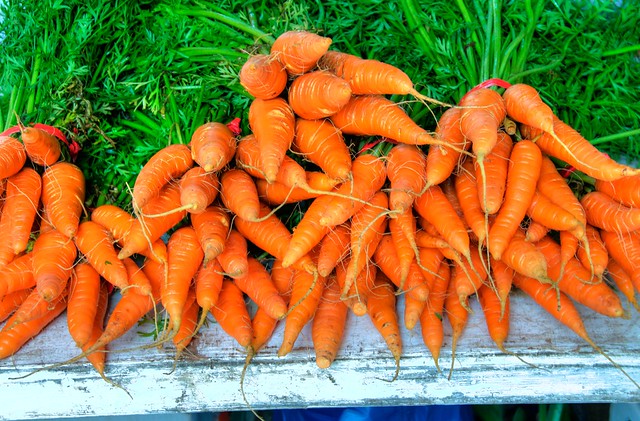
I hear a lot of people say that they couldn't possibly buy organic food for their family because it is too expensive. I agree that if you want fresh strawberries and mangoes in January in Canada or want to pick up individually wrapped fresh boneless skinless chicken breasts, then it is unaffordable. However, using some of these strategies, I think a lot of families could afford to put more organic food into their diet.
1. Buy locally grown in-season organic fruits and vegetables: Organic foods are least expensive when they are local and in season. If you are used to buying any type of vegetable at any time of year, then buying in-season organic fruits and vegetables will not put you out of pocket. It just requires you to adapt your menu to the season.
2. Join a community-supported agriculture (CSA) operation: Joining a CSA is a great way to get great quality local organic fruits and vegetables much cheaper than you would pay if you bought them in the store. And as a bonus, they often deliver directly to your home. We love the fact that the basket of food is different each week, which forces us to try new foods and adapt our menus to whatever is fresh that week. It is also a great way to support local farmers instead of buying everything from large corporations.
3. Employ a selective shopping strategy: Some non-organic fruits and vegetables have higher pesticide residues than others. The most recent list of the common fruits and vegetables with the lowest and highest pesticide residue was published in the feature, Organic: A brand you can trust? , in Today's Parent in July 2008 (see below). If you can't afford to get everything in organic, at least buy the products with the highest pesticide residue in organic or forgo buying them when the organic version is not available or too expensive.
A little personal caveat here...I try to buy everything in organic. Even the foods with lower pesticide residue. Not using pesticides is just one part of being an organic farmer and I support all of the other reasons for going organic too. But if you're really pinched for cash, then this list might help.
Highest pesticide residue (Buy organic!)
- Peaches
- Apples
- Sweet bell peppers
- Celery
- Nectarines
- Strawberries
- Cherries
- Lettuce
- Grapes grown outside US
- Pears
- Spinach
- Potatoes
Lowest pesticide residue (save your money):
- Onions
- Avocado
- Sweet corn (frozen)
- Pineapples
- Mango
- Asparagus
- Sweet peas (frozen)
- Kiwi
- Bananas
- Cabbage
- Broccoli
- Papaya
4. Freeze! Buy in bulk when food is in season and then freeze it. Some foods can be frozen as is and others require a bit of prep (if you use Google you can find a lot of guides like this one: Freezing Vegetables-Fruits). I love freezing roasted peppers to use in sauces and soups in the winter. We always freeze lots of fresh strawberries. I often make soups and triple the recipe and then freeze the leftover soup. I also bake and freeze that too, e.g. muffins, zucchini bread.
5. Buy Meat in Bulk from Farmer: If you use tactic number four and this one too, you're going to need a separate freezer...I know we did! We buy beef in bulk from a local organic beef farmer. We are considering getting lamb this year too. It is much less expensive to get it in bulk from the farmer than it is to buy just enough for one meal at the store or at the market. And the more you buy, the cheaper it is. Find a friend and split a whole cow.
6. Eat Less Meat: A vegetarian diet is a great option and a good way to save money. But if you are a meat lover like me, then just find ways to eat less meat if you want to buy organic. Choose several days per week to go meat free. When you do serve meat, decrease the portion size and increase the servings of vegetables in turn. It will slim your waistline and your credit card bill too.
7. Buy non-certified organic: The organic certification process can be very onerous. And for a business, onerous means expensive. Often times there are farmers that have put a lot of organic practices in place but have not been able to put the required resources towards certification. If you want to be 100% sure that your food is organic, go with a certified organic product. But if you are looking to save money, you can often find trusted local farmers that are running an organic operation but are not certified.
8. Buy store brand organics: We love Loblaws and the PC Organics line. The PC Organics foods are often much less expensive than the equivalent brand name foods. We find that things like baby food, pasta sauces, pasta, rice, juice, crackers, cereal, and so on are much cheaper in the PC Organics line than they are from other brands.
9. Make your own: Prepared and packaged organic foods can often be very expensive and you can save a lot of money by making your own. Buy organic ingredients and make your own bread for example. Or buy organic potatoes (or sweet potatoes) and make your own oven fries instead of buying packaged frozen fries. Make your own pizza, muffins, cookies, lasagna, salad dressings, and so on. The one thing that I actually found cheaper to buy in the store than to make myself was applesauce.
10. Grow your own: If you have a bit of space, plant a garden and grow your own organic vegetables. Even if you are in an apartment with a small balcony, you can use planters to grow a few things. If you only have a bit of room for your garden or just don't have a lot of time to tend to it, then just plant the things that grow easily in your area and that your family eats a lot of. We just planted lettuce last year. Several different kinds in a big pot. It cost pennies to produce and meant that we had fresh lettuce on hand all the time (until the bulldozer ran over it when they came to put in our new septic system...grrr). Next summer, I want to plant zucchinis and tomatoes too, since we eat a lot of those and don't get as many as I would like from our CSA.
Bon appetit! :)
Photo credit: Ed Yourdon on flickr


Reader Comments (22)
[...] post:Organic on the cheap! [...]
Paying more for organic products is a scam. There is no legitimate research to prove that fruits and veggies pick up pesticides thru their roots. And you can merely wash off the produce before you eat it. Don't pay a dime more! Big scam
agree with you and we buy organic when we can and get veggies delivered through CSA. however, pesticides (and by extension, fertilizers and other industrial farming techniques) are increasingly difficult to live without, especially if we (humans in developed countries) want to maintain our current lifestyle - there are ever more people to feed in the world and less arable land to cultivate it on: it is much more profitable to turn it into parking lots or sprawling burbs. buying local helps self-reliance which is is only one component to a healthy economy (N.Korea takes it to the extreme and the people live and die with routine famine).
side note: i predict, over the next 2 or three generations, a return to a class-based society, where the rich can afford to buy a variety of healthy foods necessary to build the brains and braun necessary to succeed in life, while the poor eat mass-produced empty foods (even "produce" that looks and feels like real veggies) to survive. We currently make a lot of our own food (due to multiple food allergies) but if we could hire domestics, we would. Sad to think, but their rates should be reasonably cheap again in our kids lifetimes.
[...] The Heart and Stroke Foundation put together a guide on shopping and cooking on a budget that has some great tips for getting more out of your food budget to go along with its general guide on healthy eating. If you try to buy organic, but find it expensive, you might also be interested in my post Organic on the Cheap! 10 Strategies. [...]
I am not sure if it is the case in Canada, but the organic label in the UK means that the farmer has met certain standards. These standards don't mean they have used no chemicals, but that they have used only those that are approved by the certification body.
So it is possibe to have food that's better than organic, and I think your list includes some of them, for example, if you grow your own veg with no artificial fertilisers and pesticides.
@ Rob A: Canada's http://laws.justice.gc.ca/en/SOR-2006-338" rel="nofollow">Organic Products Regulations come into force in June 2009 (speaking of which, I should blog about them). However, there have been standards in place for longer than that and much of the industry tends to follow those. There is some background here: http://www.ota.com/pp/canada.html" rel="nofollow">Canada Organic Standard and Regulation.
As a mom of two grown children I agree with everything you have said. As a family we have dealt with chronic illness for the last 15 years. We have hypothyroidism, and Polycystic Kidney Disease in the family. PKD was the first diagnosis and I remember that the only book I could find at the time regarding what I could do had to do with diet. It basically stated that a plant based diet was the best nutrition for our body. It also recommended that as many chemicals and additives that we could eliminate from our diets and lives the better. Our bodies might not only last longer but we would feel happier doing so.
Diet For a Small Planet written 40 years ago addressed the arguments by Crammer above. Many others have written since then. It is not just the "rich" who can eat healthy. That is a rumor fueled by business interest. There is a direct link between hunger in the world and the commercialization of our food system. Frances Moore Lappe, the author of 16 books on the subject states that it is "a shortage of democracy not food that causes hunger".
I would also add that there is a lack of knowledge about food in general. One of the first things I had to do was literally get my pans out of the sandbox where my children played with them and back into the kitchen for me to play with. I am still playing and still learning about food.
15 years later we are all vegetarians. We all feel good today. Today is a good day. Thank you for continuing the conversation.
@Jay and (to expand upon what was written by @PhD In Parenting)
The other consideration that very few people think of is the reality that many genetically modified organisms (GMOs) and seeds for these GMOs contain pesticides injected right into the seed so the plant itself is resistant to the pests which typically target it (i.e.: tomatoes, strawberries, sweet bell peppers, etc.). It isn't, therefore, simply about washing the pesticides away, it is about ingesting them in the very meat and pulp of the fruits and veggies that we love. Our, adult, systems may tolerate this adequately but what about the GI systems of our infants and toddlers. Do they not deserve better treatment than that? Where do we draw the line at how many chemicals and toxins are safe for our babies??
[...] 2. Eat organic: Help mitigate the detrimental effects of climate change by eating more organic food. Organic agriculture eliminates the detrimental effects of pesticides on our environment, reduces greenhouse gas emissions and reduces energy usage. It is possible to incorporate more organics into your family’s diet while on a budget. [...]
[...] are so important. Are you a #2 person? One of my favorite blogs, PhD in Parenting, has a list of 10 ways you can afford organics. She covers everything I have and would say much better than I can so I will only add my own [...]
I come across studies like this all too often http://www.sixtysecondparent.com/_webapp_295750/Agricultural_Pesticide_Is_Linked_to_Childhood_Developmental_Delays I use many of the strategies you mention above to get me organic meat and produce - my friends and I help each other out by telling each other when we find a good deal or by going in together to get a better deal ( in bulk)
Great post! Lots of great strategies here! For your Ontario readers - check out the Ontario CSA Farm Directory to find a CSA that delivers in your area. http://csafarms.ca/index.html
Some CSAs will even let you work on the farm in exchange for some of your food - a great option for those who enjoy a little manual labour, who have some free time and who want to save a little more cash. It also provides a nice connection to your food and the farmers that grow it.
I'd caution against the non-organic frozen corn. Organic is the only guarantee against non-gmo corn - as you pointed out in the above comments, you cannot wash off the gmos. And I'm starting to become aware how dangerous they really may be...
http://www.mommypotamus.com/eyewitness-report-animals-wont-eat-gmos/
For those that aren't sure about whether organic is worth the money, pesticides aside, please watch Food Inc. It sheds some light on our food industry in general, and there are many, many things that we can do to change things for the better.
If buying organic is too costly for you, supporting your local farmers market is a good start. Or as suggested, grow your own veggies. You don't need much space at all, and every little bit helps. But most importantly, avoid processed, genetically-modified foods, and factory farmed crap that corporations would like us to believe are real food. Our health and the health of our children will be better off for it.
Thank you for such a wonderful post. It is truly important to buy organic when possible. The more we support our organic farmers and other retailers the more likely organic will become the norm. Filling our bodies with processed foods containing all sorts of chemicals is the cause of many diseases and other illnesses. Simply washing produce isn't the solution. Big box stores are realizing that they must provide organic in order to remain competitive in the market-since the demand from consumers is there. Organic is possible for everyone's budget. Your strategy for organic on the cheap is great!
[...] on sale like lean meat and dairy. I think Annie from PhD in Parenting does a nice job of summing up how to eat “Organic on the Cheap..” if you’d like to read more [...]
[...] the growing season almost here, we shared my friend Annie from PhD in Parenting’s Top 10 Strategies for Choosing Organics on the Cheap. Buying everything organic can get pricey, but prioritizing can help us stretch our grocery budget [...]
Thanks for this article. It's a great collection of tips!
Note that there is a more updated list of the lowest and highest residue foods at http://www.ewg.org/foodnews/summary/. The Environmental Working Group (EWG) retests annually and the list changes a tad each year.
Also Farmer's Markets are a great place to find non-certified organic (or "no spray") crops if you don't have a connection to any local farms. And I have found that some grocery stores, like the Fred Meyer chain in Seattle, offer great prices on organic produce--they have less selection than an upscale grocery store like Whole Foods but their prices are much more everyman-compatible.
Excellent suggestions. I've been working on a similar list, and if I ever publish it, I will definitely point to yours as well. We need to keep getting the word out about organic foods and their benefits, as well as dispelling the disinformation myths.
Great list! I do all of these things, to the extent possible. I even put in some time each week working at the CSA which makes my cost lower. And thank you for the links on the benefits of organic foods. I might add canning, which I am trying to get good at, to ways to do organic on the cheap. All of these things require time and work, but if you have the time, the work is enjoyable. I feel great about being more connected to where our food comes from, and I think it's really great for my kids to spend time on a working farm and to help with our little garden as well.
Just wanted to suggest a low cost applesauce since you mentioned it being the one item that is cheaper to buy... Try making raw applesauce with a raw peeled and cored apple and a raw peeled banana in the blender, add a bit of water depending on your preference consistsncy wise and if you like cinnimon add that too... Easy as that :-)
[...] That is just the beginning. For more ideas see: Organic on the Cheap: 10 Strategies [...]