












Child's Hierarchy of Needs
 Thursday, January 14, 2010
 Parents often find it overwhelming trying to meet their children's needs. With limited time, limited resources, and limited patience meeting all of their needs can seem like an impossible task. If we can't do it all, where should we begin? Where should we focus? What is most important?
Last year, Meagan Francis from The Happiest Mom developed a Mother's Hierarchy of Needs based on the work of Abraham Maslow who developed Maslow's Hierarchy of Needs. In simple terms (from businessballs.com, emphasis mine):
Each of us is motivated by needs. Our most basic needs are inborn, having evolved over tens of thousands of years. Abraham Maslow's Hierarchy of Needs helps to explain how these needs motivate us all. Maslow's Hierarchy of Needs states that we must satisfy each need in turn, starting with the first, which deals with the most obvious needs for survival itself. Only when the lower order needs of physical and emotional well-being are satisfied are we concerned with the higher order needs of influence and personal development.
I enjoyed Meagan's take on Maslow's hierarchy as it relates to mothers (theoretically applies to fathers too?) and wanted to create a corresponding child's hierarchy of needs. Here is what I came up with: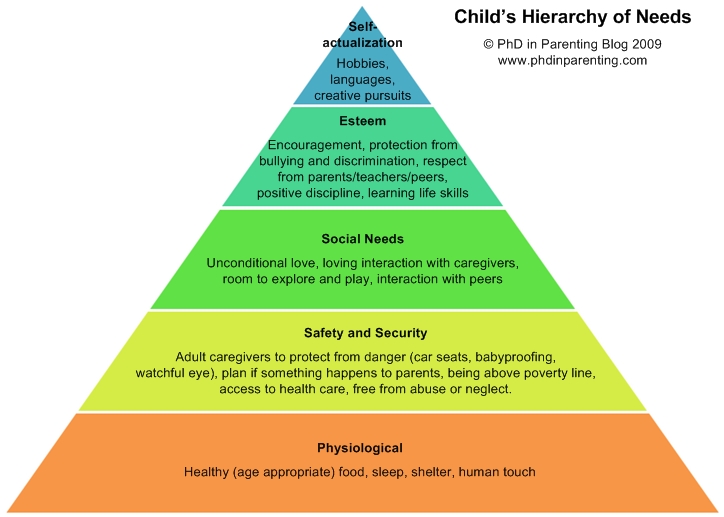
Difference between children and adults
The important thing to note when looking at the Child's Hierarchy of Needs and comparing it to the Mother's Hierarchy of Needs or general hierarchy of needs is that children are wholly dependent on others to provide their needs, at least initially. That certainly puts a great deal of pressure and responsibility on parents to understand and respond appropriately to those needs.
While researching this topic, I came across an article on Maslow's Hierarchy of Needs that explains that:
Adults have little awareness of their security needs except in times of emergency or periods of disorganization in the social structure (such as widespread rioting). Children often display the signs of insecurity and the need to be safe.
I found this note particularly interesting. I guess as we get older we learn to deal with a certain level of insecurity in our lives. I think sometimes adults forget or do not know that children do not have that same built in ability to deal with insecurity or uncertainty. People often assume when dealing with issues like seperation anxiety, sleep training or fears that their children should understand that they are safe. But perhaps we need to be more understanding and not assume that they are just trying to manipulate us.
Intersecting needs
Parents have needs. Children have needs. They are not independent at all. In my next post, I will look at how our needs intersect and what interesting challenges and dynamics that intersection creates.
**Like Meagan, I'm happy to have this shared. If you like the Child's Hierarchy of Needs, feel free to use the graphic on your own site, but ensure that you give credit to PhD in Parenting and provide a link back to this post. **


Reader Comments (23)
I first came across Maslow's hierarchy aged 16 when studying Communication Studies in college. I really like this version.
I think sometimes adults forget or do not know that children do not have that same built in ability to deal with insecurity or uncertainty.
This is something I'm learning with my son - that sometimes when he is "misbehaving" it is because he is feeling insecure or uncertain, and that I should be looking at the root cause of his behaviour rather than attempting to just deal with the behaviour itself.
I may have to print this out and hang it on my fridge. :)
That is an approved re-use of the graphic too! ;)
Child’s Hierarchy of Needs | PhD in Parenting...
Parents often find it overwhelming trying to meet their children’s needs. With limited time, limited resources, and limited patience meeting all of their needs can seem like an impossible task. If we can’t do it all, where should we begin? Where should...
I have always enjoyed Maslow's Hierarchy as a tool in both studies of psychology and education. I like the simplicity of it, and the accuracy. I like too, what you've done with it. It makes sense!
I really love this. I'm really interested in psychology and think there are loads of things like this that can be adapted and applied to children... it helps keep my brain in gear while I spend some time as a stay at home mum. Mind you, it also works the other way. The amount of things my children - Son in particular - seem to be able to teach me about life and how to make the most of it could fill a psychology / self help book all on their own.
[...] Child’s Hierarchy of Needs – PhD in Parenting : Do you know what your children really need? What needs should come first? And how to meet those needs in a way that helps your child? A great visual image to show exactly what a child needs in their life. [...]
Just wanted to let you know I loved this post and blogged about it. I can't tell you how many times I read one of your posts and am glad I found your blog!
[...] (The Happiest Mom)’s Mother’s Hierarchy of Needs and I enjoyed putting together my Child’s Hierarchy of Needs. The problem though, with each of them, is that they focus on one person’s needs. They do not [...]
It's always interesting to see theories that exclude the importance of recognizing the spiritual needs of the individual. Maslow ignored it completely in looking at what fulfills a person, and to this day people perpetuate his flawed model.
[...] Ph.D. in Parenting, one of my new favorite blogs, comes the Child’s Hierarchy of Needs (and the followup, Intersecting Needs: Maslow, interdependence, parenting, caregiving, [...]
Wendy, do all humans have spiritual needs? I have several Atheist friends who would consider themselves to be perfectly fulfilled without spirituality.
I agree with Anji. I don't think spirituality is a universal need, so I didn't include it here. I think that spirituality and the rituals that sometimes come with it can be one way of meeting other needs, but it is not the only one. Some people need to believe in God to feel secure, so maybe that helps them with their safety and security needs. Some people fulfill their social needs by going to church. Some people enjoy reading the bible or participating in religious events and rituals and maybe that helps fulfill their self-actualization needs. However, I don't need spirituality to achieve those needs. I fulfill them in other ways.
Great visual aid! I agree with most of what you wrote, and I appreciate the opportunity to explore the topic. The only thing I would move would be the bullying. To me, bullying fits better in the "Safety" or the "Social" section, depending on the type of bullying. Some kids get hurt physically by bullying, while others get socially ostracized. Simple teasing, perhaps, impacts esteem, but what many kids experience in school goes well beyond that. (I taught have high school, and I've seen some really horrible bullying situations.) There are many great resources on the web that help kids and parents deal with bullying. However, with the recent suicides, etc. in the news, it has become a more serious issue.
[...] blog post, but it is something that I’ve written about at length in other posts. Check out the Child’s Hierarchy of Needs and Intersecting Needs: Maslow, interdependence, parenting, caregiving, relationships, two posts [...]
I LOVE this! I am a giant fan of Maslow's Heirarchy of Needs, in fact, I use it to explain the basis of secure infant attachment with my clients (primarily low income, high risk new moms in South Los Angeles...no easy task!).
Thanks for this great post...very clear and it gives me some ideas about how to better tpresent information!
This has been an excellent resource for my appendix in my project module in my uni course as this links into parenting styles and the theory i have been researching!
Wonderful post. I often think of Maslow's heirarchy when I'm feeling run down. When I'm almost begrudging the baby his 4th nursing of the night, it helps me remember that I'm meeting the bottom 4 levels of needs in one fell swoop. So rolling over to put a boob in position suddenly seems like a mighty easy way to do so much at once!
This is an excellent point, and it dovetails nicely with the later point about children having a low tolerance for insecurity. I had many emotional problems as a child, despite the fact that my parents were loving, non-abusive and could provide for me. Because I was precocious with language and read and wrote early, I suspect that my parents assumed I was advanced in other ways as well, when I wasn't. My childhood was spent feeling fearful, insecure, and using dysfunctional ham-handed methods to try and carve out a niche where I felt safe. Authority figures were mystified by my acting out and nothing they did addressed my real problem. I was bullied mercilessly, but most adults were apathetic about it because I had already been branded as a kid with a "bad attitude". Nobody asked the right questions and I was never lucky enough to know the right words to express my feelings in a way anyone understood. To this day, on a primal level I assume that the world is a frightening place filled with failure and rejection, and that I have no inherent right to exist. I see a huge difference between myself and people who were raised by families who made an effort to address their insecurities, whether consciously or unconsciously. If I had been that lucky, I would have accomplished much more in life by now. Let this be a cautionary tale.
Thanks for this. It helped me with an assignment for teachers to be aware of in their classroom practice.
I only discovered the Maslow triangle during a parenting course a few weeks ago. I realise that my (so called) parents failed miserably overall, especially at the second/third level. They were self absorbed, violent and cruel ads we had to bring ourselves up. This left me with an incomplete adult life and severe depression as a young man that I am only now coming to turns with....at 47 years old! I have a very high IQ and recently put myself through university. I often wonder what a huge benefit I could have been to society had I had good parenting rather than having to give up work periodically, leading to a broken career path and relationships and periods on sickness benefit. I am now a single father to a 4 year old boy and he IS my life. By all accounts I have broken the chain of misfortune in his case. He is doing, and will continue to achieve all these goals and I hope I live long enough to see him fly free with my enduring unconditional love ringing in his ears.
As a person in child development, I am glad that I accessed this link.
Thank you.
Found this gem while working on a human development project. How well needs are met totally influences many aspects of development. It'd also be interesting to see how the needs and, therefore, development changes as the income level of the parent, or parents, decreases. Thanks for sharing!