











Are we using our brains when it comes to epidurals?

by phdinparenting on February 26, 2010 · 98 comments

A 2009 study called Social disparity and the use of intrapartum epidural analgesia in a publicly funded health care system by Ning Liu MB, MSc et al concluded that in Canada “the use of labor epidural analgesia is decreased with decreasing neighborhood economic and education levels.” Or, in plain language: rich highly educated women are more likely to get an epidural than poor less educated women. Those are facts which are supported by an excellent data set. I won’t argue with the facts [edited to add screen capture of basic results set].
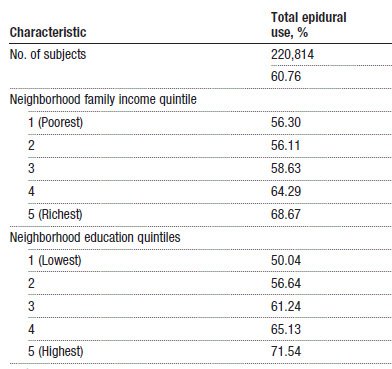
However, I take issue with some of the study’s assumptions and the conclusions drawn by some of the researchers involved. From the start, the study presents the use of epidurals as the smart choice, referring to the increased use of epidurals as “1 [sic] of the most significant achievements of modern obstetric practice.” The whole study seems to question whether women of lower socioeconomic status are just not smart enough to understand how great epidurals are.

Education level could influence a patient’s acceptance of epidural analgesia.26 We speculate that in our study women from a high-education neighborhood may have had more knowledge about labor epidural and considered that it could alleviate pain more effectively. These women could then be more likely to accept epidural when clinicians recommended it to them, or they request the service themselves.

Despite conceding some cultural reasons for some women refusing epidurals, ultimately, they seem to conclude that if you are educated about epidurals you will make the smart choice and get one. If you are not educated about epidurals, you will not know what a wonderful thing you are missing out on.

The pros and cons of epidurals

I think the first mistake the study’s authors made was to assume that getting an epidural is a smarter choice than not getting an epidural.  There are both pros ans cons to epidural use during birth. According to Sam Leeson, a doula with babyREADY in Toronto in her post on epidurals:

PROS
May offer pain relief
May offer mom the chance to rest
May be medically necessary

CONS
May not work the way mom wants
Mom will be unable to get up to urinate
Some moms complain of long-term back ache at the epidural site**
May slow labour
May drop mom’s blood pressure (an IV will be administered)
May increase the need for surgical interventions (i.e. vacuum, forceps, episiotomy and/or caesarean section)
Will increase the risk of tearing
May give mom a spinal headache
May affect the baby
May result in an allergic reaction to the narcotic (mom would need more medication)
Is cumulative (results in increasing physical disconnection the longer it is in place)
Limits options of positions for pushing in second stage labour

There is a detailed examination of the pros and cons of epidural use, giving a full explanation of these factors, in Weighing the Pros and Cons of the Epidural by renowned childbirth education expert Penny Simkin. In her article she concludes that:

The childbirth educator’s duty is to inform, not to talk women into or out of using an epidural. Many women will choose an epidural, when well informed of benefits, risks and alternatives; others will choose to avoid it if their labor allows.

When women are well informed, they will consider the information, along with other factors – such as their fears, self-perceptions, their goals for their birth experiences, their support system – and make the most suitable decision.

This is a reasonable, balanced conclusion. Assuming that an epidural, which has many risks including increasing the likelihood of need for other birth interventions (each of which carries its own risk), is a better smarter choice is inappropriate. Assuming that the decision to refuse an epidural is something that only uneducated or unaware women do, is insulting.

A brief tangent on inductions, epidurals and c-sections

One of the key risks of epidurals that is mentioned above is the likelihood that an epidural will result in the need for additional interventions, like a c-section. But often the story doesn’t start with the epidural. Experts say that a lot of women are induced unnecessarily just because they have passed an arbitrary date by which the obstetrician thought they should have given birth. In an article about Canada’s increasing c-section rate, this logic is questioned:

Today in Canada, one in five women who gives birth in hospital is induced.

What doctors fear are stillbirths. But alarmed by the rising rates of inductions, the Society of Obstetricians and Gynecologists of Canada recently urged doctors not to consider an induction until a woman is at least one week past her due date.

Claudia Villeneuve says that women are getting induced “if they’re two, three, four days overdue.”

“Inductions are rampant,” says Villeneuve, president of the International Cesarean Awareness Network of Canada. “You have a perfectly normal mom who comes in with a perfectly normal baby, and now you put these powerful drugs into her system to force labour to start.”

The “humane” thing is to offer an epidural, she says. With an epidural, a woman can’t feel pain in the lower half of her body. But epidurals slow labour, sometimes so much that labour stops. “Now you have to get this baby out,” Villeneuve says. Two-thirds of first-time C-sections are done for “failure to progress.”

Interestingly, despite this logical explanation for part of the increase in the c-section rate, one of the authors of the study this post is about (the one about how smart women get epidurals), Dr. Mark  Walker, is quoted in the same article as saying that “We don’t know what the ideal rate [of c-sections] is. I think it’s fair to assume it’s lower than where we are now.” (note: the WHO says it shouldn’t be higher than 15 percent and Canada’s c-section rate is 29 percent).

An alternate hypothesis

Back to the epidural study. In addition to rejecting the authors’ assumption that an epidural is a smart choice, I also reject their conclusion that education level is what causes women of higher socioeconomic status to  have a higher epidural rate.

**WARNING: Evidently from the comments so far my attempt to facetiously poke fun at myself and my socioeconomic cohort in the next paragraph was a complete failure. Please take it with a grain of salt or feel free to join in telling me what a jerk I am while I ponder whether I want to keep writing at all if there is no room for a bit of sarcasm and creative license here and there to make a point (going to keep writing…and keep learning). **

Instead of saying that rich educated women are making the “smart” choice by getting an epidural, I’d be more likely to say that women with perfectly manicured nails, pretty shoes, and a white collar job in the city who have never done a day of manual labour in their lives or endured any type of hardship are more likely to be unwilling or unable to endure the pain of childbirth than rural blue collar working women with practical shoes, callouses on their hands and whose life experience has taught them how to fight and endure. That is, of course, a generalization since not all rich educated women chose to have epidurals and not all poor uneducated women refuse them. However, I think it is a more likely explanation for the difference in epidural rates across socioeconomic groups than the one the authors of the study put forth.

Or, if I am wrong and women of higher socioeconomic status are truly choosing epidurals because they think it is the smarter, safer choice, then we need to seriously reconsider how women are educated about epidurals and find ways to ensure more of them learn about the risks of epidurals and are given the confidence in their body’s ability to birth a baby and to endure the pain of childbirth.

My experience: I had an epidural for my first birth because I was “educated” about the “benefits” of the epidural and scared of the pain. I ended up spending a very uncomfortable night, lying on my back, waiting for my baby to be born. I needed a nurse to tell me when to push and for how long.  They had to use the vacuum extractor to get my baby out (and I’m very lucky that is all they had to use). For my second birth, I refused the epidural because I was educated about the risks of an epidural. I was able to labour in whichever position was most comfortable for me, which mostly meant standing up and using gravity to help move things along.  I was able to feel when it was time to push and knew how long and how hard to push because my body told me and not because a nurse was counting for me.

Image credit: mangpages on flickr

Related Posts with Thumbnails

{ 93 comments… read them below or add one }

1 MZ February 26, 2010 at 11:57 pm

Another possible con of an epidural is complications with breastfeeding, should some of the other cons arise. For instance, the women I know who had spinal headaches from epidurals had a lot of trouble breastfeeding b/c they had to lay on their back for weeks while the hole healed (blood patching doesn’t always work). We also know that c-sections can cause at best a delay in breastfeeding.

Reply

2 phdinparenting February 27, 2010 at 10:11 am

MZ

I agree. My son was 8 weeks old when he latched on for the first time. I know our troubles were partly due to tongue tie, but they were likely compounded by the fact that he was so sleepy after the birth in which they pumped copious amounts of epidural into me (the normal dose wasn’t enough and they had to keep upping it until I was finally “frozen”).

Reply

3 Stephanie - Home with the Kids February 26, 2010 at 11:58 pm

I have to agree. I was induced with my first (9 days late, so at least over that one week guideline), but with more education I would have really pushed for monitoring and one more day, as I was in light labor already. Probably could have done without the pitocin that lead me to need an epidural if I had known better.

I’d had hopes for my later pregnancies, but the second was an urgent C-section, and the third, a hoped for VBAC turned out to be a C-section for breech. But now I know enough that when I talk to other moms I can help them to consider whether that epidural is really needed.

Reply

4 Spilt Milk February 27, 2010 at 12:01 am

In Australia (and I’m assuming elsewhere with similar health systems) the c-section rate is higher in private hospitals than the larger public hospitals. I suspect this is at least partly due to higher levels of epidural use in private hospitals. Anecdotally, it can take longer to get am aneasthetist in a public hospital, and labouring women are also more likely to be left alone in the early stages. They are also less likely to be induced because their pregnancy is managed by midwives or a GP instead of an ob/gyn. Women with higher education levels are more likely to have private (expensive) care. So, whilst a greater tolerance of pain and exertion amongst ‘blue collar’ women may be a factor, I would question whether these women are afforded the same ready access to epidurals in the first place. This might be one case of less access to healthcare actually being a positive for some individuals.

Reply

5 phdinparenting February 27, 2010 at 12:07 am

Split Milk:

This study was done in particular in Canada because that could be excluded as a factor due to our public health care system. There were differences between teaching hospitals and non-teaching hospitals and between rural hospitals and urban hospitals, but they accounted for those factors in the analysis of the data and were comparing apples with apples.

Reply

6 Amber February 27, 2010 at 12:06 am

I did not have an epidural with either of my babies, but they were both very fast labours. My second child, for instance, was born 45 minutes after I arrived at the hospital – there wouldn’t have been time. I was never offered an epidural, again I think because my labours were both fast and I was never induced. So I can’t really comment on choosing one.

I wonder if there are other differences in care between the two groups. For example, are more educated women more likely to see one type of care provider over another? Are they more likely to be induced, or experience other interventions that may lead to a higher rate of epidural anesthesia? I think that sometimes the way that care is delivered varies with the patient, because of biases or fears on the physician’s part. After all, doctors are people, too. For instance, I understand that doctors often treat other physicians differently when they are patients, or lawyers who they fear may be likely to sue them.

Reply

7 phdinparenting February 27, 2010 at 10:35 am

Amber:

Those are all good questions and I don’t have answers to all of them! But I can answer some. In the study, among women who had an obstetrician as their health provider, 62% had an epidural compared with 43% epidural use among women who did not have an obstetrician (note: they do not say whether the ones who didn’t have an OB had midwives, no provider, some other provider). The poorest, least educated women were about 5% more likely to have an OB than the richest, most educated (all groups were in the 74 to 79 percent range for OB use).

Reply

8 Rebekah February 27, 2010 at 12:11 am

While I agree that the presumptions are certainly biased, your conclusion is as well.
I had an epidural, at 0cm in preparation for induction, I was able to get up to use the bathroom, I did tear but that was a known risk and I honestly can not blame that on the epidural, as the OB and midwife did perineal stretching throughout labor, and I could still feel that I was having a contraction, but it wasn’t painful. I even squatted to deliver, with the help of my husband and midwife. I agree that there are risks and benefits to an epidural, but I think the problem is more in the fact that no one actually agrees on what those risks are. A 2005(?) Northwestern study suggested that the long held belief that epidurals a)increase the length of labor and b)increase the risk of c section are invalid. I recall this from when I was pregnant with my daughter in 2007, so I don’t know the current follow up to the study, maybe you have more current information? I think the idea that epidurals are the right choice for everyone is wrong, but the anti epidural movement isn’t right for everyone either. Every medical intervention, or lack thereof has risks and benefits.

If both camps could get together to study the REAL risks and benefits it would go a long way in helping mothers make the best choices. Sure, some of the things the doula you cited mentions are possibilities but how much of a risk, and are there other risk factors for those things? ie is a spinal headache more likely in an obese woman? does waiting until 4 cm dilation (the current standard, I believe) make a difference in any side effects? saying it is a risk isn’t enough, a mother needs to know if 50% of women have this complaint or less than 1%, who is doing the study? is every woman who had an epidural at a particular hospital surveyed or just those who volunteered to discuss problems with theirs?

Reply

9 Rebekah February 27, 2010 at 12:13 am

as an addendum: I was 42 weeks, and had copious amounts of meconium in the fluid as well as a degrading placenta. the induction was medically necesarry.

Reply

10 phdinparenting February 27, 2010 at 12:20 am

Rebekah:

I’m not familiar with the study you mentioned, but if you find a link please do post it here.

I don’t have it with me now, but I found one of the best books for more detailed information on risks and benefits was Henci Goer’s Thinking Woman’s Guide to a Better Birth.

Reply

11 ebbandflo aka pomomama February 27, 2010 at 12:43 am

I’m not sure if your assumption that white collar women can’t cope with pain is valid at all, though it does seem quite insulting (I’ve met some incredible stoic blue bloods and some reall whinging miserable deserving poor) …. but socio-economic status aside, all labouring women deserve effective pain relief when required/requested.
Another consideration which might be valid is rates/uptake/availability/quality of pre-partum education between the different groups. Pre natal education does inform about pain relief strategies during labour but also will cover (I hope) analgesia available, pro’s and con’s, outcomes, delivery, etc. Without this kind of information, the idea of needle inserted into your back for pain relief is terrifying – the much more common needle into the backside seems less so.
One of the many things running thru my mind as my baby ground his way face-first outwards thru my pelvic canal was what kind of pain control was going to be best for us both since the situation was rapidly spiraling out-of-control. On offer were gas-and-air, systemic analgesia e.g. intramuscular narcotics, and an epidural. Epidurals terrified me (maybe something to do with having administered a fair number in my time), but our pre-natal education told us that the epidural was the least invasive in terms of drug getting into the neonatal circulation. Having been a pethidine blue baby at birth myself it’s not something I wanted to inflict on my child. The pethidine slowed my respiratory rate leading to seclusion from my mother and a subsequently difficult breastfeeding relationship, formula feeding and all its sequelae.
In summary I chose an epidural precisely because I was educated, in great pain and hoped to deliver an alert, viable baby who would breastfeed/bond ASAP.
Yes, I am white collar; no, I don’t have manicured nails; I like shoes; I’ve worked in both the City (with a capital C) and rural locations; I’ve seen/experienced adversity but still consider myself comfortably off; I delivered a healthy baby who was alert enough to breastfeed within 30 minutes and build his strength up enough to survive a harrowing 11 days with his own post partum issues. I’m glad I thought of his welfare rather than my own vanity birth plan.

Reply

12 phdinparenting February 27, 2010 at 9:22 am

ebbandflo:


I’m not sure if your assumption that white collar women can’t cope with pain is valid at all, though it does seem quite insulting (I’ve met some incredible stoic blue bloods and some reall whinging miserable deserving poor).

I was poking fun at my own socioeconomic cohort and my own reasons for choosing an epidural the first time around. I’m sorry if you find it insulting. I was trying to inject a bit of tongue-in-cheek humour into an otherwise serious topic. Choice of words aside, my experience has been that women in my socioeconomic cohort are very likely to opt for an epidural before even getting close to the point of feeling they need one because we get told that if we don’t get it early, it might be too late.


Another consideration which might be valid is rates/uptake/availability/quality of pre-partum education between the different groups.

Yes, that was raised in the study as well. They said: “In addition, women in socioeconomically disadvantaged groups were also more reluctant to attend antenatal health education classes.31 Attending antenatal classes could make pregnant women more aware of available pain relief techniques and could result in higher epidural rate as well.32” However, I would question whether the women who do attend antenatal health education classes are getting a balanced view of pain relief options during labour or if they are getting the hospital’s view that an epidural is the way to go. Each class is different, obviously, but it seems the majority of women around here go to the classes taught by the hospital, buy books like “What to Expect When You’re Expecting” and talk to their OB/GYN about pain relief, which might give a very different perspective than going to a class taught by a doula, working with a midwife, or reading books about natural childbirth.


One of the many things running thru my mind as my baby ground his way face-first outwards thru my pelvic canal was what kind of pain control was going to be best for us both since the situation was rapidly spiraling out-of-control….

It sounds like you made an educated and appropriate choice in your situation (not that you needed me to tell you that, but just in case you think I’m condemning all epidural use, which I’m not). My big objection is the assumption that an epidural is always the smart choice, because I don’t think it is. As Penny Simkin says in the article I linked to in my post: “When the mother is managing her pain well and progress is normal, the risks of an epidural outweigh the benefits. If, however, she is exhausted, in extreme pain or requires painful interventions, the benefits may outweigh the risks.”

Reply

13 zchamu February 27, 2010 at 12:04 pm

To be fair, if someone made a joke about “crunchy granola birkenstock-wearing armpit-hairy women with babies in slings” not wanting epidurals because of their obvious assumed beliefs, people would take issue with it too. KWIM?

Reply

14 phdinparenting February 27, 2010 at 12:09 pm

Even if it was the “crunchy-granola” woman herself? I thought the “rules” of comedy were that you can make fun of yourself, but not others (e.g. Jews can make Jew jokes, blacks can make black jokes, lesbians can make lesbian jokes, but people who are not part of those groups cannot make fun of them)?

Reply

15 Candace February 28, 2010 at 9:02 pm

I believe in the “don’t go there rule” of comedy. The humor has to strongly outweigh the potential offensiveness. And the potential offensiveness is related to the discrimination the group has faced (and perhaps how recent that is) and the extent to which the persecution or discrimination is part of the joke. So, for example, it is theoretically possible a Jewish person could tell a Holocaust joke so funny that it is okay, most likely that would still be offensive. But Mel Brooks and the Inquisition? Enough time has passed.

At any rate, I think you are safe gently tweaking your own, relatively privileged cohort.

Reply

16 phdinparenting February 28, 2010 at 9:16 pm

I wasn’t thinking anything like a Holocaust joke (nothing to joke about there), but more like a Jew poking fun at certain Jewish stereotypes.

Reply

17 Candace February 28, 2010 at 9:28 pm

But Mel Brooks, we’re okay there, right? Because that’s a friendship deal breaker.

Just kidding…mostly.

Reply

18 zchamu March 1, 2010 at 7:46 am

Honestly? I didn’t see it as poking fun. If it was “poking fun”, it would have been phrased differently. It came across as a shot. If that wasn’t what you intended, then just learn from it and phrase it differently next time.

Reply

19 ebbandflo aka pomomama February 27, 2010 at 9:35 pm

It might be that hospital pre-natal classes do “push” their preferred pain relief methods but round here, and we experienced two of them, birthing classes are taught by private groups with no particular influence over what happens in hospital.
… and both (yes, we really went to two – long story!!) emphasised how much safer as a method of pain relief an epidural was (and the drawbacks were also covered as per timing, immobility, lack of push etc.) compared with the systemic administration of drugs to the mother.
Maybe another and equally as insulting conclusion from the study is that posh educated women care more about their baby’s welfare, in terms of systemic vs. localised administration of drugs during childbirth, than their own wellbeing?

Sorry, I didn’t catch the humour in your writing.

Reply

20 phdinparenting February 27, 2010 at 10:01 pm

ebbandflo:

There was no discussion of use of other drugs (other than epidural) in the study at all, so I’m not sure I understand where your comment is coming from (re: equally as insulting conclusion). My assumption (perhaps incorrect…not sure) was that most women who did not have an epidural did not use any type of drug to control pain. I saw this is an issue of epidural vs. natural childbirth. I could be mistaken, but there definitely wasn’t a discussion of other drugs in the study itself.

Reply

21 ebbandflo aka pomomama March 1, 2010 at 11:10 am

re: use of other drugs
Although the study was focussed on just epidural or not, and historical records were selected on that basis, in that birthing population where the info was drawn from how many women from which socioeconomic background (aka class) selected a directly administered pain relief drug which would pass thru into the baby’s circulation? Was there a class bias, and therefore would my proposed conclusion stand? ie. do poorer women care less about the welfare of their babies? We’ll probably never know as the study was focused exclusively on epidural yes or no, and seemingly a retrospective records-based collection (though without access to the full article I’m really just guessing here, I don’t have an institutional log in for anything more than the abstract). Without it being specifically stated, and it wasn’t the focus of the study, I think it is dangerous of you to assume that the women who didn’t have the epidural laboured drug-free.

Reply

22 phdinparenting March 1, 2010 at 11:21 am

Here is the info on the methodology in case you were interested:

For this study, we used the 2004–2006 Niday perinatal database of the province of Ontario, Canada. This Internet-based regional perinatal surveillance database was hosted by the CritiCall Ontario. By 2006, a total of 82 hospitals and midwifery practice groups reported to thedatabase, enabling it to cover 95% of births in the province of Ontario. The Niday database provided information on maternal and prenatal characteristics, health service status, intrapartum interventions, and infant outcomes.

We linked the Niday perinatal database to the 2001 Canadian Census data for Ontario by converting maternal postal codes into dissemination areas (DAs), which were small, relatively stable geographic units with a population of 400–700 persons of relatively homogenous SES.16 We excluded records with missing information on birth outcomes, pain relief, multiple gestations, nonhospital deliveries, and cesarean section deliveries.

Outcome of interest in this study was epidural analgesia as a method of pain relief for this delivery.

I agree that we cannot assume women who didn’t have the epidural laboured drug-free. I hadn’t considered the alternative initially, but certainly did after you brought it up, which is why I said my assumption was probably incorrect. But we also cannot assume that they used other types of drugs. The study doesn’t provide that info one way or another. It is a good question though.

Reply

23 Kathy February 27, 2010 at 2:55 am

Interesting and thought-provoking as usual, Annie, and I agree that the assumption that epidural is the clever choice bears examination, for all the cogent reasons you cite.

I do, however, also agree with ebbandflo above – I think your language around the pain tolerance of women of higher socioeconomic status is unnecessarily belittling, and equally as unlikely to represent the true picture (no doubt a complex one) as the insouciant idea in the study that “if women are better educated, they’ll choose epidural – The Smart Mum’s Choice.” Furthermore, I’d also suggest that yes, pain tolerance is one reason why some women might choose epidural, but in fact, it is not an invalid one. Despite the popular scorn heaped on individuals with low pain tolerance, the fact remains that ability to cope with pain varies. Little is achieved by trying to push people beyond their thresholds for the sake of an ideal, especially at a time such as birth, which is rife with so many other emotional stressors and delights, and is immediately followed by a period where the mother’s reserves will be called upon intensely as she bonds with her newborn.

My personal disclaimer here is that I had three spinal anesthetics (not epidurals – full spinal blocks) to deliver my three daughters via caesarian sections, and while the first two deliveries were emergency c-sections where spinal was the safest and best choice, I deeply regret the third spinal (and third caesarian, in fact), as it caused permanent nerve damage to peripheral nerves in my cervical spine. I was educated, but also afraid – too afraid of uterine rupture to attempt a VBAC last February after two previous c-sections, especially as my second delivery, an attempted VBAC, had failed after 21 hours of (unmedicated, naturally commenced, midwife-supervised, mobile) labour. Third time around, I wasn’t afraid of the pain – I was afraid of losing my baby or my own life. I now believe I should have taken the (small) risk and tried. But hindsight is always 20/20, isn’t it?

Reply

24 phdinparenting February 27, 2010 at 9:54 am

Kathy:

I agree that pain is not an invalid one. In my case, I chose an epidural the first time out of fear of pain. I was scared into believing that if I didn’t get an epidural right away (I was 6cm when I arrived at the hospital and not in any pain yet), that it would be too late. Not knowing what to expect and being very fearful of the pain that was sure to come, I signed up for an epidural before I was in any pain at all.

Reply

25 Noble Savage February 27, 2010 at 9:01 am

I agree with many of the others here, Annie. While I understand your arguments against the study you mentioned and agree that assuming education = greater uptake of epidurals is a false dichotomy, the language you use to describe ‘white collar’ and ‘blue collar’ women is full of assumptions as well. Being well-educated does not automatically translate into being well-paid, so claiming that all white collar workers are rich is simply false. Unless by ‘well-educated’ you mean educated to the level of a master’s or doctorate degree in a male-dominated field that pays significantly more than those which are care or service-oriented and considerably less well-paid, of course. I have a bachelor’s degree so if that’s considered ‘well-educated’ then I don’t fit your ‘rich’ stereotype. Nor do I (or many other women) fit the (rather insulting, frankly) generalisation of the shoe-and-looks obsessed, well-groomed, weak, urban woman who hasn’t done a days’ “real” work in her life. Similarly, not all blue-collar women are salt-of-the-earth, no-nonsense, vanity-less broads who work with their hands and don’t suffer fools gladly. Your breathtakingly prejudicial comments reduce both types of women to their patriarchy-approved stereotypes: the delicate flowers vs. the noble savages. Neither are helpful. I’m disappointed in this post.

Reply

26 phdinparenting February 27, 2010 at 9:34 am

Noble Savage:

The study looked at neighbourhood income characteristics and neighbourhood education characteristics. So no assumption was made that highly educated = rich or vice versa. Both were looked at independently and education had a higher influence on epidural use than income did, but both played a role.

Here is a screen capture of that portion of the data:

http://www.phdinparenting.com/wp-content/uploads/2010/02/27-02-2010-9-29-47-AM.jpg

They looked at quintiles, not specific levels of education, so I can’t say which quintile refers to bachelor’s degree, which one to master’s degree, etc.

Reply

27 Noble Savage February 28, 2010 at 11:28 am

Thanks for the info about the education and income levels, that makes more sense. However, I still take issue with your ‘alternate hypothesis’, which posits that rich, well-educated women are less likely to be (or feel) able to cope with the pain than women from more disadvantaged socioeconomic backgrounds. Though you acknowledge that you are generalising, you say, “I think it is a more likely explanation for the difference in epidural rates across socioeconomic groups than the one the authors of the study put forth.” If any part of that was tongue-in-cheek and not a serious ‘hypothesis’, I’m afraid that was not clear whatsoever. Or do you just mean that your hypothesis was serious but the ‘manicured nails, pretty shoes’ bit was a joke? Either way, I see some serious stereotyping that concerns me.

Perhaps this was a case of miscommunication, the kind that can easily happen with the written word, but I would hope that you, as a blogger who often speaks out against efforts to pigeon-hole or undermine women, would welcome criticism of what appears to be negative, potentially harmful language in your post. If a statement was sarcastic, perhaps you could make that clearer next time? I hate feeling like someone who is raining on a parade, so to speak, but I really didn’t feel that the ‘joke’ was made clear at all.

Also, if your hypothesis was a joke, what *is* your hypothesis on the disparity between epidural uptake between these groups? Perhaps the idea that rich women shouldn’t *have* to endure pain (or aren’t able to) while poorer women are stronger and just ‘get on with it’ is so firmly entrenched in our minds that doctors and nurses don’t offer them as readily and quickly to their poorer patients? Also, I wonder if mistrust of the medical community as a perceived authority figure or symbol of elitism has anything to do with poorer women declining their interventions. Perhaps they labour longer at home before going in, making epidurals a less likely option if their dilation is further along, while richer women follow the ‘race to the hospital at the first sign of a contraction to be with the trusted doctors’ script? Being poor would also make transportation to the hospital and arranging care of other children more difficult, again explaining why they maybe get to the hospital further along in labour? I’ve no data to back these hypotheses up but I think it’s worth thinking about all of the factors that fit into the bigger picture, not just income and education level and what colour one’s collar is. It’s so much more complex than that.

Reply

28 phdinparenting February 28, 2010 at 4:46 pm

Noble Savage:

The part of my post that was intended to be facetious was the descriptions of richer/more educated women (“perfectly manicured nails, pretty shoes, and a white collar job in the city who have never done a day of manual labour in their lives or endured any type of hardship”) and poorer less educated women (“rural blue collar working women with practical shoes, callouses on their hands and whose life experience has taught them how to fight and endure”).

However, my hypothesis that richer/more educated women are more likely to be unwilling or unable to endure the pain of childbirth than poorer/less educated women was not a joke. It certainly was my own experience with my birth and also reflects what I have heard other women in my own socioeconomic cohort say. The women I tend to associate with online, who are from a variety of different socioeconomic backgrounds, are overwhelmingly in the “natural birth” camp. The women I associate with in real life, who are primarily from my socioeconomic cohort, fit much better the “spare me the pain please” camp. So I was describing a trend I have seen with myself and my peers. Before my first birth, I certainly fell into the “avoid pain at all costs” camp because I was not sufficiently educated about the benefits of natural childbirth or the risks of epidurals. By the time I was pregnant with my second, I knew a lot more about these things and made the educated choice to try for a natural birth and the educated choice to have the right type of supports in place to increase the likelihood that I would be successful at it (doula, birth plan, etc.).

However, I certainly did not intend to say that my hypothesis applies to all richer/highly educated women or even to the majority of them. There was a 12% difference in epidural use between the richest and poorest groups and a 21% difference in epidural use between the most educated and least educated groups. As such, my hypothesis would only need to apply to less than 1/5 of the richer/more educated women in order to hold water as a possible explanation.

That said, I thought that your other hypotheses and the hypothesis put forward by Channa are also reasonable. So if each of them applies to, let’s say, 5% of the women in that socioeconomic cohort, then together they could explain the difference.

I am, however, interested in understanding why my hypothesis is insulting or inappropriate (once you strip away the facetious language), but yours is okay. Why is it okay to hypothesize that richer/more educated women are racing to the hospital at the first sign of a contraction, but not okay to hypothesize that they might be less willing/able to endure the pain of childbirth? Personally, I don’t see myself in your hypothesis (so would be more likely to be insulted by it if I was so inclined), but I do see myself in my own hypothesis (so would be less likely to be insulted by it).

In any case, I agree that the answer is likely to be complex and there are probably a lot of factors involved. But I certainly outright reject the study’s assumption that smart women are making the smart choice by getting more epidurals.

Reply

29 zchamu February 27, 2010 at 9:04 am

“Instead of saying that rich educated women are making the “smart” choice by getting an epidural, I’d be more likely to say that women with perfectly manicured nails, pretty shoes, and a white collar job in the city who have never done a day of manual labour in their lives or endured any type of hardship are more likely to be unwilling or unable to endure the pain of childbirth than rural blue collar working women with practical shoes, callouses on their hands and whose life experience has taught them how to fight and endure. That is, of course, a generalization since not all rich educated women chose to have epidurals and not all poor uneducated women refuse them. However, I think it is a more likely explanation for the difference in epidural rates across socioeconomic groups than the one the authors of the study put forth.”

I think your posts would carry a lot more weight if you didn’t lower yourself to these kinds of “too posh to push” statements. This kind of thing is truly insulting, and I think alienates the very people you’re trying to reach.

I also take issue with the implication that if everyone knew the risks of epidurals, they wouldn’t get them. I knew the risks. I got one because I needed it.

Reply

30 phdinparenting February 27, 2010 at 9:25 am

zchamu:

I didn’t say that if everyone knew the risks of epidurals, they wouldn’t get them. I do, however, believe that if more people were educated about the risks of epidurals and understood more about pain in childbirth and how to manage it, that fewer epidurals would be requested. Epidurals have a place, but like many things I believe they are being overused.

Reply

31 abbie February 27, 2010 at 11:10 am

I would venture to guess that women of lower socioeconomic status (especially in rural areas) are more likely to have seen animals give birth, and thus understand birth as a natural process, not a medical condition. I know that’s the case for me, and I know if my horse, goats, sheep, cows, etc. can all do it without any pain relief, then so can I.

Reply

32 phdinparenting February 27, 2010 at 11:15 am

I love this comment Abbie. Thank you.

I’m sure exposure to the way things happen in nature certainly does help. It is sad that we view pregnancy and birth as a medical condition (especially when it gets called a “pre-existing condition” and is used as a reason to refuse insurance to women in the United States).

Reply

33 abbie February 27, 2010 at 11:17 am

Though I guess as an adendum I should at that I’m not of a lower socioeconomic status and my level of education is a MS degree, so I guess I would fall into the “white collar” group. But my upbringing (and preference for that matter) is notably blue collar.

Reply

34 abbie February 27, 2010 at 12:06 pm

Geez with the typos. Pregnancy brain! I’m 38 1/2 weeks, and I’m guessing I should stop typing anything for a while :)

Reply

35 TopHat February 27, 2010 at 11:22 am

I thought it was interesting that 2/3 of first time cesareans are due to “failure to progress.” I didn’t have an epidural (I was at home), but my labor was 44 hours and would have probably fit in the “failure to progress” category. I’m glad I was home and patient enough to just wait. Not everyone is going to fit in the 12-hour-average.

Reply

36 phdinparenting February 27, 2010 at 11:29 am

TopHat:

Yeah…I fit into the 9 day category in my second birth! I was having regular contractions every 2 minutes, went to hospital to get checked and was only 1cm dilated. They didn’t want me to go home. Wanted me to stay at the hospital, but not check in yet. I hightailed it out of there and came back 9 days later when I was 6cm dilated.

Reply

37 abbie February 27, 2010 at 12:07 pm

Oh dear! 9 days! I shouldn’t have read that with my due date so soon…

Reply

38 phdinparenting February 27, 2010 at 12:13 pm

The 9 days was frustrating, but the contractions weren’t that painful during that time. The way I see it (in retrospect) was that those 9 days were fully preparing my body for the birth, which then happened quickly and fairly easily.

Reply

39 FangedFaerie February 27, 2010 at 11:51 am

I wonder how much the economic part affected the study, from the point of view that the poorer women are less likely to have good health insurance and may have been discouraged from having epidurals because of cost, either in her own mind when calculating rent and groceries, or by the medical personnel. Who knows?

Reply

40 phdinparenting February 27, 2010 at 11:54 am

FangedFaerie:

That has been a factor in past studies that were referenced in this one. However, this study in particular was conducted because that factor would not play into it. All women in Canada have insurance that covers the use of epidural during birth and as a result a Canadian data set was used to study whether factors other than insurance/cost affects the decision.

Reply

41 FangedFaerie February 27, 2010 at 11:56 am

Ah, I see. Interesting, and thanks for the clarification!

Reply

42 Andy February 27, 2010 at 12:07 pm

I believe in manicured nails and comfortable shoes ;) . At my pre-natal classes I was told I could have any type of birth I wanted. I had a fair idea of the pain that would be involved (I miscarried my first) and I have a good pain tolerance. The other 2 people with me –my cousin and DH, had gone to the same classes, etc.

I started having lovely painful and very irregular contractions at 35 weeks. So when I finally got regular contractions every 5 minutes for 1 hour I was over the moon!

We get to the hospital and I was 8cm! I was was thrilled, in my mind 2more cm meant that it would be a quick labor. I got to the hospital around 12-1am. I was being vocal –the hmming, the low moans (as told to be by my pre-natal classes). The nurse recommended Fentanyl as it would take the “edge off” and not affect the baby.

Things after that get fuzzy. I remember my water breaking and then I remember a nurse talking me through the contractions while they were putting the epidural on (my cousin said it was about 12 hours after I checked in). After that the contractions stopped and I was given Pitocin.

Claudia was born a little before 3pm, using vacuum and me getting an episiotomy. The dr said she would try 3 times with the vacuum and then it was C-section for me. Claudia came out on try #2.

To me looking back, the nurses wanted me quiet but besides monitoring they did nothing else until it was time for the epidural. My cousin and DH were probably in the “deer/headlight” category and could have used a push from the nurses to do what we had learned in the classes. When the nurse came in to help with the contractions I remember thinking, “hey, this is what should have been going on before”.

In our first family portrait, DH is holding Claudia and I am in bed. I am completely swollen up, to the point that my eyes are puffy. That was a LOT of IV fluids –that I also had not wanted.

So the point of this comment? yes, I am well-educated, I went to the classes, and I am a SAHM thanks to DH well paying job. I didn’t WANT the epidural but I got it anyways. My theory on this is that women in my camp are more likely to sue, thus they get all the interventions. But this is my thought before my morning coffee, and I come from sue-happy USA.

Reply

43 phdinparenting February 27, 2010 at 12:28 pm

Andy:

I was so glad to have my doula there to remind me of the things that we should have remembered from our reading. The “deer in headlight” thing is very real and she provided the balance, calm, and reminders that we needed.

Reply

44 Andy February 27, 2010 at 7:09 pm

I so wish I could have had a doula, I didn’t even know they existed at the time

Reply

45 Alina February 27, 2010 at 12:08 pm

I think you are generally such a serious & ‘textbook’ writer that when you tried to be joking/humorous/sarcastic with your comments of the “manicured nails” it just didn’t come across correctly!! Definitely do not stop writing for your blog. But maybe you’re just not meant to be a tongue-in-cheek writer? And that’s okay!

With regards to the topic, the only thing you can really take away from this is if you wanted to spend time or money educating individuals about the risks of epidurals, then you’d target the rich, educated neighborhoods.

Reply

46 phdinparenting February 27, 2010 at 12:15 pm

Alina:

You must be forgetting my post about your United Airlines experience. ;)

When breastfeeding is a safety hazard

Reply

47 Alina February 28, 2010 at 8:02 am

On that post you totally nailed it! :)

Reply

48 Wanted Natural February 27, 2010 at 12:23 pm

I am not sure than any of the assumptions that were made are correct at all. At least not in the town that I am from. My husband and I chose to attend the more expensive Natural Birthing Pre Natal classes. The families that attended these classes were definately older and from a higher socioeconomic class. These VERY educated women were choosing to not have interventions and be more educated in the pros and cons of all their options. This being said the women who live in my town are pretty outdoorsy and active, (Not the high heel,manicured type mentioned above). I wonder if it is the lack of adversity faced in life that increases rates??? It makes sense. The whole Outward Bound program is based on this philosophy.

The other thing that I thought may increase the rate of epidural use in higher socioeconomic group women could be that professional women are getting more used to controlling situations and needing to be in control of situations. They are less likely to just deal with things as the come and be able to relinquish themselves to the birthing process than women who do not hold such positions of control in their lives (general workers following instructions Vs. Managment makeing decisions).

Though I was looking to have, and ‘planning’ for a natural birth free from chemicals, in the end I did take the epidural. I fought the doctor who wanted to induce me instead allowing my daughter to ‘cook’ until SHE was done. But even with going into labour naturally I got an epidural, not because I was more educated or anything other than the fact that I had a 24 hour labour with 12 hours of it being strong contractions every 2 minutes overnight. By 7am the next morning I did not have anything left to give, I have been puking all night and really needed rest if I was going to deliver at all. Turns out I had a hard time letting go of tension as well and that was part of things, I was not relaxed enough. After 10 hours of 2 minute contractions I was only 2 cm dialated. Once I had the epidural I actually progressed very quickly to 10 cm (within 30 minutes). I did then require other interventions as there was muconium in the fluid so the doctor helped get her out with the vacume. Looking back I wonder what if, but deep down I know that though it was the right decision for me. Maybe next time I will be able to get more rest in the early labour stages so that I have the energy to finish strong. Who knows. We will have to wait and see.

All this being said my daugther is a healthy happy very bright little girl and I think that she is no worse the wear for it. She did not come out with a big bruise or bump on her head and I am pretty sure that they did not need to pull on her to hard to get her ‘unstuck’. I think that everyone is different and every labour is different, to paint those who choose an epidural as either ‘smarter’ or ‘unwise’, weak or anything else is unfair. There are a lot of active strong intelegent women who choose to have an epidural and there are a lot of active strong intelegent women who choose not to or never get the chance at an epidural because their labour goes too fast. All I say is that Women should look at all their options, the pros and the cons and if they are going to make a birth plan do not be too set in it as nothing ever turns out as you imagine when a baby is involved.

Reply

49 phdinparenting February 27, 2010 at 12:26 pm

Wanted Natural:

Those are all very reasonable points. Thank you for your comment.

Reply

50 Mama in the City February 27, 2010 at 3:36 pm

I like all of your points and agree with you. Every labor IS different. Every women in labor IS different.

“All I say is that Women should look at all their options, the pros and the cons and if they are going to make a birth plan do not be too set in it as nothing ever turns out as you imagine when a baby is involved.”
^ Excellent point and it rings so true!!

Reply

51 Kacie February 27, 2010 at 12:33 pm

That study is so frustrating to me. Epidurals are not always the “smart” choice! Sometimes, they do make sense. But not always!

I would argue that women who are fully educated on the natural birth process would be more likely to reject an epidural.

Obviously, having an epidural will cost more money than a birth that doesn’t have one. Perhaps women of less means to pay are not offered an epidural (or refuse it) because the money isn’t there to pay for one?

Reply

52 phdinparenting February 27, 2010 at 12:39 pm

Kacie:

In other countries that might be true. In Canada, however, everyone (rich or poor) has the same government health card that will pay for the epidural. This study was done in Canada for that reason, i.e. to see if factors other than ability to pay affected the reasons why women do or do not use an epidural.

Reply

53 Kacie February 27, 2010 at 12:43 pm

Oh, and I just saw your response to an earlier comment also discussing the economical impact of this. I didn’t realize this was a Canadian study, so that makes sense!

Reply

54 Marcela Beatty February 27, 2010 at 3:12 pm

I personally feel that epidurals are overused. I also believe that there are certain mother’s that require it.
My best friend had “back labor” for 24hours. She struggled, and tried to be strong to have a natural birth, but in the end we (including her) knew that she needed the rest and was in far too much pain. She received the epidural and was able to see her birth in a whole other way.

In my case both my kids have been natural. I got to the hospital with my first about two hours before he was born and with my second about 20 minutes before. Although in much discomfort I was able to labor at home for most of the labor.

I’m a nurse at a County hospital in LA and used to work with labor & delivery doctors and nurses. I have heard many stories of them just using the epidural as “routine” so the mom won’t be in pain. I think sometimes physicians and nurses push or suggest the epidural right away instead of suggesting she start out trying to labor without meds and comforting and letting her know what a good job she is doing. Another problem is the inability of letting mothers labor in different positions and out of bed. I think if they were able to move around and labor in different positions in the hospital, mom’s could find different and personal ways of dealing with their pain. If the mother is truly in an unbearable amount of pain, options can be talked about again and an epidural can be given.

I was kind of going on and on, sorry. Hope this made some kind of sense.

Reply

55 Amanda February 27, 2010 at 5:28 pm

Was there any mention of the race of the poor and less educated women? I don’t want to inject racism/discrimination where it is not appropriate, but is it possible that the medical establishment is less likely to offer an epidural to a minority?

Reply

56 phdinparenting February 27, 2010 at 8:44 pm

Amanda:

That is a good question. Here is what they had to say about race and culture:

Women from different neighborhood economy and education groups could also have significant differences in race/ethnicity, cultural background, religious background, attitude toward health care, and seeking of perinatal health care. Hispanic, black, and Asian women were less likely than their non-Hispanic white counterparts to have received epidural. 8-10,26 Although similar normal delivery women were equally likely sensitive to pain regardless of their race,27 their culture values may have strong influence on their attitude toward labor pain.28 Asian women considered labor pain to be natural and would like to tolerate it stoically.29 Religious women proved to be less likely to use epidural,15 probably because their religious leaders oppose it. Economically or educationally disadvantaged migrant women could also be less likely to receive epidural, because the language they used or the cultural style in which they expressed pain was unfamiliar to service providers.30

So it doesn’t look like they would be less likely to be offered an epidural (unless they were asking for pain relief in a language not understood by the care providers), but other cultural factors may cause women of some cultural backgrounds to refuse an epidural.

Reply

57 Heather (formerly Maternal Spark) February 27, 2010 at 9:02 pm

I wanted a natural birth. I ended up with a c-section.

I was a full two weeks overdue so they induced me. It didn’t go anywhere and after 20 hours of painful, PAINFUL pitocin induced contractions that came one after the other I ended up with an epi and c-section. It was nowhere near what I’d envisioned for myself or my baby who had complications and ended up with a 3 day NICU stay. (she was the biggest baby in there being 14 days overcooked).

After the whole ordeal I discovered that my mom was 2 weeks overdue with both me and my sister. I bet ya if I was allowed 2 or 3 more days everything would have been just fine. I don’t know that they were right on with my due date anyhow.

Now, I wonder what to do for the next one. I’d like to try vbac but at the same time if I’m going to be 2 weeks past due again (who knows right?) then what choice do I have? I’d rather have a scheduled c-section than go through what we went through the last time.

Interesting and insightful post as usual!!

Reply

58 phdinparenting February 27, 2010 at 9:07 pm

Heather:

Fudge the date of your last period to put your due date forward a bit? (only half kidding!)

Did you have a midwife or an OBGYN? I find OBGYN’s are generally more anxious to just get the baby out as soon as you’ve passed that magic date, whereas midwives are willing to wait longer as long as there are no signs beyond the date itself that indicate a need to deliver.

Reply

59 Candace February 28, 2010 at 6:52 pm

Can you get a real midwife? Or is it illegal for a midwife to do a VBAC where you are?

If you are stuck with a doctor, you can still just not allow them to induce. Go in for the tests, make sure everything is okay (check the oil, as I call it), and then just keep putting them off. Or, as Annie says, fudge the date if the confrontational approach is too much.

I was almost two weeks “overdue”. They thought my son was over 11 lbs (he ended up being over 10 lbs). They tried to scare me. I did my research, went in for the tests, and put the midwives off (it was a hospital midwife practice).

They like to make you feel like it isn’t up to you…but it is. Of course, it isn’t easy to resist advice from medical professionals who make it seem like consequences are dire. And it may not be worth the stress, depending on how strongly you believe you are making the right call.

Reply

60 Heather (formerly Maternal Spark) February 28, 2010 at 8:41 pm

thanks ladies – you’ve given me some things to think about!

Reply

61 Luschka March 5, 2010 at 5:42 pm

And to add to that – I don’t know where you are, but ‘term’ is classed as different things in different countries. In the UK it’s 38 weeks and in France it’s 41. The WHO classes full term as up to 42 weeks, so… don’t be bullied anywhere before – but do get your checkups if you feel reduced movement.

Reply

62 Channa February 28, 2010 at 6:32 am

Interesting issue. I wonder if this is similar to vaccine compliance, in which as far as I understand, wealthier and better educated parents vaccinate more than poorer and less educated parents, so it looks like vaccinating is the more educated choice… mainly because the population group who chooses not to vaccinate due to educated concerns about the risks of vaccination is so small as to be statistically insignificant. Similarly, those of us who knew all the pros and cons of the epidural, and chose to skip it for all the reasons you mentioned, may be a statistically insignificant group.
I wasn’t convinced by the pain tolerance theory, though, since we also know that wealthier and highly educated women are much more likely to breastfeed than their poorer and less educated counterparts, and that is pretty painful at the beginning for most of us. I personally found it much easier to tolerate six hours of intense drug-free labor than weeks of sore nipples.

Reply

63 phdinparenting February 28, 2010 at 9:30 am

Channa:

That is a very good point (about those making an “educated” choice to avoid something like an epidural or vaccines being statistically insignificant).

With regards to the pain tolerance of birth versus breastfeeding, I agree that a few hours of labour/birth is more tolerable than weeks of sore nipples. However, the epidural is presented to women as a completely safe risk-free option for eliminating the pain of labour, whereas formula is presented to women as an inferior way of feeding their babies. So they may think there is no harm in choosing an epidural and therefore opt out of the pain of birth, but endure the pain of breastfeeding in order to be able to give their child the best. Even at that, we know that there are numerous women who do want to breastfeed but who do end up giving up. There are certainly some who are not able to endure that pain and do turn to an alternative.

Reply

64 Andrea March 1, 2010 at 3:10 pm

Yes, one of the reasons I wanted to avoid an epidural the second time was I figured, a day (more or less) of pain would be worth not suffering 8 weeks of pain due to bf start-up problems! But, when I was pregnant with my first, I had no idea bf would be like that — I knew there could be problems but assumed they wouldn’t happen to me :P I was too focused on my fear of the actual delivery to think that far ahead maybe. With my second, of course I had a completely different perspective, and was able to think ahead, to what I wanted AFTER the birth. And while there was still pain in the early days nursing my second, at least he wasn’t too sleepy to latch!

Reply

65 Steph February 28, 2010 at 4:59 pm

I’m a pretty good candidate for your generalization above- PhD, SAHM, white collar, white collar husband with executive job. I wasn’t offended by your generalization at all. Because I am the *only* person I knew until recently (having just joined the real life crunchy granola brigade) who had given birth without an epidural (twice). Due to that fact, I am considered in my cohort as unusual, strange and freakishly tolerant to pain, as opposed to normal, as I would have been in my mother’s generation ;)

I don’t think I agree with the facetious “intolerant to pain” hypothesis (which I wasn’t supposed to ;) ), but I’d propose the “intolerant to fear” hypothesis. Just about everybody I know IRL is afraid of birth. Some have very good reasons that won’t change no matter how much information they have (histories of complications etc.), others are being offered bad information, incomplete information or are encouraged to think by the prevailing view of their cohort that the epidural is a normal way to give birth.

Now, let’s not get me started on DH’s home country where all his female relatives with normal pregnancies and normal babies are being offered routine (unnecessary) c-sections “because it hurts less”. (Again, upper socio-economic cohort, incomplete information is being offered, a wide take-up of the interevention is occuring…)

Reply

66 Steph February 28, 2010 at 5:00 pm

Oh and for next time, I’m not a buyer of shoes and have never had a manicure, but I do routinely purchase baby carriers that are not strictly necessary as my poison of choice ;)

Reply

67 phdinparenting February 28, 2010 at 5:21 pm

Steph:

I probably fell somewhere in between at my first birth – I was fearful of pain. Not sure if I was intolerant to it or not because I just wasn’t going to let it get that far. I’m used to being in control and not knowing how much it would hurt scared the heck out of me!

But I said “unwilling” (which would include your “intolerant to fear) or “unable” because I have certainly had numerous people tell me that they tried to do it without an epidural, but it just hurt too much. I didn’t want to dismiss their experiences as being “unwilling” to deal with the pain of childbirth. Rather, I wanted to recognize it as them being truly unable to deal with it at that point. And as Penny Simking said, if a woman is unable to deal with the pain, then the benefits of the epidural may outweigh the risks.

Reply

68 Steph February 28, 2010 at 5:39 pm

I agree completely. I know several women who have experienced some pretty profound birth trauma due to the extended, uncontrolled and terrifying pain they experienced in birth trying to hold out *against* an epidural. If they had felt able to ask (rather than feeling like they were “failing”- a good case for your point about being “unable” rather than “unwilling”) for one a few hours earlier, their birth experience would have been quite different and, ultimately, I think, far more positive.

Epidurals are undoubtedly an important intervention, the simple fact that they can take a c-section from an out-of-body, terrifying experience to a beautiful birth is another important argument in their favour. My experience of my cohort (and it is just my own experience), however, is that women are afraid of birth. It’s no longer perceived as a natural event for which the vast majority of us can complete without major intervention. I think it’s that fear that ultimately contributes to the belief that epidurals are a part of making birth “safe”. Safe from pain (which, realistically, is significant!), safe from sick or dying babies, safe for ourselves (both understandable fears). For many women, they are necessary, positive and a part of a beautiful birth experience. For others, they lead to our ubiquitous “cascade of intervention” and all that entails. The difference between the two…? As many and varied as the women giving birth, I guess.

Reply

69 Rebecca March 3, 2010 at 10:46 pm

I would likely fall within the generalized cohort as well (at least the highly educated part) and am also somewhat “freakish” amongst my coworkers and friends because I planned and had a natural, drug-free birth. I can’t even count how many times someone at work would advise me when in my third trimester to “go for the epidural – it’s great!”. I definitely think that fear of pain is part of the puzzle but also wonder if any of the following come into play:

1. Increased faith in the medical system and the medical managment of childbirth – most of my peers have absolute faith in their doctors, and the medical model. Most of them do feel that childbirth is somewhat of a medical emergency rather than a natural thing that our bodies were meant to do. Those who “required” medical interventions during childbirth (inductions, c-sections etc.) believe that those interventions were absolutely neccessary or they or their infant would be at risk of serious complications or die (though evidence based practice and statistics suggest otherwise). One coworker went as far as to have an elective c-section (uncommon in Ontario, but her care was through a privately funded fertility clinic) as she felt that it was safer and more controlled. (I do work in health care and wonder if my peers in particular may have more faith in the medical model than the average woman in this cohort or women working in corporate jobs.)

2. Sense of entitlement – e.g. entitled to pain relief/entitled to avoid pain

3. Dissociation from one’s body and/or nature in general – along the lines of Abbie’s comment above – I wonder if the fact that most women in the higher income/higher education cohorts have not been exposed to anything but portrayals of medically managed childbirth plays a role in creating the fear of pain (usually women are portrayed screaming in pain and cursing their partners). I also wonder if women in this cohort are so used to being in/working with their heads, that they are less connected to their bodies and possibly fear pain more than some one who uses their body in their work. Some of the women I know expressed that they had limited faith in their own ability to deal with the pain, and their own body’s ability to birth. A total tangent here, but I wonder if athletes, who are very in-tune with their bodies, are more or less likely to have an epidural?

Anyway, I’m just throwing some ideas out there (and rambling at this point). I’m not even sure why these things might differ between groups (except for the entitlement piece and maybe the working with head vs. body part (assuming that higher income/education = mental work and lower income/education = manual labour which is probably an over-generalization)) – they are just ideas based on discussions I’ve had with people who would fall within the cohorts with the highest epidural rates. We talk about childbirth at work a lot – I work in a female dominated area of health care (more than 85% of the employees at my workplace are women) where someone is always pregnant or returning from mat. leave, and those who’s children are older still love to talk about their experiences. It’s definitely educational! And entertaining!

Reply

70 Candace February 28, 2010 at 6:45 pm

I’m going to read through the comments later, partially because people being obtuse about sarcasm is one of my chief pleasures in reading the comments on blogs…so I will leave my comments about the connections with class until then. Though I think you are right that a more likely explanation lies in how we are conditioned to think of birth…or even in how hospitals treat different patients.

In the meantime:

I always use an epidural as an example where I twice, knowingly, made a less than optimal choice. However, since I was educated about the risks and benefits, I don’t really regret the choice. Well, perhaps a little with #2 because it went much faster than I thought it would. And I certainly do not feel upset or attacked when presented with evidence that epidurals have side effects.

Birth #1 was over 24 hours. My water had broken early, I accepted pitocin after 8 hours, an epidural after another 4 hours, ended up with a fever, and so on.

Birth #2 took less than 4 hours in the hospital. If I had realized how quick it would be, if I had better support in place to help me try other types of pain relief, I might not have requested the epidural.

At any rate, I can look at studies showing that epidurals have potential risks for mom and baby without feeling personally attacked.

One thing I would add to the plus column is that it can actually allow a mom who is tense and is therefore feeling sensations more as “pain” to relax into the contractions. And that has to of course be weighed against being “stuck” in one position or the potential drawbacks of the drugs.

Another point to make is that some women can still move around under a light epidural. I can. Twice I used the birthing bar towards the end of the labor. If hospitals were more open to how women can move with assistance, even with an epidural, then possibly that would mitigate at least one of the “cons” of an epidural.

Reply

71 Noble Savage March 1, 2010 at 2:43 am

This was not about people being ‘obtuse about sarcasm.’ I get sarcasm. I live in the land that invented it! I just don’t think it was used here, at least not effectively. I (and a few others) disagreed with Annie’s hypothesis and the language she used to generalise about it — that’s it. I don’t feel ‘offended’ or ‘personally attacked’ at all. I’ve never even had a damn epidural so it really has no impact on my life. I’m simply disagreeing with her. Regardless of whether sarcasm/humour/whatever was being employed, I’d appreciate it if my disagreement wasn’t met with “Can’t you take a joke?” which is a silencing technique.

At any rate, I think I’ve said all I need to say on this subject so I’m bowing out now.

Reply

72 phdinparenting March 1, 2010 at 8:39 am

I’m happy to discuss people’s objections to my arguments. I wasn’t intending to use a silencing technique, so apologize if it had that effect. I obviously screwed up on the choice of words, but hoped that we (my readers and I) could still have a discussion about the issues despite poor choice of words. That is why I was trying to clarify that I was attempting (again, failed) to poke fun at the stereotypes. I really did want to discuss the issues, my hypothesis, any alternate hypotheses, etc. I did want to hear from people who disagreed with me, especially if they were truly disagreeing with my argument and not just the descriptors I used for the two groups. If I screwed up so badly that we can’t even do that, then I’ll accept that and just move on.

Reply

73 Candace March 1, 2010 at 9:10 am

I was very clear that I hadn’t read the comments yet. Therefore I did not call you obtuse.

The rest of my comment about being personally attacked had nothing to do with that either. It had to do with many posts across many blogs where whenever ANYONE mentions risks of c-sections or non breastfeeding or WHATEVER, someone starts taking offense and talking about how in their case it was necessary. The epidural is my example of how *I*, when I’m *personally* involved, can look at the research without taking offense.

Reply

74 Heather King February 28, 2010 at 11:09 pm

Here’s what I’d like to see the numbers for: What percentage of people who work in hospitals, in particular maternity wards, choose epidurals? Those are the people making informed decisions and I’d guess they tend toward “no” on the needle in the spine, wheelchair, bedpan option.

Women, especially educated, wealthy women who are used to solving and problems and controlling situations, want to believe and are led to believe there is some great medical solution to the problem that childbirth is tough and painful. The truth is, elective epidurals and C-sections really just give you different ways to take your pain.

I think fear and control are big factors – a long recovery doesn’t sound as scary as the unknowns of late labor, transition, and pushing even though it may actually be much tougher on your body. I, for one, was ready to take my pain straight up – deal with it on the front end with a natural birth so that I could be done with all things delivery related once my babies were out. Fear and control were factors for me, too, though. I was much more afraid of having someone (probably a student) stick a needle in my spine than any labor pains!

BTW, I appreciate the snark. Maybe you should have a “snarky saturday” so everyone will be ready for it.

Reply

75 Andrea March 1, 2010 at 10:42 am

When I had my first, I most definitely wanted an epidural. I knew there were some risks but didn’t look into those too much, because I was afraid of the pain. But I was shocked when during the hospital class, a dad asked about risks, and the instructor basically laughed it off, implying there were no risks, you silly man! Not being brave, or educated enough to argue, I didn’t speak up, but it bothered me she wasn’t upfront about the possible issues — even though I planned to have one myself! I don’t know about the other parents there, but I consider DH and I educated, middle-class. We just weren’t “educated” about childbirth (despite being in a class about it!)

With my second, I informed myself and also chose m/w care, with the goal of avoiding an epidural (which I was able to do) in part because I almost ended up with a c-section, and had many bf issues at the start. Most women I know though, avoid researching this topic and make the argument that a person wouldn’t have a tooth removed without pain relief. These are educated, smart, strong women. But they in many cases make the choice NOT to be educated on this topic (I’ve gotten more than one crazy look for even suggesting a woman at least hold off as long as possible on getting an epidural). Or, they are taking at complete face value what they are hearing from medical professionals (like one friend who got an epidural at 3 cm, while she was tolerating the pain just fine, because the admitting nurse said “if you are going to get one, may as well get it now” — no mention that it might slow labour etc. etc.)

Interestingly, the one woman I know who has worked in as a nurse in L&D chose to go med-free as well — according to her, she didn’t want her birth to be managed to suit the schedules of the doctors, something she’d seen time and time again…

Reply

76 phdinparenting March 1, 2010 at 10:59 am

Andrea:

Yup – that “if you are going to get one, may as well get it now” is exactly what I was told the first time too. Along with a “before it is too late”.

Reply

77 Andrea March 1, 2010 at 3:20 pm

To be fair, my own experience was a bit different. When I was having my first I was in such pain (back labour, contractions every 2 minutes from the get-go) that I was convinced I must be on the verge of giving birth, that maybe I was one of those “lucky” women who don’t feel early labour. So imagine my surprise to only be 1.5 cm dilated when I got to the hospital — they would not give me an epidural at that point (at the time I wished they would!) So I can’t say *I* was pressured into getting one. But I also can’t say the OB or the hospital classes gave me any other coping tools either. And I probably didn’t seek any out on my own because I assumed I’d get an epidural, like everyone else I knew!

Reply

78 Megan March 1, 2010 at 7:48 pm

I was the same way – severe back labor and contrations 1.5 – 2 minutes apart from the get go. Except I was dilated at like 5 or 6 when I arrived at the hospital. It was so overwhelmingly different from what I expected (slow, long labor) that I was like “I need this now before it’s too late” and everyone just went along with it.

Reply

79 Candace March 1, 2010 at 3:14 pm

Out of curiosity, and sorry if this has already been covered, but did they take into account whether it was the first birth for these moms or not?

Reply

80 phdinparenting March 1, 2010 at 8:32 pm

Candace:

It appears as though it included all births that met the study’s criteria, which would have included first birth and additional births from the same mother.

Reply

81 Candace March 1, 2010 at 8:39 pm

My thinking is this–educated and wealthy women (statistically) have fewer children. **PLEASE everyone note this is not a judgment, just a statistical correlation** Therefore, unless the study controlled for this, more women from a lower socioeconomic cohort would be more likely to be on a second or third birth. Not sure how much this would skew the study…but just another factor to possibly consider.

I’m also assuming they controlled for age, as well, because usually that is considered in most studies. Otherwise, that could also theoretically skew things, as well.

Reply

82 phdinparenting March 1, 2010 at 9:48 pm

Candace:

Yes – they controlled for age and there was no statistically significant difference when it came to epidural use across maternal age groups.

Also, turns out they did look at number of children, I just wasn’t familiar with the term they used (“parity”). The stats were as follows:
- 1st baby: 71% used epidural
- 2nd baby: 55%
- 3rd or greater: 46%

In the study, they didn’t cross-reference parity with the income/education elements. That doesn’t mean they didn’t look at whether it was a factor (i.e. they may have ruled it out or may not have), but either way it isn’t referenced directly as being a contributing factor to the lower use of epidurals among lower income/lower educated women. But they missed other possibilities, so that could be a reasonable hypothesis too.

Reply

83 Megan March 1, 2010 at 7:43 pm

Excellent question to Candace above. I had an epidural with my first and it was similar to the fear Annie talked about – not necessarily fear of the pain, but of the unknown “will this get worse? how long will I be enduring this?” etc. With the benefit of experience now, I would not do it again. I was very far along when I got to the hospital and had my baby in half a day. If I had realized how far along I was (maybe if someone had told me “you’re doing great” instead of “whatever you want” because I requested it – my husband was just as new to it as I was and just wanted me to have what I wanted). I try not to regret it though so that I don’t have any bad memories of the experience – I just look at it as it gave me some time to relax and focus on what was going on so I would remember it later better, if that makes sense.

I was also curious if family involvement is a factor – I have no research to back this up, but it seems like lower socioeconomic classes actually have more family involvement, where higher classes may be more about ‘individuals’ – and maybe having more support or more relatives who have ‘been there done that’ around, you just get through it together. I’m not stating what I mean very well, but I hope what I’m trying to say makes sense!

Reply

84 Ariel March 2, 2010 at 1:50 am

Great topic and wonderful discussion. I think you and the commentators have done a great job of pointing out the biases and assumptions of such a study. I am of the opinion that how a woman approaches labor and delivery has less to do with academic education and everything to do with what kind of information she is exposed to prior to giving birth.

I was lucky to attend a prenatal class taught by a nurse who clearly outlined the risks and benefits of hospital supplied pain-management and labor inducement. She encouraged her students to consider alternative methods of pain management and emphasized the importance of keeping mobile and trying different labor positions. I am eternally grateful to her for neither sugar-coating the scary side of labor or terrifying couples into automatically asking for epidurals.

As a first time mother, I had no idea what to expect during labor, but I decided that I wanted to do my best to have a natural birth. I read a couple of Ina May’s books, which are full of wonderful (if dated) first-person descriptions of natural labor. These powerful accounts gave me much needed confidence in my ability to do what my body was designed to do. Having had a natural birth, I cannot imagine asking for an epidural and numbing such a profound and powerful experience. (I am, of course, speaking only for myself and my experience. I was only in active labor for about 7 hours and I have no idea how I will react in any subsequent labors). I was also lucky to be encouraged and supported by the nursing staff. When I told them I didn’t want any drugs, they suggested I go home to labor. Having read that a woman is more likely to accept/request an epidural (or deliver by c-section) the longer she is in the hospital, my husband and I took their advice and high-tailed it back home where I had the privacy of my own bathtub. Anyway, my point is that women of all socioeconomic backgrounds are bombarded with images of labor that cannot begin to approximate the experience of birthing a child. Shows like A Baby Story posit c-sections, pictotin drips and epidurals as not only routine but also as the “smart” or “obvious” way to labor. I’m not sure how socioeconomic background plays into epidural use, but I think that women need to educated themselves so as to make informed decisions about labor, medical intervention, and pain management. Doctors and medical staff should respect those decisions and support women so that they can labor with confidence and not in abject fear.

Reply

85 Sandy March 2, 2010 at 1:28 pm

I have had the pleasure of birthing two children. One with the epidural and one without. I hated the epidural. I hated not being able to feel everything – I couldn’t even wiggle my toes. If given the chance I would have a natural birth again. During my first pregnancy, I had a group of well-educated women try to make me feel somewhat idiotic for planning to have a natural birth and for going to prenatal classes to help me and my husband cope with labour. These so-called ‘educated’ women told me flat out that they weren’t even bothering with classes, that as soon as they felt their contractions they were planning on asking for an epidural right away. I walked out of that house that night, not feeling idiotic, but feeling like the MOST educated woman for learning all about birth, and my body’s ability to birth a baby. I actually felt sorry for these women. They missed out on so much. The fact that they didn’t give their bodies a chance to do what it was meant to do, or to even learn about it only proves that they are, to say the least, not very educated. Having a natural birth has been the best experience of my life, and I try to tell this to pregnant women every chance I get. I’ve had a doctor cringe at my birth story, and ask me why I just didn’t have an epidural. The nurse in the hospital with the birth of my first child, made me feel like I was ridiculous for trying to go natural, and 10 hours of back labour later, with the threat of a c-section on the horizon, I felt that I needed to get an epidural, and after that the nurse was sweet as pie. I regretted it right away. These women who are choosing to have an epidural, without giving natural birth a try, are right up there with women who schedule unnecessary c-sections. They may be educated, but they are doing themselves a great disservice. (sorry for such a long comment!)

Reply

86 plastikgyrl March 2, 2010 at 10:06 pm

I will admit to only having read the abstract, and to only having read the first 25 or so comments to this post, so I don’t know if my points have already been covered. That said:

1) The part in the abstract where it says that the difference in rates between rich and poor and more vs less educated are lower in teaching hospitals and higher in community hospitals is interesting. My guess is that those women who expect to get an epidural are going to get it no matter where they labour and birth (assuming it’s not an unanticipated homebirth). The more important factor in this is whether the environment itself leads to the “choice” in epidural. In a small community hospital where there isn’t 24/7 access to an anesthesiologist, labour and delivery nurses and midwives are possibly more likely to offer a variety of different comfort measures to labouring women before opting to suggest an epidural. In an environment where it’s readily accessible, it may be more heavily pushed by hospital staff.

2) Did the researchers take into consideration the women who had been induced for medical indications?

3) Did the researchers study who the care providers were? Women who give birth in community hospitals are more likely to have family physicians as their care providers than women who give birth in teaching hospitals. It’s a numbers game: there often isn’t a high enough population to support more than one on-call OB (or general surgeon with OB skills training) for emergencies at many Level 1 hospitals in Canada. And midwifery clients have significantly lower rates of epidural use than labouring women in general.

I did have a problem with the marketing of the article in question, as you did. I do have one other thought: are poor or less-educated women offered epidurals less BECAUSE they’re poor and/or less educated? Is there a built-in prejudice around poverty and whether some women “deserve” pain relief more than others (which is a problematic thought on so many levels)?

I am (some might consider) overeducated. I did everything I could to avoid an epidural during my first labour, but in the end, my persistently posterior baby triggered contractions that were more like a non-stop uterine spasm that was doing nothing to my cervix and exhausting me. While I grieved and felt a great deal of guilt for months after that birth, I am in retrospect sure that the epidural was what prevented me from having a c-section. There is a time and a place for all interventions, but when I look at the breakdown of epidural rates by LHIN (Google OPSS 2008 Report), and I see that Toronto Central had an almost EIGHTY PERCENT epidural rate in 2006-07, I’m horrified. That is blatant misuse, in my opinion.

Reply

87 phdinparenting March 2, 2010 at 10:40 pm

plastikgyrl:

Those are good questions….here are some answers:

2) They excluded c-section births, but otherwise did not seem to take into consideration medical indications.

3) They looked at whether the woman had an obstetrician as her antenatal health provider, but didn’t go into any more detail than that. They found that 62% of women who had an obstetrician had an epidural and 43% who did not have an obstetrician (which could mean midwife, family physician, etc.) had an epidural.

Reply

88 natalieushka March 3, 2010 at 9:46 pm

The whole idea of having to get the epidural now “before it’s too late” infuriates me. I specifically asked my maternity doc when it would be too late and she said “when the baby’s crowning?” She told me that if anyone is told it’s too late to get the epidural, the care provider is not telling them the whole truth – most likely they’re just feeding her a line to encourage her to go on without it. Anecdotally, I received my (very light) spinal after 1.5 hours of pushing, 45 minutes before my son was born. I am so glad I held out as long as I did; I feel like I gave it a 100% effort.

Reply

89 phdinparenting March 3, 2010 at 9:54 pm

natalieushka:

To be fair to those who said it to me, I think the fear was that it may take a while for the anesthesiologist to get there and then a while for the epidural to actually take effect. So if I did wait too long, I might be stuck doing what I was so fearful of (going through transition, crowing, etc.) without the epidural. But I think that giving women more confidence in their ability to birth the baby is a better place to start.

Reply

90 Luschka March 5, 2010 at 5:46 pm

I guess there are different takes on ‘educated’ too – I am well educated, but I knew nothing about pregnancy or childbirth till I became pregnant. And since then I’ve educated myself in PREGNANCY and CHILDBIRTH. I’ve written a lot about natural birth on my blgo, because seriously, I can’t believe how blindly people go in to it. Like someone who went in to hospital in labour and was surprised by a chart on the wall with ‘optimal birth positions’. She thought – get this – that you have to use stirrups by law. I had a home water birth and I’d not exchange our beautiful, almost bloodless, beautiful peaceful gentle birth for anything in the world. Great post as always.

Reply

91 Jill March 6, 2010 at 8:39 am

It surprises me that you would be shocked by a woman’s ignorance, considering that you also knew nothing when you became pregnant. But I guess there’s a world of difference between starting the process ignorant and showing up at the delivery room that way.

I can understand going into labor ignorant. We live in a culture that expects doctors to be in charge of our health and to trust them implicitly. This means we can just be “along for the ride” if we want to be. I’m not saying it’s a good idea, but it is possible within our system.

What amazes me are some of my friends who seriously had no idea what was done to their newborns after birth – drops, K shot, and Hep B. I remember telling a friend that we refused the Hep B vaccine, and she said, “Oh, I’m not sure my daughter got it.” I asked her, “Did you refuse it?” She said no, which means that she got it. There’s no way the hospital wouldn’t have hounded her and asked her multiple times if she didn’t want it (they came in a few times a day with the forms and the vaccine, and we had to say no every time). I think if you choose to vaccinate (and we do as a whole, we’ve only refused Hep B and the chicken pox vaccine) you should know what they are getting and be aware of the risks.

Reply

92 Michelle July 17, 2010 at 8:24 pm

I am just reading this now. I haven’t read through all the comments, so I don’t know if it has been brought up or not so I’m sorry if this is repeated information.

I have serious problems with the conclusion of this study, particularly as a sociologist. Now I haven’t actually read it, mind you, just what you have presented here. I do not know how they can use “neighbourhood” statistics to determine whether or not women were coming from high income/education brackets. The only thing that can determine what education and income level a woman has is her actual education and income level!!! So I have a serious problem with using where you live to indicate your education-income. While only an anecdote, I am educated (PhD) and believe to have a high income to boot. As does my husband. However, we live in a neighbourhood that would be considered “working-class.” Yes, we could probably live in a place more “educated/rich” but we choose to live here. We have lower mortgage and therefore have more money to save for things we want (vacation, retire, education for our children, etc). We can’t be the only ones who live like this – especially since one of our neighbours is an engineer with a master’s degree and I know of other friends who are purposely living in areas “below their means” (is that the right expression?) and therefore the “neighbourhood” in which they live does not tell the story of their education or income. Moreover, there has to be lower income/less educated women who live in “better” neighbourhoods. For instance, if one lives with their parents or renting. Again, is it just me that has a problem with this as measure of a woman’s education/income level? If the measure is problematic then the conclusions are problematic as well.

By the way – I gave birth – without epidural – at home. And research indicates that women who give birth at home are more likely to be educated (bachelor degree or higher) – and that’s *her* education – not the neighbourhood she lives in!

Reply

93 Michelle October 10, 2010 at 2:09 am

Hi there, it’s a late respond but I would lake to share how it’s done in the Netherlands. I’m Dutch and a natural birth is ‘the normal way’ in this country. An epidural is not even possible if you’re in a small hospital during the night. A third of all births are at home: if you don’t have medical problems, you can chose between at home or hospital. A midwife helps you at home or in the hospital. Most midwives promote the natural birth at home, simply because that’s their business. When you’re in trouble, a gynaecologist is called onto the case. Twenty percent of the births is with epidural – you can’t have an epidural with the midwife, certainly not at home, but in the hospital there has to be a anesthesiologist too and he won’t be there in that small hospital in the middle of the night.

I chose to give birth at the hospital. That’s only for the last hours by the way, giving birth to my son took 24 hours, only the last 4 hours were in the hospital. My daughter was a bit quicker: 12 hours, of which an hour or less in the hospital. You can call the midwife if: your contractions occur with a pause of 3-5 minutes, AND last more than a minute, AND it has been like this for an hour. Because then it’s serious business, then they will come and check you out. And then the midwife tells you if it’s time to go to the hospital. So I chose the hospital because I wanted to be more special care around when giving birth. Too many women want to give birth at home and are rushed to the hospital in the latest stage of giving birth – in my opinion, anyway I didn’t want that. So I preferred the hospital, and was glad that I did. No epidural, that wasn’t even possible. And yeah, I screamed for it. There was no time in between the contraction. (We call that a ‘contraction storm’?? so there’s no pause, you don’t know when a contraction starts or ends.) Luckily I had two darling nurses in the hospital (I wouldn’t have had them at home) who motivated me, helped me breathing, prepared the baby’s clothing, because, yes darling, you’re almost there. Still I would have preferred an epidural, because I didn’t know when to push, I didn’t have any energy left, I do not recall that whole last hour, I was totally knocked out and I don’t think that is the best way (mentally and medically speaking) to give birth. So I talked about this with the midwife during my second pregnancy, and yes, it was possible to have an epidural, but only during the day or in a hospital in another town. I was not heavily traumatized and decided to ‘see what would happen’. The second time around was a lot easier. It was nighttime, so no epidural, but I didn’t need it anyway, it was a lot easier.

The problem here is: we don’t have a choice. There will be in a few years I guess, but right now the epidural is simply not available everywhere. There’s a lot of discussion about this and very often we refer to the USA, because ‘you girls’ have a lot of epidurals and c-sections, even when it’s not necessary! Well, that’s what they say around here, I think it’s not that simple. But I want to be able to do it my own way and I think that’s what we all want. Doing it your own way makes it a lot easier, it is as simple as that.

Reply

Leave a Comment

{ 5 trackbacks }

Previous post:

Next post: