










Tuesday
Apr062010
Is WIC shooting the CDC in the foot when it comes to breastfeeding rates?
 Tuesday, April 6, 2010
During the past week two significant studies on breastfeeding in the United States were released.
The Centres for Disease Control and Prevention (CDC) released statistics on Racial and Ethnic Differences in Breastfeeding Initiation and Duration, by State using data from the National Immunization Survey for the period of 2004 to 2008. The racial differences highlighted in the statistics are profound and widening, but the study also noted statistics for breastfeeding rates based on the mother's education level, age, WIC eligibility, and state of residence. Overall, it found that 73% of mothers initiate breastfeeding, 42% are still breastfeeding at 6 months (although not necessarily exclusively) and 21% are still breastfeeding at 12 months. As a benchmark, Canadian statistics show a 90% initiation rate and 54% still breastfeeding at 6 months (no 12 month stats are available for Canada).
The other study by Harvard researcher Melissa Bartick, MD, MSc and the Alliance for Prudent Use of Antibiotics Arnold Reinhold, MBA was published online in the American Academy of Pediatrics journal Pediatrics and is called The Burden of Suboptimal Breastfeeding in the United States: A Pediatric Cost Analysis. Their study looked at the cost of low breastfeeding rates and concluded that if 90% of new mothers were able to follow guidelines for six months of exclusive breastfeeding, an estimated 911 deaths could be prevented and $13 billion could be saved (a topic I also addressed last year in my economic cost-benefit analysis of breastfeeding). Please also see Best for Babes excellent analysis of the horrible ABC coverage of the study on the costs of low breastfeeding rates, which featured biased formula company supporting pediatrician Dr. Lillian Beard.
According to the breastfeeding section of the CDC website:
 The CDC website provides a lot of information and resources for mothers and for other organizations wishing to support breastfeeding. For mothers it provides information on the U.S. Department of Health and Human Services breastfeeding helpline and on La Leche League. For other organizations, it provides resources for improving breastfeeding interventions at the state and local level, as well as resources for improving maternity care practices in hospitals and birthing centres.
The United States WIC program provides federal grants to States to provide supplemental foods, health care referrals, and nutrition education for low-incomce pregnant, breastfeeding and non-breastfeeding postpartum women, and to infants and children up to age five who are found to be at nutritional risk.
Emily from Adventures in [Crunchy] Parenthood wrote a post last year on WIC and infant formula. In her detailed analysis of WIC, infant formula, and breastfeeding, she wrote that:
 It is also important to look at where WIC gets its formula and how much it pays for it. According to the United States Department of Agriculture's Economic Research Service's (ERS) study on WIC and the Retail Price of Infant Formula:
In the ERS study and Emily's post about WIC, there is a lot more detail about exactly how this works and what the consequences are. Ultimately, while the pre-rebate cost of infant formula for the WIC program in 2005 equaled $2.34 billion (44% of pre-rebate costs), the post-rebate cost to WIC was only $628 million (17% of post-rebate food purchases), for a total annual rebate of $1.71 billion . Infant formula is by far the most heavily rebated food provided through WIC (ref: WIC Food Package Costs and Rebates Summary: Fiscal Year 2005).
 Back to the CDC statistical study that I mentioned at the start of the post. It found that breastfeeding rates among women who are on WIC are significantly lower than the rates among women who are not on WIC. At first glance, people might assume that this is simply a case of lower breastfeeding rates among low income women. However, it is more complex than that.
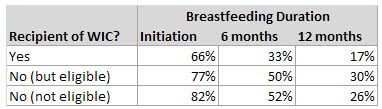
What is most striking about this data is the significant difference between the breastfeeding rates among women who are on WIC (66% initiation, 33% at 6 months, 17% at 12 months) and women who are eligible for WIC, but not using the program (77% initiation, 50% at 6 months, 30% at 12 months). In fact, low income women who are not on WIC have breastfeeding rates that are more comparable to higher income women than they do to their WIC-recipient low-income counterparts. Looking at these stats, combined with information from a recent Canadian study on the impact of free formula samples on breastfeeding rates, it would appear that a good portion 2.22 million infants on WIC in 2009 were being formula fed due to easy access to WIC's formula vouchers.
Interestingly, the Canadian Maternity Experiences Survey, found that the gap in breastfeeding rates among different income levels was not that big (especially when compared with the gap in breastfeeding rates among women with different levels of education or in different age groups). Canadian women who are at or below the low income cut-off had a breastfeeding initiation rate of 88%, with 47% still breastfeeding at 6 months. Women above the low-income cut-off had an initiation rate of 91%, with 56% still breastfeeding at 6 months.
The CDC does mention that one of the limitations of its statistical analysis is that it isn't always clear which contributing factor leads to the lower breastfeeding rates. For example, Black non-Hispanic women were least likely to breastfeed (only 54% initiate breastfeeding) and if non-Hispanic Black women are more likely than other races to participate in WIC, then it isn't clear whether it is race or WIC participation that leads to the lower breastfeeding rates. Either way, pushing formula vouchers on these women is not going to solve the problem.
I understand that low income women need financial support. However, I think anyone who stops to think about it for a moment will realize that subsidizing the cost of formula, while providing lackluster breastfeeding support (which varies from state to state and is better in some places than others), gives moms a damn good reason to formula feed. The more women who are enticed by WIC's formula handouts, the further the CDC will be from meeting its goals of increasing breastfeeding rates and the further the country will be from saving that $13 billion and 911 lives.
But what should the United States government do instead?
I think that as a minimum, under WIC, it should:
This type of breastfeeding support should not be optional. The quality should be consistent across the country and state's should be audited to ensure that they are providing appropriate levels of services as a condition of the grant.
If WIC does offer formula it should do so only when specifically requested by the mom (as opposed to offering it unless it is specifically refused) and it should be in the form of rebates to be used for any brand of formula, rather than entering into a deal with a specific company.
Ultimately, if the point of WIC is to improve the health of low income mothers and babies and if the goal of the CDC is to increase breastfeeding rates in order to improve the health of the nation, all decisions about how WIC's support to moms and infants is provided should be done with a view to supporting breastfeeding first and foremost, with formula as an option only available upon specific request. These moms do not need to be guilted into breastfeeding, but they should be given all the support in the world to help them be successful.
Note: As a Canadian, I do not have any direct experience with WIC myself, so please correct and/or elaborate on any of my points if they are inaccurate or could be expanded on. What I do, however, have experience with are excellent government run programs that support breastfeeding and that appear to be severely lacking in much of the United States.
The Centres for Disease Control and Prevention (CDC) released statistics on Racial and Ethnic Differences in Breastfeeding Initiation and Duration, by State using data from the National Immunization Survey for the period of 2004 to 2008. The racial differences highlighted in the statistics are profound and widening, but the study also noted statistics for breastfeeding rates based on the mother's education level, age, WIC eligibility, and state of residence. Overall, it found that 73% of mothers initiate breastfeeding, 42% are still breastfeeding at 6 months (although not necessarily exclusively) and 21% are still breastfeeding at 12 months. As a benchmark, Canadian statistics show a 90% initiation rate and 54% still breastfeeding at 6 months (no 12 month stats are available for Canada).
The other study by Harvard researcher Melissa Bartick, MD, MSc and the Alliance for Prudent Use of Antibiotics Arnold Reinhold, MBA was published online in the American Academy of Pediatrics journal Pediatrics and is called The Burden of Suboptimal Breastfeeding in the United States: A Pediatric Cost Analysis. Their study looked at the cost of low breastfeeding rates and concluded that if 90% of new mothers were able to follow guidelines for six months of exclusive breastfeeding, an estimated 911 deaths could be prevented and $13 billion could be saved (a topic I also addressed last year in my economic cost-benefit analysis of breastfeeding). Please also see Best for Babes excellent analysis of the horrible ABC coverage of the study on the costs of low breastfeeding rates, which featured biased formula company supporting pediatrician Dr. Lillian Beard.
The CDC and Breastfeeding
According to the breastfeeding section of the CDC website:
CDC is committed to increasing breastfeeding rates throughout the United States and to promoting and supporting optimal breastfeeding practices toward the ultimate goal of improving the public's health.
In order to achieve these goals, CDC utilizes an evidence-based policy and environmental approach to breastfeeding protection, promotion, and support. CDC's breastfeeding activities cover a wide range, from conducting and supporting research about breastfeeding to evaluating and sharing information about existing strategies to protect, promote, and support breastfeeding. CDC also works closely with partners and organizations working to improve breastfeeding across the country.
The CDC website provides a lot of information and resources for mothers and for other organizations wishing to support breastfeeding. For mothers it provides information on the U.S. Department of Health and Human Services breastfeeding helpline and on La Leche League. For other organizations, it provides resources for improving breastfeeding interventions at the state and local level, as well as resources for improving maternity care practices in hospitals and birthing centres.The WIC Program and Breastfeeding
The United States WIC program provides federal grants to States to provide supplemental foods, health care referrals, and nutrition education for low-incomce pregnant, breastfeeding and non-breastfeeding postpartum women, and to infants and children up to age five who are found to be at nutritional risk.
Emily from Adventures in [Crunchy] Parenthood wrote a post last year on WIC and infant formula. In her detailed analysis of WIC, infant formula, and breastfeeding, she wrote that:
Under the WIC program, new mothers are eligible to receive vouchers for free infant formula. This answers a lot of questions by those who wonder how low-income mothers are able to afford formula in the first place. While WIC is supposed to provide counseling and support for breastfeeding, I have found this not to be universally available. WIC office policies can vary by state, and even by city. In many cases, a pregnant woman receives counseling in the form of a 20-minute video they will watch some time during their pregnancy, and maybe a phone number to a local lactation consultant. WIC offices usually provide pumps for free, but this is often not advertised - one must ask for it. Once the new baby arrives, unless a mother indicates otherwise, she is issued vouchers for formula.
It is also important to look at where WIC gets its formula and how much it pays for it. According to the United States Department of Agriculture's Economic Research Service's (ERS) study on WIC and the Retail Price of Infant Formula:Since 1989, State agencies that administer WIC have been required to operate an infant formula rebate program as a means of containing WIC costs. Under the rebate agreement, a WIC State agency receives significant discounts from a formula manufacturer in the form of rebates for each can of infant formula purchased by WIC participants. In exchange, a manufacturer receives the exclusive right to provide its formula products to WIC participants in a State. In fiscal 2000, infant formula rebates nationwide totaled $1.4 billion.
In the ERS study and Emily's post about WIC, there is a lot more detail about exactly how this works and what the consequences are. Ultimately, while the pre-rebate cost of infant formula for the WIC program in 2005 equaled $2.34 billion (44% of pre-rebate costs), the post-rebate cost to WIC was only $628 million (17% of post-rebate food purchases), for a total annual rebate of $1.71 billion . Infant formula is by far the most heavily rebated food provided through WIC (ref: WIC Food Package Costs and Rebates Summary: Fiscal Year 2005).
Why am I telling you all of this?
Back to the CDC statistical study that I mentioned at the start of the post. It found that breastfeeding rates among women who are on WIC are significantly lower than the rates among women who are not on WIC. At first glance, people might assume that this is simply a case of lower breastfeeding rates among low income women. However, it is more complex than that.What is most striking about this data is the significant difference between the breastfeeding rates among women who are on WIC (66% initiation, 33% at 6 months, 17% at 12 months) and women who are eligible for WIC, but not using the program (77% initiation, 50% at 6 months, 30% at 12 months). In fact, low income women who are not on WIC have breastfeeding rates that are more comparable to higher income women than they do to their WIC-recipient low-income counterparts. Looking at these stats, combined with information from a recent Canadian study on the impact of free formula samples on breastfeeding rates, it would appear that a good portion 2.22 million infants on WIC in 2009 were being formula fed due to easy access to WIC's formula vouchers.
Interestingly, the Canadian Maternity Experiences Survey, found that the gap in breastfeeding rates among different income levels was not that big (especially when compared with the gap in breastfeeding rates among women with different levels of education or in different age groups). Canadian women who are at or below the low income cut-off had a breastfeeding initiation rate of 88%, with 47% still breastfeeding at 6 months. Women above the low-income cut-off had an initiation rate of 91%, with 56% still breastfeeding at 6 months.
The CDC does mention that one of the limitations of its statistical analysis is that it isn't always clear which contributing factor leads to the lower breastfeeding rates. For example, Black non-Hispanic women were least likely to breastfeed (only 54% initiate breastfeeding) and if non-Hispanic Black women are more likely than other races to participate in WIC, then it isn't clear whether it is race or WIC participation that leads to the lower breastfeeding rates. Either way, pushing formula vouchers on these women is not going to solve the problem.
What needs to change?
I understand that low income women need financial support. However, I think anyone who stops to think about it for a moment will realize that subsidizing the cost of formula, while providing lackluster breastfeeding support (which varies from state to state and is better in some places than others), gives moms a damn good reason to formula feed. The more women who are enticed by WIC's formula handouts, the further the CDC will be from meeting its goals of increasing breastfeeding rates and the further the country will be from saving that $13 billion and 911 lives.
But what should the United States government do instead?
I think that as a minimum, under WIC, it should:
- Offer quality breastfeeding classes for all pregnant moms
- Have a breastfeeding expert conduct a home visit with all WIC recipients to assess how things are going with the new baby and see if any breastfeeding support is required
- Offer free access to lactation consultants (e.g through bi-weekly free drop-ins)
- Offer free access to breast pumps
- Offer 24/7 access to peer breastfeeding counselors, who should ideally be moms of the same race with significant breastfeeding expertise, but not necessarily former WIC recipients themselves (as is currently the case) because the pool of qualified and interested individuals from that group may be too low to find a large enough pool of quality volunteers (thanks to Elita from Blacktating for making that point on twitter recently)
- Provide extra food vouchers to moms who are breastfeeding and not accepting formula vouchers
This type of breastfeeding support should not be optional. The quality should be consistent across the country and state's should be audited to ensure that they are providing appropriate levels of services as a condition of the grant.
If WIC does offer formula it should do so only when specifically requested by the mom (as opposed to offering it unless it is specifically refused) and it should be in the form of rebates to be used for any brand of formula, rather than entering into a deal with a specific company.
Ultimately, if the point of WIC is to improve the health of low income mothers and babies and if the goal of the CDC is to increase breastfeeding rates in order to improve the health of the nation, all decisions about how WIC's support to moms and infants is provided should be done with a view to supporting breastfeeding first and foremost, with formula as an option only available upon specific request. These moms do not need to be guilted into breastfeeding, but they should be given all the support in the world to help them be successful.
Note: As a Canadian, I do not have any direct experience with WIC myself, so please correct and/or elaborate on any of my points if they are inaccurate or could be expanded on. What I do, however, have experience with are excellent government run programs that support breastfeeding and that appear to be severely lacking in much of the United States.


Reader Comments (73)
I interviewed to be a breast feeding peer counselor through WIC last fall. I actually got the job but decided not to accept because while it was only 20hrs a week, 10 had to be in office without my son with me. And my husband had just been accepted into grad school. He was going to be my child care. Anyway, while I didn't actually get to work with them, I will say that they are making strides to improve breast feeding rates. If you are mostly nursing (meaning you can still be getting SOME formula but not enough to feed your child) you get significantly more foodstamps. So much that if you have additional family members you'd be able to feed them with the amount you're getting, not just yourself. And they are expanding the breast feeding peer counselor program everywhere. I know in my city, Rochester NY, we have one of the more active PC programs. They go to the hospitals, home visits, phone calls, anything and everything to offer support or give advice or information to a breast feeding mother. They used to be all about formula but I think they're understand now that's not for the best. I was super impressed and I hope to work with them someday in my goal to become a LC.
In the Canadian context, there is a family resource centre- almost fully funded by prov. government grants- near me that hands out free formula. Their prenatal classes and new parent classes do not necessarily include breastfeeding support unless those attending are specifically interested. At the same time, provincial government pouring money into new breastfeeding marketing campaign (with ads requiring a very high literacy rate to comprehend.) One hand does not know what the other is doing.
WIC does offer additional food vouchers for breastfeeding mothers. If you choose to use formula you lose your breastfeeding package. Breastfeeding package is more than just the post-postpartum package, I don't remember details of it as it's been a long time since I was on the program.
I wrote a post last year about WIC and breastfeeding. http://www.ourlifeupstate.com/2009/09/forced-to-breastfeed.html But basically I completely agree with you! :)
Thanks for the info. Just to clarify, I wasn't trying to say that WIC doesn't do any of those things now. I just wanted to create a list of things they may be doing or may not be doing that should be the absolute minimum baseline for providing an environment that is supportive of breastfeeding.
this is a very interesting piece, thankyou. I had WIC for my last two babies (twins) because I had left their father. I was an experienced and committed breastfeeder (thank goodness--these two turned out to be severely asthmatic, and I credit breastfeeding with the survival of one and the present asthma- and allergy-free status of both now-14-year-olds). I did receive extra food vouchers, to support my own nutritional needs. My good friend, a former LLL leader, is now working with her local WIC program. I definitely believe that race explains the difference b/t WIC and non-WIC low-income breastfeeding behavior. Lower-income people are less likely to deviate from their mothers', sisters', and friends' choices regarding birth and feeding than those from more-educated groups. I also observed this among enlisted personnel and their wives in the U.S. military.
Also, I got the job as a peer counselor and have never been on WIC myself. I also forgot to mention that in my area at least, foodstamps can be used at many stands at our huge farmer's market. So if you're breast feeding and getting more foodstamps that's ton more local, fresh food you can get, even all natural beef that is about the same price as beef at our local super market.
That is fabulous that you can use the foodstamps at the farmer's market.
I work as a breastfeeding educator at a WIC program in California. I'm not sure about the rest of the country, but in California and some of our neighboring states, there are AMAZING breastfeeding education programs. WIC, as a whole, is putting much more emphasis (money and other resource), into breastfeeding than it used to. Since October of last year, mothers are not able to get formula (unless it is doctor ordered), for the first month of the baby's life (that change took place at a federal level). In our community (and most others I know of), WIC mothers are required to attend comprehensive prenatal breastfeeding classes and their first appointment after they have their baby is with a trained breastfeeding counselor or a lactation consultant (depending on their comfort level with breastfeeding). Additionally, most WIC clinics have several lactation consultants on staff, along with a whole crew of other breastfeeding support staff who can see mothers, issue pumps, and answer calls. Most of our moms receive a prenatal call while they are pregnant reminding them of our breastfeeding services and answering any questions they have, and many receive a call in the first week of their baby's life to check in with how things are going.
Even with all of that, our breastfeeding rates aren't impressively high. From what I can tell there are two major things holding back our rates. One is a cultural thing...A lot of the moms we see have either no support people at home, or they have many people around them who are telling them that they shouldn't breastfeed for some reason or another. And the second is the pediatricians in our area, who have one excuse after the other for why moms shouldn't breastfeed (jaundice, mom had a c-section and needs pain meds, baby lost weight in the first week, etc, etc). I get a few calls a week from moms who were told to stop breastfeeding by their doctors because their baby has jaundice.
I am Canadian, however we lived in the US when we had our second child. We qualified for WIC and took it as a means to help us get through. I breastfed and was given so many coupons for food we gave a lot of it away. I was saddened that a lot of the food was packaged, fruit juice and cereal. I would love to see a system that promoted more fresh fruits and veggies!
WIC also had a lot of classes and support if you needed it. The office i went to was so overwhelmed at times I was in awe of the need. We were in California before the recession hit. I can only imagine it now.
I think as a whole WIC is an amazing program that could use more of everything :)
I was also contacted about being a peer councilor for WIC. They acknowledge the fact that the breastfeeding rates are low but the FDA has been doing research on increasing rates since 2006 when they piloted the Peer Councillor program. They rates in the piloted areas increased and now the program is being started nationwide. WIC by no means is excited about the numbers but they do want to move forward and include peer councilors into the normal visit to encourage pregnant mothers as well as mothers who are currently breastfeeding the opportunity to get support from other mothers like myself who have breastfed.
I also want to mention that with the economy the way it is some of the lactation services in hospitals were cut back. This important first step in a new mother's life should involved a trained professional that just isn't there anymore in the hospitals.
Also the doctor's offices are not enforcing breastfeeding so that is yet another step that could have been another opportunity for education.
All in all I believe WIC is not the only culprit here. There is a chain of events that leads a new mom to think that bottle is best instead of the breast. WIC is working to change and I hope to play a part in it.
I wish our state would let WIC be used at farmer's markets. I might have actually used it. WIC just supplied a bunch of stuff we never needed, mostly dairy, so I didn't bother applying for it even though we would have qualified.
I'm on WIC for the first time in 13 years and things have come a long way since my oldest was a baby. Breastfeeding is very much encouraged, a food package is offered for a year with everything they offer (it used to be 6 months and just a small list of foods), support is offered if one wants it, and they offer incentives along the way. If you initially breastfeed, you get a magnet. Then at 2 months you get something else, four months is a bib, six months is a plate and sippy cup, and so on. At a year, you get a gift certificate. At 6 months and a year, you get your picture taken with baby and hung on the wall of fame. They're small things, but it's encouraging. The counselors are very pro-nursing. It was never a question for me, but they have the pros on posters all over, with posters of the cons of formula beside them. This is in Stephenson County, Illinois and I realize that every office is different but I am very impressed with how nursing friendly mine is.
WIC actually totally revamped their foods last year. Lots more variety in the foods (including fruits & vegetables), some organics available, including all the baby foods.
http://www.cdph.ca.gov/programs/wicworks/Pages/WICAuthorizedFoodListWAFL.aspx
While I certainly think WIC's promotion of formula is closely related to poor breastfeeding outcomes, I'm also interested in how maternity leave and breastfeeding friendly employers factor into why low income American mothers are less likely to breastfeed. Welfare reform (PRWORA) has left poor women with extremely unforgiving work requirements, often in locations where pumping is difficult. Many poor women aren't able to stay home with their infants and usually don't have lactation rooms or office doors to lock when pumping at work. Maternity leave (or the US's lack thereof) and workplace support need to be addressed as well as WIC. The US needs a major culture shift when it comes to breastfeeding, but it also needs to provide financial support and job security to all mothers so they can do what's best.
I am trained as a WIC peer counselor and I am mentored by a WIC IBCLC for hours towards pathway 3. I completely believe that WIC is at fault here. It is simply too easy to get formula and the education where I am(Illinois) is really lacking. WIC needs a major overhaul. It should be as easy as asking for formula. Half the moms don't even try and those that do never make it long. They know the formula is there and that it takes no effort to get it.
I have to read through this more closely, but as a WIC recipient for years now, I have to say here in the local office they have been hugely encouraging of and supportive of breastfeeding (the actual counselors, employees, etc). And while they do offer formula vouchers if you are not breastfeeding, you get a much better package of vouchers overall if you are breastfeeding - presumably because the nursing mother needs added nutrition. I'll come back when it's not so late to read through the details of what you've written more carefully. Great topic, Annie.
-elizabeth
I qualify for and use WIC and my 9 month old has never had any formula. I was offered a pump before my baby was even born b/c they knew I was going back to work. They have been so supportive of breastfeeding. That said, I think the breastfeeding rates are very low in my community. When I'm out and about I almost never see a baby without a bottle (sometimes a bottle of kool-aid or chocolate milk, even).
My friend of similar income level, career choice (teacher), marital status (married) and education level chooses not to use WIC, and also breastfeeds her 9 month old baby. We both save money by breastfeeding! I think it is our culture, education level, we have access to good information (books, internet, etc.), and other factors that have helped us want to and be able to breastfeed successfully. We both have supportive husbands that encouraged us through those some-times rough first few weeks.
The overall food package changed recently to be more supportive of breastfeeding (I believe Oct 09), so if you're looking at online information it can be hard to judge if it's up to date. Certainly the new food package offers additional solids for a mother who has never used formula.
Beyond that the quality of breastfeeding support from WIC seems to vary widely by geography.
It is my understanding that you are much better off as a bfing WIC client than a formula feeding one. You get a lot more food, a lot more support and a breast pump. WIC isn't the problem here. If they could take out the age/race/culture/income/education variables and show the same difference I would be right there with you.
While I agree WIC isn't totally at fault, even a revamped program doesn't change the rates. The perscriptions for formula are needed for the entire first year. My oldest (23 months) had to supplemented because she was a preemie. While WIC encoirages breastfeeding they don't seem too excited or interested in pushing it as much as they should. My youngest is 5 months old and exclusivly breastfed. I was told by a worker that it's okay if I felt that I couldn't breastfeed I could always get switched to formula. Also I'm not sure I would trust too much of what the WIC study says. I was told by a cashier at a store that moms on WIC recommend other moms to say they breastfeed so they get the extra food. I've had both packages...if they actually thought about it, they are pAying forore out of pocket by buying their formula rather than WIC supplying it. So your percents on WIC breastfeeders is probably even lower than that. I breastfeed because I've seen And read that it is best for babies and helps build their immune systems. Further more, those I know who breastfed their children are significantly more healthy and don't get sick near as often as those who have formula fed their babies. I have seen it with my own daughters as well. My oldest has been sick more often than my youngest at the same age and my oldest was only supplemented. I am convinced that alot of BF issues are clutural, supportive help, and education.
I think it's a cultural stigma in some parts of the US. As well as a stigma in some races. In most African American circles no one has breast fed and if you do you are looked down on. Most people just take the formula. Who wants to be hassled with breast feeding? It hurts! That is the argument, at least where I live in the midwest.
I was nursing my son, in a private area of the zoo (large shaded trees, a bench well off the path, and a huge Aiden and Anais swaddler covering us). A young lady saw me and came close enough for me to hear, she yelled out, Ew. Gross! Get a bottle! And sneered at me. The only way she new what was going on was that I was playing with the feet of my two week old.
My kids have all had very severe allergies, all three. I kept at breastfeeding and they are all fine. I know it was the breast milk that helped them. I know that's what keeps them healthy. I had a medical emergency with my middle son and he has all sorts of complications - I will always think it's because I had to stop nursing him at 3/4 months. Regardless, the other two have medical records to prove severe allergies (doctor advised to slow down vaccinations) and skin problems - ecezema. Four years after nursing no problems. I bet a formula fed mother could not say the same....
Also, all three of mine had RSV one severe and we nursed and nursed. No hospitalization. I'd be interested in an in depth study on the health benefits of breastfed children from infancy to teenager!
I'm really glad to hear these positive stories about WIC offering solid breastfeeding support. My own experiences five years ago were *dismal*, and I know many women across the country who have received poor support ranging from bad advice to outright antagonism for breastfeeding exclusively to six months or - heaven forbid! - past a year. The emphasis on dairy and processed foods (cereals, Nestle-produced juices, blocks of cheese large enough to constipate a whole family of newborns ;)) is troublesome and rarely mentioned. I personally was on the receiving end of several ignorant comments, admonitions and near-scoldings regarding healthy growth rates (would someone PLEASE get these folks a copy of the international breastfed-exclusive growth charts?) and things like the "dangers" of breastfeeding whilst pregnant or into toddlerhood were baffling at best, and offensive at times. I was interviewed years ago to work as a peer counselor, but ended up declining due to the baby-unfriendliness of the work place and the clear uphill battle I'd have had to support anyone going against the grain or the mainstream wisdom of the time.
I have received WIC twice now. Once with my older son who is now 14 and with a 2 year old. I have not been getting vouchers for the two year old for about 3 months. Not because I don't qualify but because the office does nothing but harass me about the two year old breastfeeding. From the time he was 6 months old they told me it was no longer necessary and that I could get vouchers for formula. When he was seven months old my supply dipped (I was pumping and nursing) and I needed help with a pump when mine broke. They didn't have one in the office I could rent so they just wanted to give me formula. Maybe it depends on where you are, but I live in a high latino area. While I am not latina, latinas tend to breastfeed. It seems that our WIC office likes to discourage breastfeeding here.
Ok, I've no knowledge of WIC as I'm in Scotland. Here the breastfeeding rates in low income households are atrocious - I sometimes wonder if they are even wrong (with 8-13% breastfeeding at 6-8 week review on average, compared to the national average of 35%). Low income families receive vouchers for milk - formula or cow's milk, and the voucher does not cover the full price of a pack of powder, which has been criticised by low income parents.
How about changing the system to give the value of the voucher to the parent to spend as they please, so they can save money if they breastfeed?
I know the argument against it - fear that formula feeds would be diluted for the pack to last longer, cows milk being used instead of formula. There's never an easy answer but surely if adequate support for new mothers was available (either to support breastfeeding or to support safe formula feeding) these things shouldn't happen? Or am I an idealist?
Yeah, the food package for a nursing mom is NICE. It's way more than a kid gets. I was so sad when we hit a year and I lost those benefits. I don't think that WIC recipients know that, though, unless they are breastfeeding. I'm also pretty certain that, monetarily, it's still probably worth less than the formula vouchers.
I do think that there's a lot that WIC needs to do. In my case, my local WIC office was very supportive (although I didn't need it). Even so, though, there's definitely more they could have done in terms of peer counseling and having lactation consultants. And I've heard some awful stories about WIC offices, so I know this varies a great deal.
I do think WIC is the main reason low-income families do not breastfeed. I was on WIC when I was pregnant and after I had the baby, they didn't do much to help encourage breastfeeding. So, when I told them I had stopped they had no issue giving me checks for TWELVE cans of formula a month! Now that I don't qualify for WIC anymore (and I know more than I did then) I will certainly be breastfeeding this time around.
I am exclusilvely BF'ing my 6 month old. WIC provides me with 4 gallons plus of milk, 1 1/2 lb of cheese, over 33 oz of cereal (fortified low sugar) 2 lbs of beans (4cans, 1 lb dried, or one 18 oz peanut butter), 3 46 oz containers of 100% juice, $10 in fresh fruits and vegis 2 dozen eggs 6 5-6oz cans of tuna or salmon and 2 lbs of specific whole grain breads. Its enough to serve me breakfast and snacks for an entire Month. However, WIC was designed to be a supplemental program, not a food stamp program. And recipients must be under 200% of Fed. Poverty Guidelines. Food Stamps in Michigan are administered separately, and recipients typically must be at or under 135% of Fed. Poverty guidelines. If I continue breastfeeding past six months, I continue to receive this package AND I get infant cereal, pureed fruits and vegis for the baby as well as pureed meats. If I stop BF'ing all I get are formula vouchers, cereal, and the fruits and vegis.
I live in Ohio and used WIC with both of my children. They provided me with a double pump so I could continue to work, a manual pump, and all of the food vouchers Kristen mentioned (above). It was amazing! I felt well-supported, but I did have to make an appointment to get b.f. consulting if I was having trouble. I like the idea of peer counseling, and round-the-clock support. As a doula, I have had clients call in the middle of the night, b/c they did not know where else to turn.
I knew some girls I worked with who would exclusively breastfeed, but told WIC they were supplementing sometimes, so they could receive both formula and b.f. benefits. Then they would go and sell the formula at local resale shops. Gross. What a waist of gov't money.
Perhaps WIC does need to reevaluate and redirect their services to promote and better support breastfeeding services. Not a bad idea!
I'm exposing myself as a conservative here, but I really don't think increased government intervention is the key. I think the culture must change first. I especially think doctors need to be more supportive of breastfeeding. I was given an entire can of formula by my Ob-gyn months before Baby was born, and told by my pediatrician to begin supplementing with formula immediately to "get him used to it in case something happens, like you die, or want to go on a date". Perhaps this study will help the medical community become more breastfeeding friendly.
I do think a government sponsored publicity campaign could be effective if they actually showed breastfeeding moms actually breastfeeding on billboards and TV. Too many people act like it's a deviant behavior which should be done in private if at all.
While I don't believe WIC should be demonized because I do appreciate the attempts they're making to put more emphasis on breastfeeding, I must say my local WIC office has given me a horrid experience.
It started when I was pregnant and wanted to take a breastfeeding class through the local hospital. I called to ask WIC counselors if that class could count as credit toward the WIC breastfeeding class I had to take and they told me no. I ended up going to both classes (thank goodness). While the breastfeeding class offered by the hospital was interesting, informative, and gave me a lot of notes to bring home, the WIC version consisted of a short 20-minute video and another 10 minutes of lecture / questions. We were given the business card of a lactation consultant and sent home. I could not believe they had required I attended that poor excuse for a breastfeeding class.
After I got home with my little one, I had some problems breastfeeding. Once I finally reached the lactation consultant (because she rarely came into work, a snide comment given by one of her coworkers), she gave me terrible advice. I had already learned contradictory information from LLL and the lactation consultants at the local hospital - yet she gave me bad advice with gusto.
I went back to work and invested money I didn't have in a Medela Swing. Fast-forward two months later, when my child was four months old, they gave me a double-electric pump. I'm not saying I'm not thankful - indeed, I am because I feel I got my life back the day I got a double-electric . . . but why on EARTH was I not given the tools I needed earlier? It would have made our breastfeeding journey that much more manageable.
When I returned a few months later because part of that double-electric broke and I needed to pick up new flanges, I was shown a manual pump (that couldn't generate any suction) and was told by the LC that NO, faster suction in the beginning did NOT make milk let down faster. By this point I know this woman has no idea what she's talking about - and SHE is supposed to be giving breastfeeding advice and support?
Finally, other than the extra food vouchers if you exclusively breastfeed, there is no other "attagirl!" from the office if you've actually made milestones. I was even told by another WIC recipient "Good luck with your goal of one year, I couldn't make it two weeks before I was up here telling these people to give me formula." And did they give her formula? Absolutely. Did they try to resist or give her breastfeeding support instead? Absolutely not.
I'm in Indiana and have been receiving WIC for a year. I am still breastfeeding my daughter and never received formula vouchers and was asked each time I picked up checks if I was still breastfeeding. The baby food I received after my daughter was 6 months is an issue that needs to be addressed within WIC. It was 3 boxes of baby cereal and 90 jars of pureed foods! It was way too much for an infant just learning to eat and felt like a push to feed solids. I went to WIC and had the amounts reduced, have donated a lot of jars and still have a pantry overflowing.
I think it's important to note that the formula WIC recipients receive is not enough to fully feed a baby. So even though the mother may be enticed to use formula, she will still have to pay for additional cans each month.
Indiana WIC gave out a separate check for the local farmers' market last summer (in my area at least). I was amazed at how much I could get for $3, and more importantly, it gave me the impetus to go to the market and by more there. :)
Katie, do you know if your WIC offices ever call those doctors to educate them on breastfeeding?
I do believe that WIC contributes to formula feeding. I have a few friends who asked my "why breastfeed when formula's free at WIC" though I do not qualify for WIC due to income guidelines. I also went to a WIC office for a breastfeeding support meeting and saw a sign that said "Got Formula." I was really turned off by that. I believe that in my state (WV) that nursing moms are given a voucher for a can of formula when their baby is born. I do know that many states have great breastfeeding programs but I believe that WIC makes formula feeding easier because the moms don't have to buy as much. The food package offered by WIC does not appeal to me since I didn't feed my daughter jarred purees or meats. I wish they would just offer fresh fruits and veggies instead of jarred foods and processed cereals. I also don't know how the breastfeeding package would help that much since I don't really eat most of the foods on the list. I also don't understand why they would provide cow's milk for my one year old since she does not drink cow's milk. So at her age, we wouldn't really benefit from the program since they would no longer give me the breastfeeding package after age 1. I believe that WIC is beneficial if they can provide lactation services but I really think that they should provide a better package to breastfeeding moms and encourage nursing past one year rather than pushing cow's milk on toddlers.
Today is a simply awesome day for breastfeeding posts (check out my twitter stream!). I'm loving today! Well done!
As a CA WIC recipent I will second what Katie says about not providing formula for babies first month (30 days) I was having a heck of a time with my newest kiddo and he'd been having blood sugar issues and was having a really hard time eating from the breast. I thought i might have to supplement a bit because I wasn't sure I could pump for his needs but ended up plotting through because I sure as heck wasn't going to buy the stuff myself just to use a few bottles worth.
I also wanted to add that I am also on WIC in the USA. My daughter is 9 months old and was exclusively breast-fed until she was 6 months old. Because she was exclusively breast-fed she also gets A LOT more baby food then if she were on formula. I get all the baby food she would eat in a whole month (cereal, meat, fruits and veggies). On top of that, I get 5 gallons of milk, 2 lb cheese, 4 cans beans, whole grains (bread/torillas), 36 oz cereal, $10 fruits/veggies, 30 oz tuna, 64 oz juice and 2 dozen eggs. I also agree that WIC doesn't do a very good job at educating women on breastfeeding and support. The breastfeeding counselors periodically still call me and make sure all is well. They always called before she would hit a growth spurt and remind me of what was going to happen and to just stick with it. They gave me a free hand pump and directions on how to get a double electric from Medical Assistance. I think they are improving, but they still have a long way to go. I don't think it's right to be getting rebates from formula companies. If they spent more on lactation consultants, breastfeeding counselors and educators, pumps and resources they would ultimately save all the money spent on formula. Also, if they discouraged formula use and educated what it really is I think most women would just opt for how nature intended us to feed our children. Human milk does the body good :) I like to think that when one is properly educated, they will choose the correct way because it's common sense.
“get him used to it in case something happens, like you die, or want to go on a date”
o. m. g. I think I just thew up in my mouth a little. I probably shouldn't hug my daughter much either since I could die any minute and then what will she do?
I'm not personally familiar with WIC but I do know my area (Greater Cleveland, Ohio) is littered with breastfeeding billboards with WIC on them. I just started noticing them a few years ago though so maybe the changes some people mention are true. WIC terrifies me for a completely different reason - I've heard them denying benefits if parents don't vaccinate. yikes!
I receive WIC and am breastfeeding. WIC did offer breastfeeding support - peer counselor, access to a pump if I was working, extra supplemental fruits and veggies, etc - but we also get 95 jars of baby food per month. NINETY FIVE JARS. Plus baby cereal.
I don't think paying WIC counselors to visit moms is the key. Quite honestly, I knew more than the peer counselor did (to be fair, I've been breastfeeding for years and years.)
I think the key lies in community, and mentor moms. The government can encourage breastfeeding, but the real change has to come from the culture and person to person. We need to see breastfeeding as beautiful, but that's difficult when time and time again people compare breastfeeding to other bodily functions (i.e., pooping.) We need moms who have successfully breastfed to encourage other moms. BFing needs a PR campaign!
Also we need to not be so PC. In many mommy circles, mommy magazines, parenting pros, etc. sometimes seem afraid to say that breastmilk is better than formula. That formula is not the best choice. Everyone is so afraid of being seen as judgemental that they are downplaying the real benefits (financial and health) of breastfeeding. It's a hard subject to speak openly about.
There are other factors to consider besides WIC. Hospital practices of supplementation, formula bags, keeping the baby in the nursery, C-section rates etc.all negatively impact breastfeeding rates.
[...] and WIC Posted on April 8, 2010 by Kathy Today, I read this post, “Is WIC shooting the CDC in the foot when it comes to breastfeeding rates?” It was an interesting take on a couple of new studies that have been released: racial and [...]
Nicole:
You are right. There are lots of other factors to consider. I wrote about a lot of them in my post on the http://www.phdinparenting.com/2009/09/10/societal-barriers-to-breastfeeding/" rel="nofollow">societal barriers to breastfeeding and you mentioned a few others here too. However, the reason I wrote this post and singled out WIC in particular is due to the significant difference in the breastfeeding rates between low-income moms who are on WIC and low-income moms who are not on WIC.
Are you meaning to say WIC vouchers? Because foodstamps is a completely different program. You can have a much higher income on WIC than foodstamps. You can only use WIC vouchers at farmer's markets in certain states. :( I think it should be a requirement of the program.
I'm another breastfeeding WIC mother, and despite still qualifying for it, canceled my WIC after my DD was six months old because of the atmosphere at WIC. My first post partum visit I was asked what formula she was using- and when I said she was breastfeeding (10 days old) they asked me "you know the formula is free, right?" ARRGH. despite being a full time college student, I was never offered a pump (though I did get one through the hospital because my DD was kept for 8 days) and never given any breastfeeding education except a bag with a burp cloth and a video that was all made by *NESTLE* yeah. They also told me my DD was overweight at 3 months (yes she's off the charts, but she's also a very tall baby- and 50th percentile length to weight) Then, they were upset with me for not introducing cereal at 4 months because "she would become anemic" despite that their literature was already saying solids after 6 months.
I did however get complemented by staff and other moms when I was nursing in the waiting room.
That is awful Rebecca. Thank you for sharing your story, but UGH UGH UGH.
I have nursed 3 kids one for 4 months, one for 20 and my 3rd for 8 months and counting.
My daughter I was alone and very tired. I contacted WIC and they simply told me to give her formula. No one ever asked if there was any other issues (I was sleep deprived and depressed). I gave into the formula. I got more depressed for a while. I did get sleep but I am still not sure why it worked that way.
My son was nursed for 20 months,despite supply issues and 2 rounds of thrush and mastitis in both breasts. WIC gave me a pump i was not able to figure out. That is all they would help me with . When my situation got settled at home I was able to stop with the formula all together. I was still given the vouchers. I told them they were not needed, still got them.
With my baby because I had supply issue with my son they automatically gave me formula and told me that I should start to supplement with that. I do not have supply issues with nursing this time. We are fine but I do have pumping issues. For the first 2 weeks the WIC office called to make sure things were going well. Then the calls stopped. I actually needed help because my daughter would not nurse in many other positions, when I called and left a message no one returned my call.
Munchkin is 8 months old Monday, I have made it through a deployment with 3 kids, one nursing and one in therapy for spectrum disorder. If I can make it this far anyone can. It is something I know I am doing good for my kids.
While I do support what WIC is doing I also believe if they say they are going to help they should. I also think that they should not offer name brands of formula at WIC. It is funding these companies so that they can advertise in magazines and give free samples to doctors offices. I, sadly, do have to purchase formula and when I do I buy store brand. I do not want to put funds into the pockets of formula pushers!
WIC told me my son was overweight as well! He was EBF at this point and had was about 25 pounds before 12 months old. I was suggested a diet. i was horrified!
I think that another factor that we have to consider is that low-income women in the US probably also have less access to quality maternity leave, and are less able to afford to take unpaid time have. I have read studies that indicate that short maternity leaves are correlated with lower breastfeeding rates, which makes sense to me. It is absolutely possible to pump while you are away from your baby, but it's not easy, and it's even less easy if you're working someplace where you don't have any access to privacy. When you have to return to work within weeks of giving birth, AND you have access to free formula, I really see how breastfeeding rates would take a hit. :(
Curious where you live Rebecca?