











Why do moms quit breastfeeding?

by phdinparenting on December 1, 2011 · 110 comments

Most moms who wanted to breastfeed, but ended up formula feeding, will be able to cite a reason or two. Breastfeeding advocates generally say that most of those hurdles can be overcome most of the time. The divide between these two perspectives — of insurmountable versus surmountable problems — often results in heated discussions and hurt feelings. Moms feel like they are being told that they didn’t try hard enough and breastfeeding advocates are frustrated at the lack of recognition of other contributing factors.
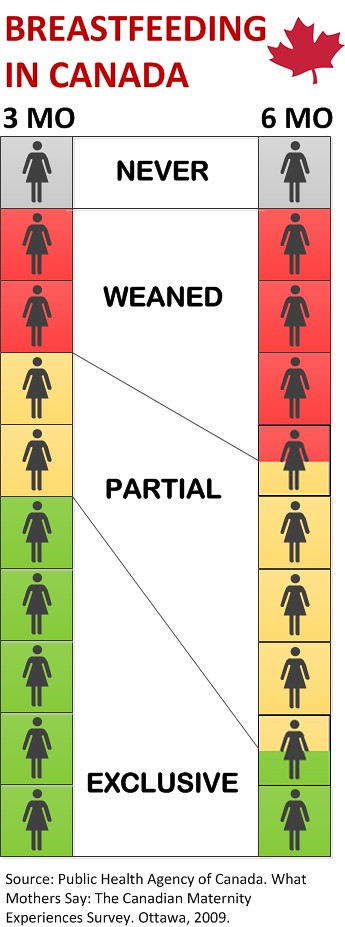
In Canada, around 90% of women initiate breastfeeding, which is great. But things go downhill quickly. The World Health Organization and Health Canada both recommend six months of exclusive breastfeeding, with continued breastfeeding until 2 years or longer. How do the Canadian statistics stack up against that recommendation? At 3 months, 68% of moms are breastfeeding and 51% are exclusively breastfeeding. At 6 months, 54% are breastfeeding and 14% are exclusively breastfeeding.

Or, in other words, by the time a baby is 6 months old:

  • 10% will have never been breastfed
  • 36% will have been weaned
  • 40% will have been supplemented at some point (either with formula or early introduction of solids, other milks, juice, etc)
  • 14% will have met the recommended duration of exclusive breastfeeding

Why are so few moms meeting the recommended duration of exclusive breastfeeding?

Reported Reasons

According to a Today’s Parent Survey (by John Hoffman), only 1 in 10 women report “problem-free” breastfeeding. That means that 90% of women who chose to breastfeed have to overcome some sort of hurdle in order to continue breastfeeding. Some of the are able to overcome those hurdles with help or with time. But others are not.

According to the Today’s Parent Survey, three types of breastfeeding problems were particularly prevalent among moms who weaned early:

  • Low milk supply
  • Low baby weight gain
  • Baby who seemed uninterested in nursing or nursed inefficiently

Some other reasons I’ve frequently heard moms moms give for supplementing prior to six months include:

  • Wanting or needing to leave baby temporarily (work, date night, weekend away) and not wanting to pump or not being able to pump enough.
  • Doctor or parenting book advised them to introduce solids before 6 months.

Contributing Factors

The reasons that moms give for stopping breastfeeding are an outcome — low milk supply, low baby weight gain. There need to be reasons for those outcomes. In a small percentage of women, there are legitimate insurmountable medical reasons for those outcomes. However, for most mothers, it is other contributing factors (likely in combination with difficult but surmountable breastfeeding challenges) that can lead to that result.

Those contributing factors include:

Twice as likely, 3.5 times as likely, twice as prevalent, much more likely, four times as likely, and so on — it all adds up.

Moms don’t usually name a formula sample, a not-so-knowledgeable doctor, or a lack of comfort nursing in public as the reason for their low milk supply, but in a lot of cases it probably is a contributing factor. That doesn’t mean that these moms didn’t try hard enough (and really, hard enough is subjective and will be different for each person), but it does mean that these are issues worth tackling. They are hurdles, or barriers or booby traps, or whatever you want to call them. They are silent killers of breastfeeding relationships.

What is Missing?

We can compare the statistics on actual breastfeeding duration with the recommended duration and see that Canadian mothers come up short. But that doesn’t tell the whole story. The key information that is missing from these statistics is information on women’s breastfeeding goals. We need a long-term study that asks pregnant women how long they plan to breastfeed exclusively and when they plan to wean and that compares that with what actually happens. Is there a gap? If so, how big is it? What reasons do the moms give for the gap? What other contributing factors came into play? A comparison between the recommended duration of breastfeeding (6 months exclusive, continued nursing for 2 years or more), women’s own breastfeeding goals, and actual length of breastfeeding is essential to a full understanding of where and how things break down.

More Data, But What Else?

Yes, we need more data. That said, there is already some evidence that a lot of women stop breastfeeding earlier than they planned to. According to the Today’s Parent survey, at least 1/3 of breastfeeding moms stopped earlier than they had planned and the numbers are probably higher for first time moms.

In the meantime, however, we need to keep working on breaking down the barriers and tackling those contributing factors. They should be eradicated wherever possible. Or, where that isn’t (yet) possible, we need to at least make moms aware of the danger so that they can protect themselves and their breastfeeding relationship.

Breastfeeding advocacy doesn’t really need to focus on the 10% of women who choose not to breastfeed. It needs to focus on the large numbers of women want to breastfeed and are devastated when things don’t go the way they wanted them to. Breastfeeding advocates need to create awareness among those women (before it is too late) and help them to navigate the minefield.

What do you think should be the first priority in tackling those contributing factors?

Related Posts with Thumbnails

{ 106 comments… read them below or add one }

1 Stephanie @Good Girl Gone Green December 1, 2011 at 11:57 pm

I am actually breastfeeding longer then I thought. I am at 14 months now. I exclusively breastfed until about 8 months. My little one wasn’t interested in food. We did baby led weaning. She only took to food around 10-11 months maybe.

The first month or so of nursing I wanted to quit everyday, it was painful and there were lots of tears, but I persisted and got support and made it through. I am so happy I did! :)

I have some breastfeeding question: can I get in touch with you Annie? I would love your opinion if you have the time! :)

Reply

2 Joyce December 1, 2011 at 11:58 pm

I wish the partial category was split. It would be interesting to see how many people start food early; how many supplemented initially and then moved to exclusive breastfeeding; and how many started by exclusive breastfeeding and moved to supplementing. For instance, I would be listed as partial because my baby got formula in the NICU until I could pump enough to cover my baby’s meals (4 days). I got the best breastfeeding support possible and have exclusively pumped/breastfed since then so I think I am a different situation to someone who had a fussy baby at the breast and started supplementing with formula due to this.

As for priorities – the doctors have to be number one. So many doctors are misinformed as to current breastfeeding practices and are just plain breastfeeding-unfriendly. If we can get doctors (all docs not just pediatricians!) on board to support women and their breastfeeding goals (whatever those goals might be!) we’d be half way there.

Reply

3 phdinparenting December 2, 2011 at 12:02 am

Joyce:

Yes, I agree on splitting that data.

Reply

4 cari December 4, 2011 at 8:21 am

I EBF until a week before the 6 month check up. At that time (for all three babies) we started solids so the pediatrician wouldn’t fuss at us. They still push starting solids at 4 – 6 months, with a day over 6 months being a big red flag.

Reply

5 Mandi December 2, 2011 at 12:10 am

Great post! I appreciate that you don’t cut on women who choose not to Breastfeed. Baby c was breastfed for 3 weeks, but in that time she wasn’t gaining weight and I needed to supplement. At 3 weeks I was in the hospital for an e.coli infection and she with spinal meningitis. We had to give up Breastfeeding all together.

Reply

6 Angie December 2, 2011 at 12:21 am

I think the first step should be to require all hospitals with maternity servcies to be Baby Friendly Hospitals. This would help ensure that women were having a good start to their breastfeeding relationship, with accurate information and adequate early support to stave off those common, early-weeks difficulties.

Then, I’d say we need better community-based lactation support networks- just as women discuss what daycare they’ll send their child to (if they do not stay home), we should have the names of professional lactation guides and peer counseling support groups at the tips of our fingers. It should be as common to have a lactation guide & support group as it is to have a pediatrictan & a babyshower.

Finally, I think there should be strict, regulated marketing guidelines for formula. No print ads in parenting magazines, women should have to opt in for formula samples (instead of having them sent simply because they shopped at a certain store), etc…

These three steps would protect breastfeeding for those women who choose to do so…

Reply

7 phdinparenting December 2, 2011 at 9:32 am

I agree completely on these points.

Reply

8 Mama December 4, 2011 at 6:37 am

Hate to break it to you Angie but you’ve just described my situation here in Australia and I still had to fight with all my might to successfully breastfeed. We also have similarly dismal rates of breastfeeding continuation to the rest of the Western world.

Baby friendly hospital – check. Not so baby friendly when your perfectly healthy baby falls slightly outside the charts for growth. They just try to force you to go out and buy formula (as they aren’t allowed to stock it in the hospital). They talk big ideals but the actions are just the usual undermining ones. Think about it…all the education and ideals cannot compete with the fact that the midwives (and paed’s etc) have most likely formula fed their children – and if it was good enough for their child… They also have to cover their rears so will always go the “safe” option that won’t get them sued. Formula is deemed “safe” by our society and so no harm is seen in fattening a newborn up with it instead of doing the hard, “riskier” option of getting over all the breastfeeding hurdles the mother is experiencing to get the baby fed “before she gets brain damage”. Yes, those (false) words were uttered to me by a paediatrician who really had no interest in breastfeeding success at all despite being employed at a Baby-friendly hospital. The LC at the hospital was worse than useless and actually caused more problems than she solved.

Lactation support in the community – check. ABA (Australian Breastfeeding Assn) has a support network, 24hr helpline, private LC’s numbers were made available to me. I was too scared to ring the helpline number as I had no idea what to ask. I couldn’t get to the ABA meetings at the time when I needed them. A publicly funded community nurse who had LC training was also available (and was a wonderful help in reassuring me that what the last 6 or so medical professionals had said was a load of shite. Mum and the internet were saying the same thing but it was a relief to hear it from an “expert”).

No formula ad’s and samples – check. Australia (as far as I know) operates under a voluntary agreement from manufacturers not to advertise formula. They advertise identically packaged “follow-on milk” and “toddler milk” instead. I don’t read magazines or watch tv with ad’s on it so have had very limited contact with any advertisements of any type for formula-type products. I was never offered or received any formula samples and would assume this is the case for most mothers in Australia.

The ONLY reason I have successfully breastfed my daughter is because of family support – from my mother (who would not accept that I couldn’t breastfeed – she got me information and support from her experienced peers to get me through the problems I was experiencing) and my husband (who has been 100% with me at every single step of the way). The thing which stands out the most to me is that they (and I) placed a huge amount of *value* on breastfeeding and its benefits.

I think we need to focus on changing social attitudes to breastfeeding. If it was truly important to each and every one of us then the majority of us would find a way – and be given REAL support by family, peers, employers and our community. As it is, formula is seen as being a perfectly good substitute.

Reply

9 Crunchy Con Mommy December 2, 2011 at 12:34 am

Interesting data. I think doctors need to be more educated. At my son’s 2 week checkup the doctor told us to start supplementing with a bottle of formula each day “just so he gets used to it in case you want to go on a date or something”.
I was disgusted by the suggestion, am am still nursing him as a two year old. But I bet a lot of people would think that was sensible advice!

Reply

10 phdinparenting December 2, 2011 at 11:21 am

That is the same advice my mom got almost 40 years ago. It is completely outdated and inappropriate. It is a sign that doctors are not keeping up their knowledge on this topic.

Reply

11 Heather H. December 2, 2011 at 12:44 am

I agree with Joyce, I think having better data for the “partial” category would help. I’d also love to see continued research on the effects of IV fluids given to Moms during birth and subsequent breastfeeding challenges. With my son, we were more or less forced to supplement while in the hospital (Don’t even get me started on that, four years later it STILL makes me angry) and for his first month (because the pediatrician insisted, until after a month when I got up the courage to throw the SNS and formula away and EBF from then on) – and I am absolutely 100% convinced that many of our breastfeeding and DS’ weight loss problems were directly related to the massive amounts of IV fluids I received during labor & delivery (5 liters. Yes, FIVE.) I cannot be the only one in this situation, given the prevalence of IV fluid use during hospital births, particularly when epidural anesthesia is used. So I think that really, truly understanding and continuing to study the effects of that on breastfeeding initiation and duration could make a huge difference. If we know that baby loses a bit more weight after birth when Mom had a huge fluid bolus then maybe pediatricians would be less likely to push formula so hard until it was clear that bab’s weight loss was not just due to loss from excess fluid

Reply

12 Olivia December 2, 2011 at 8:29 am

That is a very good point. We know that many babies have artificially high weight because of those fluids, and when that water weight drops mothers are told their babies are losing too much weight.

Then there is this. I was given the “choice” to have my baby given an ounce of formula or have her kidneys checked by ultra sound because she had not urinated since birth. I think it had been less than 24 hrs. Later my midwife said she could have peed during the birth process (c-section) and no one noticed.

Reply

13 'away from your crazy mom' December 2, 2011 at 2:15 pm

These points reflect my experience too.

Reply

14 melissa December 3, 2011 at 10:58 pm

Heather, here is an article about a study about the effects of fluids and newborn weight. The study suggests new guidelines be established to attain the true weight of the baby to avoid supplementing.
http://blog.breastfeedinginc.ca/2011/08/maternal-iv-fluids-linked-to-newborns.html

I too was told to supplement from the doctors, lactation consultant, nurses, and my midwife! I knew it was just water weight. Though, I was floored when the lactation consultant suggested to “just give her a formula when you feel tired”. Good grief your a breastfeeding expert!

My wish is that there was not only updated information about breastfeed but more information about how breastfeeding changes as the baby gets older. All the troubleshooting information is for the newborn stage. I have more questions about BF now at 10 months then at the beginning.

Reply

15 Laura December 2, 2011 at 12:45 am

Great post! Dr’s lacking bfing knowledge is huge.

But I think the lack of seeing breastfeeding in our society is probably the biggest deterrent. I can count on one hand the number of times I saw a baby nursing before I had my own. Women go into it with no prior knowledge of what its going to be like, how often the baby will need to be fed, what kind of problems they might have, and then add to all that the uncomfortable feeling you get every time you need to feed the baby in front of other people makes it so much worse. I’d love to see nursing on TV in every show or movie with a baby, and not as some bizarre joke (like accidentally drinking pumped milk), but just to replace every seen where they show a baby with a bottle or making a bottle with the mother nursing would be beneficial.

Reply

16 Paula December 2, 2011 at 2:00 am

Agreed!

Reply

17 Michelle December 2, 2011 at 7:06 am

I agree Paula, and to go along with that I think that every day cultural expectation or what is considered the norm weighs heavily on whether a person perseveres. In the part of Australia that I live in breastfeeding seems to be the ‘normal’ ‘expected’ thing to do. For most of my peers/friends etc, formula is the ‘other’ – what you use if you can’t breastfeed. The expectation is great, unfortunately I don’t think enough women take advantage of the help or services available. What is not the ‘norm’ in the part of the world I live in, is asking for or seeking help if you are having problems with breastfeeding. I feel most women go it alone when there are problems.

Reply

18 Paula December 2, 2011 at 12:47 pm

Interesting! It doesn’t seem so different here in the US. Women need to look for support when having problems, and not just to their mothers, friends, or doctors. There is a wealth of knowledge online that can help a struggling mother understand and deal with her problems.

I wonder what the statistics look like in Australia. I found the stats on the US – http://www.cdc.gov/breastfeeding/pdf/2011BreastfeedingReportCard.pdf
And it is nice to read that the US is using this data to “to track progress, identify the areas where mothers need more support, and work within their communities to better protect, promote and support breastfeeding mothers.” I am also happy that my state, California, is so supportive of mother’s nursing at 1 year. But I wish they had data at 1+, as the WHO recommends nursing until 2.

Reply

19 Michelle December 2, 2011 at 4:11 pm

Here’s what I found. Looks similar to above – I am probably more familiar with US rates from running Sixty Second Parent :) “The Longitudinal Study of Australian Children, funded by the Australian Government, provides the most recent and extensive national data on breastfeeding in Australia. Amongst the infant cohort in 2004, from a 92 per cent breastfeeding initiation rate, there was a sharp decline in both full and any breastfeeding with each month post birth. By one month old, 71 per cent of infants were fully breastfed. Only 56 per cent of infants were fully breastfed at three months, 46 per cent at four months and 14 per cent at six months (AIFS 2008). The rates of any breastfeeding (including both full breastfeeding and complementary feeding) were 83 per cent at one month, 73 per cent at three months, 63 per cent at four months, 56 per cent at six months, 30 per cent at 12 months and five per cent at 24 months (AIFS 2008, Baxter 2008, Baxter personal communication 2009). Figure 2.1 presents these data, reproduced from AIFS 2008.” http://www.health.gov.au/internet/main/publishing.nsf/Content/49F80E887F1E2257CA2576A10077F73F/$File/Breastfeeding_strat1015.pdf

Reply

20 Delphine Le Doeze December 2, 2011 at 12:49 am

I am still breast feeding my son who is now 19 months. My child will stop when he’s ready. Breast feeding was physically difficult at first. No one tells you how incredibly painful it can be. Then when your breasts finally get used to it, after a month or two, their her usually has to go back to work. In my case I quit working because I had to be completely available 100 percent to my baby. Many women think they can do both and try to pump and it becomes a huge chore. Women are being misled to think that they can do it all. The experience of motherhood with breast feeding has changed me radically. To breast feeding a mother has to be completely available to her child, she has to be flexible and she has to put her child first. Many women I know are simply to rigid to breast feed and they want to resume living the way they were prepregnancy. The women who can let go of their old selves, and are flexible and open enough to try something new, to live differently, will be able to breast feed successfully their child for a long time. The child knows what is best for him and can lead the mother to do the right thing.

Reply

21 Marcy December 2, 2011 at 1:00 am

I agree that I think a big help would be to help women realize that nursing on cue is optimal and to relax about feeding “schedules” etc.

But do please keep in mind that quitting a job and staying home are a luxury that is not available to many women. This is why part of the focus also should be on making workplaces more breastfeeding- and pump-friendly.

Reply

22 jessica December 3, 2011 at 3:56 pm

I totally agree that making workplaces more breastfeeding and pumping friendly would go a long way for many women, but to call being a SAHM parent a “luxury” dismisses the sacrifices many, many families make in order to provide exclusive or nearly exclusive maternal care for any given period of time.

I have no numbers on the “norm”, but it is difficult for a family who chooses to have a SAHM and to do so sacrifices a vehicle, home internet access, new clothing, various living standards, be told by a two-income couple who have a larger house in a nicer neighborhood, take vacations, have more/newer/nicer vehicles, more home electronics, clothing, etc – that the SAHM family is living the life of luxury/privileged/luck.

Reply

23 Jem December 2, 2011 at 3:26 am

If you’re happy to pay my bills for me, I’ll “let got of my old self” and give up my job without hesitation. :D

Reply

24 Mrs Rochester December 2, 2011 at 7:24 am

Agree very much with you Delphine. I think most women don’t realize that breastfeeding an infant is basically something you have to be on call to do 24 hours, at the babies demand. It’s a big deal, but it’s not really that bad if your husband is on board, you resign yourself to it, and you don’t have to rush off to work. It’s something many women don’t want to face these days, but working outside of the home and babies under a year old just really don’t mix and it’s a recipe for exhaustion and breastfeeding trouble to try. I do know some women who have made it work and they are extraordinary. There are matters aside from just breastfeeding that compel me to believe women need to be focused on their young children at the 0-1 (or 3, or 5 age if they can swing it) and keep their job a distant second (or third, depending on where the husband falls in). Until “feminists” give up this dogged nonsense that work is so bloody important and trumps the wellbeing of their own children, we’re not going to see these rates improve. I would support policy that would enable families to live (frugally and reasonably) on one adult income, at least temporarily, rather than support direct “let’s pay for childcare” policies. The general thinking on what’s best for helping moms and babies is upside down right now, IMO.

Reply

25 grammargeek December 2, 2011 at 8:19 am

I have to go back to work eleven weeks after delivery so my family can have insurance. Due to pre-eclampsia, I’ve been on hospitalized bed rest for 55 days now. Gosh, the insurance sure has come in handy, as has the short-term disability. I am not returning to full-time work after I fulfill my contract, but I will have to do something to pay medical bills. This is a pretty stressful situation. But I’m sure glad I can be judged by people like you and Delphine.

Reply

26 Mollie December 29, 2011 at 11:50 am

I am in the same boat minus the pre-eclampsia, but I did fight kidney stones and had surgery during my maternity leave. I would love to be a sahm but giving up cable and new clothes does not replace much needed insurance. I have EBF for 3 months and am about to return to work. Good luck to you!

Reply

27 Olivia December 2, 2011 at 8:34 am

Let’s not deride feminism in this discussion. The core of feminism is to allow all women to make the best choice for themselves. No where in feminist discussion is it said that all women must work and send their babies to day care. I am a feminist, and with my baby to be born next spring, I am choosing to stay home. However, I worked after my first was born because I was the sole earner in our house at the time (husband was a full time student). Neither choice is wrong, only a product of my circumstances at the time.

Reply

28 Mrs Rochester December 2, 2011 at 8:59 am

“No where in feminist discussion is it said that all women must work and send their babies to day care” actually there was a big push for this in the 70s, how quickly we forget (or maybe we were not born then) and the women flooding the workplace made it harder for husbands to get jobs and drove down wages so that now both have to work in many cases unless you plan REALLY well or are old, just to run a household…so, I do blame SOME elements of feminism. Instead of placing value on mothering, many feminists did (and still do) hold raising small children as something that can be shunted off to lower skilled, lower paid workers, in effect, showing that mothering is somehow “beneath” a professional, educated, woman. This is somewhat veering off topic, but having to (or wanting to!) work a full time job months or weeks after giving birth does play a role in breastfeeding.

Reply

29 Olivia December 2, 2011 at 9:09 am

Yeah, the 70s, 40 years ago. Times have changed.

Reply

30 Ara v. December 4, 2011 at 11:24 am

Yes, but many of us were raised by women who had gotten that message loud and clear. I was born in 1976. It was never imparted on me that being a SAHM would be an acceptable thing to do as a woman with aspirations toward a good education and career. I wasn’t prepared to even accept that as a choice when I got pregnant with my first… so until then we’d made choices based on the continuing assumption of our comfy two-income existence. Then I had the baby, and I went back to work (granted, after a lovely six-month maternity leave) and it was the wrong choice for me. But at that point I was trapped by the choices we made, based on the lingering message of feminism taught to me by nearly everyone in my family as they’d all bought into it in the 70s. Since then we’ve downgraded our home, moved closer to family, accepted some help from said family, and I started a small business for supplemental income, but I am largely stay-at-home and it’s an amazingly gratifying decision. I wish someone, anyone, who’d raised me would have said, as I dreamed about having a power-career, that I might feel differently when kids come along, and even if I doubted it at the time, to at least entertain withdrawing from the workforce as a distinct possibility.

Reply

31 Olivia December 2, 2011 at 9:11 am

And I agree that working shortly after giving birth is an impediment to breastfeeding. I think that is why the rates are higher in countries like Canada that have generous maternity leaves.

Reply

32 Mrs Rochester December 2, 2011 at 9:20 am

Yes, times have changes (maybe) but the policies and cultural shifts pushed on us back then linger, it takes a while to swing the pendulum and reach a middle ground. And, still, w Pelosi, in the U.S., pushing for subsidized childcare, it’s not valuing mothering, it’s valuing working outside the home. Im not big on government subsidies in general, but I’d rather see the gov subsidize leaves than childcare…

Reply

33 Melissa December 2, 2011 at 9:24 am

What you’re describing is one tiny slice of feminism in the 1970s (and yes, I’m qualified to discuss this, since my PhD focused on class and gender identity in the 20th century U.S. and very specifically on feminist representation in the post-World War II era up to the 21st century). Calling this particularized, popularized version of feminism is the equivalent of saying all rectangles MUST be squares. And to say that “women flooding the workplace made it harder for husbands to get jobs and drove down wages” is so historically inaccurate that I don’t even know where to begin. I’ll just say that neoliberalism, the destruction of unions, sending jobs overseas, and the move from a Fordist to a post-Fordist economy were major contributing factors that had absolutely nothing to do with “feminism” and everything to do with an assault on the working class.

Also, I went back to work when my son was 12 weeks old. We are still nursing at 19 months and have had almost NO problems. It wasn’t easy, but I made the commitment to pump and was fortunate enough to 1) have carefully educated myself about the biology, culture, and legal rights of breastfeeding and pumping; and 2) have had an excellent supply and no issues with things like mastitis, etc. He’s a lovely child, developing normally, extremely happy, and very attached to both his father and me. You’re metaphorically prescribing a cold medicine for the flu, and in doing so, reinforcing classist and racist stereotypes that “bad” mothers go to work. Interestingly enough, this was precisely the criticism of the type of “liberal” feminism you describe–that it excluded working-class women and women of color who disproportionately had ALWAYS worked fulltime out of necessity.

Do some reading. Start with Stephanie Koontz’s The Way We Never Were. It may change your thinking about women and work. I certainly hope so.

Reply

34 Mrs Rochester December 2, 2011 at 9:49 am

I’ve heard of the book and have read much on the topic and quick frankly, there’s not alot anyone can tell me that would change my mind that women should be home with their babies at the VERY least from 0-1, and ideally from 0-3 or 0-5 if they can swing it. You all can figure out who to blame for the fact that so many can’t (or feel that that can’t do this)—somehow I could–or figure out rationalizations why it’s “good” for women of small children to work. Children under 3 don’t function ideally thrown into the fray of group settings for upwards of 6 hours a day and they need modeling from mom. Yes MOM.

Reply

35 Joyce December 2, 2011 at 1:43 pm

You must come from money.

Mothers work where I come from. We work, or our babies don’t get fed. We work, or we can’t afford heating. We work, or there are no Christmas presents. It has been this way for hundreds (yes, hundreds) of years and it will be for hundreds more.

We turned out okay. Having an alternative caregiver did not ruin us.

Arguing that mothers should not work is counter productive to the cause that mothers need to fight in your country. American women need extended, protected, paid maternity and parental leave so that mother **and fathers** have a real choice if they will stay home with baby from 0 to 1.

Reply

36 Mrs Rochester December 2, 2011 at 5:32 pm

Actually I don’t. My mom and dad just did without. Neither even had a college education til after the kids were grown (mom). We didn’t notice, though, we were happy. My mom was very resourceful and my dad worked hard. My grandparents, on the other hand, had both parents working, but they switched shifts and it’s probable that the grandmas didn’t work when the kids were babies, but quit and then got new jobs when the kids were older and could be left with dad or older siblings, neighbors during lags. I myself am not rich, my husband and I just waited and saved for years til we had enough money for me to downsize my job/income for a while. People do what they want to do. In America, having multiple TVs, smartphones, new(er) cars, oversized mortgages, cable, etc. is the NORM. There *is* room in alot of cases for sacrifice, if people want to make it. People have unrealistic expectations about what their standard of living should be. Now, it’s true, healthcare in the US is a joke and should be universal, and women’s jobs should be protected with longer maternity leaves. I question, though, how much the gov can be expected to financially subsidize these leaves. Perhaps a 401K style savings plan could be put into place where couples could save to finance their own leaves, tax free, or something.

Reply

37 Mama December 4, 2011 at 7:09 am

Joyce, why throw the whole “you must be rich” thing up to try and negate her opinion. Just choose to disagree, not personally attack.

Neither of my parents finished high school. When I was growing up it was considered a treat for the 5 of us to share a milkshake together. I hardly “come from money” yet I (partially) agree with Mts Rochester’s statement about infants. I do believe they should be kept in a home-like environment with a parent or single carer who is invested in their wellbeing. No-one is more invested than a mother but if that is not possible then there are perfectly acceptable alternatives. I myself spent years sacrificing and planning so that I could stay at home with my children when they were small as it is something that I place a lot of value in.

You do raise a good good point about alternative caregivers. I would be interested to see research on whether or not there has been any other point in history where children have been placed into a situation similar to childcare centres and what the effects are on children attending these for extended periods.

Children can spend up to 8+hrs with up to 30 other kids in the same rooms with different carers (on both a daily basis and over the long term due to staff changes). This can hardly be considered equivalent to a nanny/governess/au pair in the home, sisters sharing care, grandparents providing care, small family daycare providers in a home setting, or any of the other past (and present) options.

Reply

38 Dr Sarah December 29, 2011 at 9:16 pm

Mrs Rochester, the idea that the only options are group daycare or care from a SAHM is a myth. My children were at home full-time with their father during their early years while I worked. If I’d been the SAH parent, he’d have had to continue a job he hated while I gave up one I loved – and for what? I’ve yet to see any evidence that absence of a Y chromosome is a prerequisite for providing loving care for ones children.

Reply

39 Cassaundra December 2, 2011 at 11:34 am

What you are describing is a very small section of Feminism. It is called Liberal Feminism and is hated and derided by all serious Feminists. It blieved that the answer to ending women’ oppression by men was to turn women INTO men. Sadly they are still given WAY too much “airtime” and have continued on with more nonsense like suggesting that being forced to work as a prostitute is somehow empowering to women and girls and that if we defend children from sexual abuse we are “infantilising” them. Yes, that HAS been written by these morons. But despite all efforts by the backlash, the third wavers, and the male-identified capitulators, radical feminism IS still alive. And we did wonderful things in some places, like Canada, where I am able to stay at home with my four youngest children, aged 18months to 9 years, even though my abusive and sadly, mentally ill, husband abandoned us, due to wonderful Income Support programs and lovely things like Universal Health Care. But yes, according to the Liberal Feminists I am a failure as a woman because I don’t have my law degree and a full-time nanny. So please don’t hate ALL the feminists, just the sell-outs who aren’t smart enough to see the Patriarchy as the problem rather than women.

Reply

40 Mrs Rochester December 2, 2011 at 1:10 pm

Well, I certainly like the tone of what you’re saying, Cassaundra! Sadly, I think the feminism you describe is more common and pervasive than many care to admit. It doesn’t come off in bold strokes anymore because it is the norm for women to leave babies in daycare now in America. Nobody even bats an eye that this is a bad thing…

Reply

41 Dr Sarah December 30, 2011 at 4:39 am

Uh, I know this is about as far off topic as it’s possible to get… but, in response to what Cassaundra said, I’m pretty dubious about the claim that *any* section of feminism has ever claimed that it’s empowering to be forced to work as a prostitute. Maybe I’m wrong, but I think it’s much more likely that somebody’s view is being misunderstood/misrepresented here. Cites, please?

Reply

42 jessica December 30, 2011 at 10:52 pm

I think Cassaundra was engaged in a bit of hyperbole. What a certain sector of feminist thought argues is that sex work can be *chosen* and is a legitimate and potentially empowering choice for women. Those that disagree will often retort that no one would choose prostitution if other options were reasonably available and though they may not be “forced” at gun point they are “forced” by lack of access to education, poor support for addictive illnesses, shredded social safety nets, etc.

Reply

43 Delphine Le Doeze December 4, 2011 at 11:03 am

Thank you again Mrs Rochester. You are the voice of reason.

Reply

44 Delphine Le Doeze December 4, 2011 at 10:54 am

I could not agree more with you. Thank you.

Reply

45 Marcy December 2, 2011 at 12:58 am

I always wonder about the “partial breastfeeding at 6 months” number. I figure there’s a difference (at least when looking at breastfeeding advocacy) between a 6 month old who is exclusively breastfeeding expect for a few bites of solid foods, vs one that’s getting half breastmilk and half formula. Knowing that split would tell us a lot more.

As for priorities, I think hospitals need to become Baby Friendly so can avoid the booby traps that arise in those first days, and pediatricians NEED to become more educated about breastfeeding. When my 3yo was a breastfeeding baby, we twice hit a stumbling block with breastfeeding. First was when he was 6 months old and our pediatrician, who was VERY pro-breastfeeding and had literally cheered me at every well check for still breastfeeding exclusively, became worried because he’d dropped from 50th% to 25th% for weight. What was the first suggestion from my extremely pro-bfing doctor? “Try formula.” (at first we tried, but long story short he refused bottles and we realized he was totally fine & healthy and just skinny, and figured that was his normal weight pattern)

A few months later we’d moved, and were seeing a different pediatrician. He was about 10 months old and for whatever reason, for about a week, my supply just tanked and he started having very few wet diapers. This other pediatrician was also very pro-bfing, but again– the *first* suggestion was to supplement with formula.

Pediatricians NEED to go through breastfeeding training, or at the very least need to start refering to an IBCLC for breastfeeding help rather than just suggesting formula as the first option.

Reply

46 Paula December 2, 2011 at 1:24 am

Thank you for posting this. It sparked a wonderful conversation with my husband today and another mom. My brain is too frazzled from the two kids today to think of what I really want to say in regards to responding to your actual blog above, but I bet a general thanks is better than nothing! Keep up the great posts!

Reply

47 karalie thelander December 2, 2011 at 3:15 am

Hi I am a l and d nurse, I had my heart set on breastfeeding. At four days old my baby had lost 12 percent of his weight I started pumping and supplementing with similac. My milk did not come in until day 7. With ac Pc weights my baby never took more than 40 ccs after eating for 30 min. Now I mostly pump and bottle and give similac. I have never pumped more than 15 oz pumping six times a day. I tried everything under the sun to boost my supply.

Reply

48 Lisa December 2, 2011 at 4:13 am

I totally agree that doctors need to be better educated on breastfeeding & treat it less like a scheduled drug regimen–scheduled feedings rather than on demand probably affect many moms’ milk supply. However, I think training more midwives would go a long way toward improving breastfeeding rates, among other things. My care provider was a group of midwives, who were well trained on (& nearly all had personal experience) breastfeeding. I suspect that breastfeeding stats would look a lot better if more women in Canada saw midwives rather than doctors, not only because of the improved postpartum support, but also because midwives are generally less likely to do unnecessary medical interventions that can negatively impact breastfeeding, like IV fluids, epidurals, c-sections, etc.

I had a lot of difficulty with breastfeeding & despite decent support at the hospital where I delivered (BC Womens’, an official baby-friendly hospital), seeing a lactation consultant, going to a doula-led breastfeeding workshop, support from my midwives, public health nurse, & a doctor specializing in breastfeeding issues, I still couldn’t exclusively breastfeed. From when baby was two weeks old & he hadn’t gained any weight, I was advised to start supplementing with formula (or milk from the BC Women’s milk bank, but we only managed to get a few litres in total). I pumped after every feeding, took herbs, drank lactation tea, went on Domperidone, avoided certain foods like mint & sage, ate oatmeal… EVERYTHING that I could do to increase my supply.

After about four months of pumping six times a day & keeping a log of how much formula baby was drinking, etc, etc, etc, I got to the point where baby was getting about 80% breastmilk. The whole process nearly drove me nuts, & I never would have stuck with it had I not had my husband home with me to feed baby his supplement, help with all the bottle washing, etc. (He got laid off a day after going back to work following our son’s birth. Because he was able to get EI it was the best thing that could have happened, honestly.)

That’s something I’d like to see some investigation on: what do breastfeeding rates look like in countries where *both* parents are able to stay home for at least the first month or two? If women’s partners could be home longer than the days or couple of weeks that their employer lets them take, maybe moms could get a little bit more sleep, eat a little better & be able to focus on breastfeeding more than they could on their own.

By the way, we stopped the formula supplements at about 10 months when it seemed baby was getting enough nourishment from solids. Now, at nearly 16 months, he is still breastfeeding. It’s something I’m extremely proud of after all we went through to get here. I plan to breastfeed at least until he’s two. I’d like to have another child, so depending on how that pregnancy affects breastfeeding, I may wean him, rather than letting him decide.

Reply

49 Mrs Rochester December 2, 2011 at 8:15 am

About what should be the “top priority” though, it’s a hard question for many reasons. One, I see that it is a “public health issue” to some extent, but so is obesity and you can see where we are with that in the U.S. People have got to want it. It’s such a personal thing and there are so many small details and cultural things that affect breastfeeding. Issues of women not understanding that you have to pretty much do it all the time when the baby is first born, and really for several months after. How do you convey that without scaring the weak ones away? I think many people don’t understand that a baby is a full time job, or should be. Again, modern, overstretched people trying to cram 15 lbs of “to dos” in a 10lb bag doesn’t work with the primal baby creature who doesn’t want to be on a schedule. It starts with labor and birth and the hospital, too, which, I think, very unfortunately, almost sets women up for failure, or at best difficulty. I had a homebirth and all the breastfeeeding stuff just kind of flowed naturally out of that. I bet the stats of extended BFing for home birth mamas or mamas who had midwives or doulas are very strong. Maybe we should do a holistic “priority” of midwives re-claiming the birth and perinatal education process and having that be more the norm than the clinical ob visit/know-nothing dr. model that is prevalent now?

Reply

50 willa17 December 5, 2011 at 7:19 am

I live in a state where there are no licensed midwives. In my case I got very lucky to have found an obstetrician who is a woman who had breastfed both her children until they were two. I had to have a c-section because my baby was breeched and my doctor knew I wanted to breastfeed. Right after the birth, and as soon as we were in the recovery room, I had my baby placed to breastfeed. There was a lactation consultant from the hospital by my side. I was hooked on an IV fluid but I was still able to keep my baby in my arms. Luckily the baby was a good nurser right from the start. My husband stayed in the room with me for two days to hand me the baby and make sure I would not fall asleep with him in my arms while still drowsy from the painkillers. I had a lactation consultant who would visit me several times a day in my room to make sure things were going well and to teach me the different positions to nurse. Despite a c-section, I had had a positive experience right from the start.

Reply

51 Mrs Rochester December 2, 2011 at 8:20 am

Also more needs to be talked about the details of the lives of the mamas and babies. An acquaintance had a babe who was actually diagnosed with “failure to thrive.” This is an upper middle class person with advanced education. Baby was still sent to daycare every day. Baby still was not invited into mamas bed for cosleeping. You would think that the basics of this child being actually held and nurtured and allowed to cuddle and sleep with mom as he needed would be something these people would just go to naturally, but alas, no….I just don’t get it.

Reply

52 willa17 December 5, 2011 at 7:31 am

It is so sad. I don’t get it either. Some parents are so disconnected. They do as it was done to them. It is almost like they see their children as an inconvenience.

Reply

53 Kari December 2, 2011 at 8:28 am

I am surprised at the thing about covering up. I was not ashamed to breastfeed in public, but I did use a cover because it made me more comfortable. I nursed my (now 11-month-old) son every day at the pool this summer, using a cover. It probably made me more comfortable nursing in public, making nursing overall more possible for me. I don’t think that those of us who use nursing covers are ashamed of nursing, necessarily. I have nursed all over the place (parks, restaurants, stadiums) and never gotten one dirty look or comment. Some people averted their gaze, but that didn’t offend me. Many people gave supportive smiles or comments.

It is probably true that I will wean earlier than many moms who choose not to use a cover – my goal is and has been a year. Since I work full-time outside of the house, I am not interested in pumping past then, although we will go on in the mornings/at night if he is still interested.

Reply

54 Olivia December 2, 2011 at 8:41 am

My thoughts on covering in public leading to weaning sooner are that many babies don’t like to be covered after a certain age. So, if a mama has a 6 month old who will not nurse covered, and she’s not comfortable ditching the cover, then she has to choose to pump or give formula when she’s not at home. If she chooses formula, eventually that is going to cause her supply to drop and then it’s just a short matter of time before weaning.

As a USian, I am amazed at the breastfeeding rates in Canada. You are all actually doing very well in comparison. In my state only 13% of mothers are exclusively breastfeeding at 3 months! I’m sure the biggest factor in that difference is the generous maternity leave in Canada.

Reply

55 Kari December 2, 2011 at 12:43 pm

Yeah, my boy wouldn’t nurse covered now, so I usually take him to another room or the car. At this point, even having my husband in the room is too distracting for him, so we go to a quiet place even when we are at home.

My grandmother says that, at one point, one of my uncles was the only boy in the church nursery NOT receiving formula. So I had plenty of support from my side of the family.

Reply

56 phdinparenting December 2, 2011 at 8:59 am

I agree with Olivia. I think older babies not wanting to be covered is part of the issue.

I also think that if women feel like they need to cover, they may be more likely to try to put off nursing in order to find a private space, and that can end up being cumbersome and also leading to lower milk supply/lower weight gain.

With nursing covers, like anything else, there will be a range from moms who feel they always need to be 100% covered to those who just prefer a bit of privacy during the latch on/latch off.

Reply

57 Maranda December 2, 2011 at 9:23 am

My only ‘covering’ issue was that others – including my mother – wanted me to cover up and I didn’t want to. I think the current grandparent’s generation that didn’t BF doesn’t always support BFing moms, even if that’s not their intention. I was educated/stubborn enough to do things my way and not be pressured by her or anyone, but I understand why many people prefer to avoid confrontation.

Similar to my comment below about the age of doctors and nurses, I can’t help but think this will change with time.

Reply

58 Yelli December 2, 2011 at 11:10 am

Speaking of the grandparents generation thoughts on BFing…My husband’s grandmother, when I BFed for the first time in front of her, actually told us that BFing was a form of child abuse. In all other respects, she is a wonderful, educated lady and was a trailblazer for women’s rights-running her own business when most business owners were men.

That was pretty shocking but I think more people believe this than we might realize.

Reply

59 Ara v. December 4, 2011 at 11:36 am

That makes me so sad for you, and your husband’s grandmother. :(

My grandmother (mom’s mom) told me about how she didn’t breastfeed and really didn’t feel anything one way or the other about it. But now seeing me breastfeed my babies, she tells me that it makes her sad that she never did. She is so supportive and has asked to watch. She’s amazed by it. I was never close to her growing up (she lived a thousand miles away) but her love and support now have brought us so much closer. She even mails me articles from the newspaper anytime she sees anything about natural childbirth or breastfeeding. Love her!

Reply

60 Maranda December 2, 2011 at 9:00 am

Wow, this really surprised me. I can’t believe that at 6 months only about half of babies are EBF. I hardly know any FFers, so just from my personal experience with friends, relatives, etc. I would have thought that number much higher.

Six months is not long at all; most people should be able to manage that IMO. It goes by so fast, BFing for just 6 months is going to be one the smallest hurdles a lot of people have parenting for the rest of their lives . Mothers need more support and information!

I have to wonder if this number will change drastically as younger doctors and nurses come on the scene?

Reply

61 phdinparenting December 2, 2011 at 9:20 am

Maranda:

Actually, at 6 months only 14% are exclusively breastfeeding. Around half are still being breastfed, but most have or are receiving supplements of some sort.

Reply

62 Tricia December 2, 2011 at 9:44 am

Awesome post. I love that you wades through the statistics to get down to the real issue: less women are exclusively breastfeeding than ever before.

I think it’s worth it to add how birth interventions can also lead to a bad start with breastfeeding. Pitocin, epidural pain relief, and the combination of those two can lead to a baby that is too tired to latch upon birth. Those drugs also lead to inflated birth weights, so when a mother brings baby to the pediatrician at one week, the doctor freaks the mother out by saying baby has lost “so much” weight. But really? It’s water weight that the baby actually lost. Birth interventions are a huge opposing force in breastfeeding success. In addition, most doctors use the wrong standards; the WHO percentiles are meant for breastfed babies, but most doctors do not use those.

Reply

63 Erin December 2, 2011 at 10:48 am

I agree with many of the points in the OP and the thread, but for my money, the majority of the focus should be put on educating OBs, peds, midwives, and hospital staff (including the availability of IBCLCs, rather than relying on L&D nurses to give bf advice). While all the other issues are important (support, seeing other women bf), I think if we could change the medical culture, all those other issues would slowly filter away as more and more women starting breastfeeding longer and in public. (I”m also a huge advocate of bigger milk banks and more milk sharing as alternatives to formulas, but milks banks experience critical shortages, even though there are so few of them.) I’ve seen so many women have their bf sabotaged by their doctor or the hospital – many more than I’ve seen quit because their mother or husband nagged them into giving the baby a bottle. My SIL started my nephew on rice cereal at 5 months so he could “sleep better” – typical ped advice; they also had him on a schedule set him by the hospital nursery. Now, I understand not everyone can room-in every second following a birth, depending on a woman’s support system and birth experience – but this kind of thing is ridiculous. Another woman I know had a baby given (delivered C section, which involves more separation from mom) a bottle and then the ped advised her to keep up the supplementation, without telling her that this would lead to a dramatic drop in supply. I think, how can a pediatrician seriously not know that dropping feedings = lower supply? The main factors of building a healthy supply are in the first few weeks of bf – be skin to skin, bf on demand and often. They (peds) are so uneducated it’s terrifying, yet they have all the authority. The mom had a postpartum doula who was trying to give her (correct) information, but the mom eventually got uncomfortable and fired the doula – she wanted to do what her doctor told her. She was a nervous first time mother. Women shouldn’t have to be solely in charge of their own education and advocate so hard for themselves just to have a successful bf relationship. People who claim to be in authority should be in the very least grasping some basic knowledge before they dispense advice. We were so lucky because our first pediatrician told us flat out, physicians are not taught anything about bf in medical school. We literally know nothing about it unless we educate ourselves. My second ped (and current) is an IBCLC. If the medical culture changed, then society would change. Everyone who works with pregnant women and babies should be compelled to read “Breastfeeding made simple.”

Reply

64 Kerrie December 2, 2011 at 12:35 pm

Exactly, why does it seem that every time I hear of a woman’s struggle with breast feeding does it include misinformation from her pediatrician?

Reply

65 Mama December 4, 2011 at 7:19 am

Beautifully said.

Reply

66 Beth December 2, 2011 at 10:55 am

The most common issue I hear from friends is a low supply. And then probably second is poor latch. A lot of these problems I think may have been exacerbated by the hospital, new mommy concerns about weight and dehydration are completely understandable but they aren’t getting the support/reassurance they need my healthcare providers and that leads to the cycle of supplementing and them actually having low supply. I was lucky in a way that my hospital supported very frequent nursing (came in to remind, had LCs explain why, woke you at night) but I don’t think everyone has that experience. Soreness is common and I think that prevents the frequent nursing helpful in establishing supply and without good explanations and teaching about techniques a lot of hospitals say well take a break while you’re here, you have plenty of time to nurse later.

I also agree with seeing what partial means. I think it might be a bit misleading if it includes babies who get the occasional lick of food.

Reply

67 Jill December 5, 2011 at 8:22 am

I agree that low supply seems to be a huge problem. I wonder if the drive to have your child sleep through the night at a young age exacerbates the supply problem. I know for myself that night nursing really cemented my supply in those early weeks and months. Without it I might have also struggled with supply. The unrealistic expectation that infants should sleep for 8 hours (or even more) and the denial of breast milk at night surely plays into early weaning.

For me, what almost did me in both times were chronic and painful yeast infections. OBs and pediatricians have no idea how to treat them effectively. Diflucan and the cream (I forget its name at the moment) did not help at all. The only thing that worked for me was Grapefruit Seed Extract both orally and topically. Sadly with my first, I discovered this too late, and he weaned at 11 months. It was just soooo painful that I supplemented quite a bit, and by the time I solved the problem, he was refusing the breast due to supply issues and a preference for the bottle. When you feel like someone is digging shards of glass into your nipple while nursing, surprisingly you tend to not nurse as frequently! With my second, I was able to treat the infections soon enough, and we are still nursing at 18 months. All I have to say is, thank God for Jack Newman.

Reply

68 Yelli December 2, 2011 at 11:04 am

What a great post. This is clearly a more complicated issue than BFing vs non-BFing. I really like that you identified that what needs to be done is to target those who want to BF but have other factors influencing them.

Something that I don’t see there, although you reference it a little bit, is the introduction of food at 4 months. I remember when I had my first child (we were in the US) & he hit 4 months old. It felt like EVERYONE was asking/pressuring me to feed him solids. I would respond by saying that the AAP (American Academy of Pediatrics) recommended that I exclusively BF until 6 months. Most people acted like that was crazy. Although I did introduce food at the 6 month mark, (and both of my boys happily gobbled up anything I gave them) I continued with BFing following the advice on the Kellymom website.

Finally, a shout-out to the Kellymom website. I didn’t have many friends who had kids yet (although was 30ish when I had my 1st son) and wasn’t receiving BFing support from my family so almost everything I learned was from Kellymom. For example, for me at least, BFing hurt. A lot. Luckily, Kellymom addressed any issue I had and it made me realize what I was going through was normal and I didn’t give up. What an amazing wealth of information and support for those who want to BF but don’t quite know how. :)

Reply

69 Paula December 2, 2011 at 11:16 am

I agree with everything you posted! I also started feeling the pressure to feed solids early from other moms and family who didn’t realize the AAP recommended waiting until at least 6 months. My own mother tried to get to me feed solids early, “to help the baby sleep through the night” because she said that is what her mother did, and “she raised 5 children so she must be right!” I nodded my head but was shocked at what out dated, seemingly well-meaning advice she gave me.

And I also loved finding BF info on Kellymom – it is was a great, easy to use resource.

Reply

70 Paula December 2, 2011 at 11:10 am

Have any of you heard of The Fearless Formula Feeder? http://fearlessformulafeeder.blogspot.com/ ?

I am an exclusively breastfeeding SAHM of 2, a 3 month old and a 2 year old, but I still find it very helpful to understand what other mothers go through that have not been as fortunate as I with their nursing relationships. Every woman’s story is different. No one can judge why a mother quit nursing. The mothers who share their stories on FFF share their very personal, often guilt ridden experiences with unsuccessful nursing and how they came to accept formula feeding. And some of them tell stories of how they never planned to nurse from birth, which is usually the hardest for me the understand, but it really is an eye-opener into what other mothers are thinking and feeling.

Reply

71 Kayris December 2, 2011 at 11:31 am

Both my children fall into the not EBF at 6 months category and it’s because I did what they needed and not what the books said to do.

At 4 months, my son was trying to grab food off my plate. He nursed so long and so often that my nipples were raw and bleeding. In addition to nursing him, I fed him expressed breastmilk and he still gobbled down more than I could provide. He was up most of the night and I was exhausted. So we fed him cereal, a couple of times a day and he was HAPPY. He started SLEEPING. I could FUNCTION again. He always has been a high energy kid and at 7, he still puts away an astonishing amount of food (although you’d never know it from looking at him because he’s so skinny). He walked at 9 months, climbed a tree at 18 months, mastered a two wheel bike at 4 and ran a 5K with me last year at age 6.

My daughter made it EBF to 5 1/2 months, at which point she went from sleeping all night to waking up every hour to nurse. Growth spurt, who knows, but I couldn’t keep up. I have thyroid disease and keeping my supply up was a constant challenge. We introduced a meal of cereal mixed with breastmilk right before bed and bam, she was back to sleeping all night.

The point of all this is that every child is different and every circumstance is not neccesarily an obstacle to be overcome. As a white, middle class, college educated, married woman, my kids are not in the “at risk” demographic anyway, and I didn’t feel like I needed to do everything possible just to keep my kids on breastmilk only. I was happy to do what i needed to do to get some sleep and preserve my sanity.

As far as low supply, I’m with Suzanne (fearless formula feeder) on questioning the percentage of women who can’t produce enough milk. In the US, the number of young women suffering from hypothyroidism has increased dramatically in recent years. Many are subclinical and have to fight their doctors to get treatment. I wonder how valid that number is anymore.

Reply

72 phdinparenting December 2, 2011 at 8:56 pm

Kayris:

I think that if the percentage of women who truly cannot produce enough milk is increasing, then we need to ask why that is happening and work on addressing those issues too. If women are not getting treatment for medical conditions, that needs to be addressed. If there are environmental factors contributing to it, that needs to be addressed. When it comes to fertility issues and milk production, if we simply accept the situation and look to interventions (fertility treatments, surrogates, sperm donors, infant formula) instead of asking why our bodies are not doing what they are supposed to do anymore, then I think things will only go downhill. I don’t think it is either/or, obviously. We need the interventions in the meantime until the problems are addressed. My concern, however is that society is starting to lean too much on interventions and doing too little to understand and prevent health problems.

Reply

73 jessica December 3, 2011 at 4:18 pm

This is one of the most frustrating things about being an IBCLC. I do see far more women than the old numbers would have us think struggling with milk supply. Sometimes there are obvious management types of issues, but more often than not “how” the mother is feeding should not be effecting the supply the way that it appears to be in these situations. In addition to the thyroid concerns I believe that there are large numbers of undiagnosed PCOS and other metabolic syndrome disorders – but that is just from my observation – haven’t had time to do any “real” research.

But what drives me batty is that I will send these moms back to their OB/PCP for a follow-up look for retained placenta, thyroid issues, hormonal issues, etc and the vast majority of the time the Dr’s refuse to run the tests, shrug and say give them formula – every once in awhile we can get a script for Reglan out of them (shudder) almost never domperidone. Why or why do we not care that women’s bodies are malfunctioning?!?!? if we weren’t producing enough urine or blood you’d be damn sure tests would be run – but breastmilk? *shrug* that’s what we have formula for……

Reply

74 jessica December 3, 2011 at 4:20 pm

I should also note that we do have a couple of standout Dr’s and I am very grateful to them. I think that the response of the others is not breastfeeding hostility or even necessarily ignorance, but simply represents a greater cultural meme of breastmilk=luxury=cool, but unnecessary.

Reply

75 Helen December 5, 2011 at 4:20 pm

There is little training and apparently even less interest in docs knowing how to manage breastfeeding problems. Here in Ontario, Dr. Jack Newman has probably alienated many fellow doctors, because of his impatience with their ignorance and inattention. Mothers still report that despite extreme pain while breastfeeding, doctors refuse to treat for thrush if they can’t “see anything” in the baby’s mouth (or on the mothers’ nipples!). When thrush is treated, it is often too little and too late, and this is one of the more simple things to deal with. Mothers don’t know they have PCOS unless there is a fertility problem, and then no one tells them how this might effect breastfeeding. Mothers are told that their hormone problems will go away after 6 weeks, and by then heaven knows what has happened to their milk supplies. Domeperidone has been a god-send to so many women, even for short term use, after their milk supplies have bottomed out due to previous poor medical management, etc. etc. Even midwives don’t necessarily have all that much training and experience in breastfeeding, and monitoring/dealing with problems. Some days it is very frustrating to think that something that is the primary health intervention for a baby (and ultimately the whole population) is left to volunteers like me. I’m an IBCLC, and even the lay volunteers can often tell there is something that needs a physician’s follow-up. And what does the pediatrican say about the posterier tongue tie? “I can’t see anything.” So the baby lost half a pound in a month, after spending hours nursing on a nipple shield, the mother’s painfully earned milk supply was lost after her early weeks of pumping and domperidone, and now the baby has reflux just like the siblings did. Women’s health issues are seldom given the importance that they deserve.

Reply

76 Kayris December 3, 2011 at 11:02 pm

I think we need some good hard RECENT numbers on how many women really have milk supply issues. When women hear “Oh, only a small portion of women really can’t make enough milk,” it’s sort of like a slap in the face. And even if the numbers were valid, how many babies are born across the world every year? Even 1% of those mothers is still a huge number. What if you ARE one of the 1% that can’t produce enough milk? At what point do you quit letting people feel like you’re not doing enough and do what you should have been doing from the beginning? At what point do you risk harming your baby in the quest to breastfeed if it’s just not possible?

I think there probably is an environmental factor. It seems like every other week we’re hearing about something else that is dangerous or poisonous or carcinogenic. This past summer, a good friend of mine died from breast cancer at age 30. She had ZERO risk factors. What on earth gave her such a dreadful disease?

I intended to nurse both kids to a year, but my body wouldn’t let me. Once my period came back, that was it. I dried up and no amount of fenugreek or oatmeal or pumping could bring it back. So I agree that work place practices and other social issues do cause women to quit BF who might otherwise be able to succeed at it if they wanted to, but the medical aspect of being female has gotten so much more complicated than it used to be.

Reply

77 APK December 9, 2011 at 12:08 pm

I am joining this discussion a bit late but wanted to share my experience. I WAS one of the 1% whose milk never came in. Due to issues during and after delivery, I never got to see my baby from a day or so after birth. The birth weight dropped and the peditrician freaked out. I tried exclusive BFing for the first 3 weeks but was discouraged due to lack of weight gain. Tried all sorts of medicines, herbs, consulted lactation consulants and also tried pumping. It did not work.
Finally figured out that it was probably hereditary. My mom never had a good milk supply to feed my brother or me, that trait probably got passed on.
I wanted to breastfeed, but never worked out. I am tired of defending myself to other moms and at this point just want to enjoy my LO.

Reply

78 Tamara December 2, 2011 at 12:43 pm

I am currently nursing my third baby. I returned to work somewhere between 6-12 weeks with each of them, and pumped until they were at least a year. It’s hard, it’s difficult, and I admit now, on number 3, I’m about ready for it to end. However, it’s worth it to me.

I wish I could say that I’m astonished at the BF rates, but I’m not. In my area, I only know a couple of other mothers who nursed past a year. There’s so much bad information, not just from doctors and nurses, but other moms who insist that not everyone can have an adequate supply. I simply don’t understand this mentality (how did our species exist for so long if this was the case?) nor how to counteract it.

There are many issues. I only hope that by the time my daughter becomes a mom, feeding a baby will not be such a huge issue.

Reply

79 BalancingJane December 2, 2011 at 12:58 pm

I just hit one year of breastfeeding with my daughter. We breastfed exclusively (minus a dropper full of formula in the hospital) for 6 months. I know that I was lucky to have a job where I had the flexibility to pump, and I don’t think I would have been able to make it to a year without that.

As for priorities, I agree with many of the previous commenters who say we need to make Baby Friendly hospitals. As a first step, I think one of the easiest things we can do is ban formula samples in hospitals. For me, it was a much different experience to get a sample in the mail than it was to get one in a hospital–a space the felt credible and medically sound.

Also–and I’m not saying this to take any responsibility off of the marketers, but to be practical–we have to learn better critical thinking and critical consumption skills. Merely seeing an ad for formula shouldn’t be able to convince us to give up goals and things that are important to us. If exposure to formula ads are able to do that with something we have really committed ourselves to, imagine the impact advertisements are having on us in areas of our lives where we aren’t as determined? Companies aren’t going to stop trying to make money, so we have to become smarter consumers.

Reply

80 Alicia December 2, 2011 at 1:01 pm

I both love and hate seeing these statistics. I like to know about them, but I hate how discouraging they are.
I am still nursing my 16 month old right now. I suppose in theory we would fall into the “not ebf at 6 months” because we supplemented a few ounces of formula (with a cup feeder, not a bottle) when she was a few weeks old due to lack of weight gain (which I still believe was NOT a problem but between doctors and husband and family I gave in)
Thankfully that only lasted a week or two, and we were back to EBF until around 7 months. We had a LOT of nursing difficulties, and I can absolutely see why women give up. My daughter was given formula and a pacifier against my will in the hospital (they took her to the nicu for breathing problems) She had a terrible latch and it hurt so bad I cried sometimes. The LC in the hospital suggested I give her formula. Yes. The woman hired to help brand new mothers breastfeed told me to give my daughter formula. I was horrified, and did NOT follow her suggestion.
The only reason we are still breastfeeding is because I found a private lactation consultant who was amazing and worked with us. It took about 3 months but we were finally able to nurse pain free and we are still going strong. My pediatrician did tell me I could start solids at 4 months, but we chose to disregard this advice. I am always upset when I hear/see friends who are trying to nurse who get terrible advice or are misinformed about breastfeeding.
I’m not sure where I’m going with any of this, just wanted to share my experience and voice my sadness at how hard it is to successfully breastfeed.

Reply

81 Minneapolis Mom December 2, 2011 at 1:38 pm

One of my all time favorite posts on your blog! Absolutely incredible listing of research and its implications.

I completely agree that as “lactivists” it makes no sense to focus on the 10% who don’t plan on breastfeeding but find ways to inform and support the large percentage of women who don’t reach THEIR OWN breastfeeding goals.

I was shocked when I saw the “twice as likely” “three times as likely” list, because virtually every new mother I know has experienced EVERY ITEM on that list. This compilation of links to the research is very helpful.

So thank you and I am now off to forward this to my preggo friend!

Reply

82 Kerri December 2, 2011 at 5:38 pm

I agree with many others in that better training for health care providers is the biggest thing that could help. My 1st received formula supplement in the hospital. He was in the special care nursery due to some breathing concerns. They insisted on supplement because he didn’t have enough wet diapers, but I think they weren’t going by the normal newborn output and expecting 6 wet diapers immediately. I had his care providers and the hospital IBCLC pushing the supplement. Thankfully it was given via SNS and we stopped it pretty quickly, but I was determined to breastfeed. If I hadn’t been so determined I may have given up. Baby number 2 is almost 5 months old and is exclusively breastfed!!!

Reply

83 Helen December 2, 2011 at 6:27 pm

There are so many reasons why women never breastfeed, never breastfeed exclusively, wean early, etc. that it is hard to list them. After more than 35 years of helping other mothers with breastfeeding, and breastfeeding my own four children, I had to hear Suzanne Coulson lecture all day to realize something I learned to do with experience but hadn’t been specifically telling mothers to do. The secret is to nurse babies when they are drowsy, and not wait for huge, overt feeding cues. Nursing newborn babies as they start to wake up a little (but not wide awake) helps them open wide and latch on well, with very relaxed jaws. Just feeding the baby BEFORE changing it’s diaper is an enormous help. So many health care professionals still warn mothers to always change the diaper first. This is terrible advice for many nursing couples. The other secret is that babies nurse ALL THE TIME in the early days. They need to be in arms ALL THE TIME in the first few days; someone needs to be holding them. Keeping babies calm and fed continually is how breastfeeding gets off to a good start. Please don’t describe to me how hard your baby was to wake up; I know that with many births both mom and baby are not in the best of shape, or the most alert. But babies don’t need to be wide awake and crying to latch on; they can be eased onto the breast while drowsy, as they are coming out of a deeper sleep. Holding them keeps them from going into that deeper sleep in the first place, unless they are drugged.
If the baby is having trouble latching, and/or mom is sore, then competent help needs to be had. THERE’S a problem that won’t be solved soon, unfortunately. There is not enough good help available, and sometimes that help is prohibitively expensive. (Families often do not put aside money for lactation help the way they do for baby furniture or other baby needs. )If baby is tongue tied, for instance, latching may be very problematic, uncomfortable and even impossible. If mother’s ability to make milk is compromised by supplements that are unnecessary, the flow of milk may discourage baby from nursing well. Having more than ample milk makes it easier for a mother to deal with any baby problems. I know many women have difficulties with milk supply for any number of reasons, and the first rule is always “Feed the baby”. Unfortunately there is little research going on into low milk supply, and the experts, like Diane West, had a very personal interest in finding out how to fix this. My guess is that we know more about animal husbandry, fertility, and milk production than we do about human husbandry, fertility, and milk production because more money is made if humans reproduce and make milk badly, than if they do it well. It costs money to support a healthy pregnancy, and sucessful breastfeeding experience, rather than increasing income to stock holders, which is why we know so little about how to do either. If producing a healthy, full-term baby and breastfeeding it for two years made money for some big multinational corporation, you can bet there would be more of it going on.

Reply

84 Kathleen (amoment2think) December 2, 2011 at 7:52 pm

Annie,

While I agree with your overall conclusion– that Breastfeeding Advocacy need not focus on the 10% of women who don’t start breastfeeding, but on the 90% who do and struggle to meet their personal breastfeeding goals– I was really disappointed in the ‘formula as the issue’ focus in the reasons you site. I’m not questioning that the factors your list play a role, nor am I questioning that these reasons you list match what you have seen and heard. However, I think it leaves out a lot of other confounding factors that you could have gone into here.

So let me provide my list of additional factors that impact the oft sited supply issue:

-extreme maternal stress/anxiety/depression and the impact on milk production
-tongue tied infant which can reduce breastfeeding efficiency and have a negative cyclical impact on supply
-infant allergies (either to milk protein or something in the mothers diet), which impacts the health of the child and requires elimination diets that sometimes don’t work
-Poly Cystic Ovarian Syndrome or some other maternal hormonal/endocrine disorder which can impact supply

I experienced all four of the above and since my experience, many many mothers I have met have experienced at least one of the above. One of the things I find most frustrating about Breastfeeding advocacy is that there seems to be a reluctance to talk about/research and provide specific support on these above issues. I believe the really broadening the discussion beyond the ‘formula’ issue would really serve to support mothers and not make them feel they are alone in experiencing some of these issues.

Reply

85 phdinparenting December 2, 2011 at 8:33 pm

Kathleen:

Some of those issues were covered under the “reported reasons”.
Tongue tie = a form of baby nursing insufficiently
PCOS = actual medical reason for low supply

As for stress/anxiety/depression and infant allergies, it is true that those are other contributing factors. The stress/anxiety may or may not be related to poor/insufficient breastfeeding support (in my case it was).

Reply

86 phdinparenting December 2, 2011 at 8:42 pm

Sorry, meant to write more but had to go deal with a kid who got out of bed.

Issues like PCOS, tongue tie, stress, allergies are, for some moms, a reason to reach for the formula as a supplement or instead of breastfeeding. For other moms, either because they are more stubborn about wanting to breastfeed or because they have less severe versions of those issues, they are a reason to seek out more breastfeeding advice and support. In some cases, it is a combination of both. My son had tongue tie so severe that he couldn’t latch on until it was clipped for a second time when he was 7.5 weeks old. Before he was able to latch on, he did get some formula, primarily because of poor advice that I had received. But, I also wasn’t willing to wean, so I kept pumping and kept trying to get him to latch and eventually we figured it out. With PCOS, I know some people who had to supplement all along and weaned really early with their first baby, but due to better knowledge and better support, were able to do with fewer supplements and nursed for a much longer period with the second baby.

All that to say that I think our ability to properly address the medical issues that moms and babies face is sometimes limited by the lacking breastfeeding support and easy access to formula. I’m not saying that eliminating those problems would solve everything, but I do think that addressing the contributing factors would allow more moms and babies that do face medical issues to overcome them.

Reply

87 Kathleen (amoment2think) December 2, 2011 at 9:05 pm

Annie-

I agree with what you are saying… a lot of this comes down to the proper support. I certainly echo the over sentiments of the comments that inappropriate medical advice seems to be playing a big role. And I know there are women that overcame these issues. Sometimes the second time around, when, if nothing else, they were more prepared for what they were going to face.

That all being said, I was astonished by the lack of information/research out there into some of these issues. I received TONS of support- from the health care system, from my spouse, from family, from friends. The issue wasn’t the quantity of the support, but the lack of knowledge on how to address my specific issues. That and the fact I got hit with all of the above, rather then just one or two of them.

In my experience, some of these more ‘nitty gritty’ details are often brushed over, as if they are things that only a tiny percentage of people experience. When in reality, they are HUGE issues impacting many many women. So to me that it’s not just an issue of moral support and perseverance– but an issue of a lack of real hard knowledge on how to support women to overcome the plethora of ‘compounding’ issues.

Reply

88 phdinparenting December 2, 2011 at 9:33 pm

Absolutely. I think that is where the bad or inconsistent advice comes in. A friend of mine has PCOS and had midwives as her care provider during pregnancy/birth. They knew that she had PCOS and none of them mentioned that it could cause low milk supply. She had no idea and was devastated when her baby wasn’t gaining weight the way that she should have been. I was shocked that midwives, who are generally more knowledgeable about breastfeeding than doctors and nurses, had not mentioned the PCOS/low supply link to her at all.

Reply

89 Susan M. December 3, 2011 at 2:00 am

Not every mother with PCOS has low milk supply; I don’t know if the midwives should have said anything before the birth necessarily because your friend could have been one of the ones who could have been fine and would have had potentially unnecessary worry and/or a self-fulfilling prophesy – but the midwives should definitely have kept an eye out the weight gain issue. Even moms who know there is a risk (like those who have had breast reduction surgery) are still devastated when they can’t produce enough milk for exclusive breastfeeding (but they have better and better odds with each baby.)

I think another aspect that affects breastfeeding outcomes besides all those aforementioned, is the whole Westernized birth process – c-sections, inductions, epidurals or other pain medication, etc. can all affect the breastfeeding process. And I am not writing this in a judgmental sense at all (birth can be unpredictable!). But, the process of birth is designed to set up a mother’s hormonal wiring and to set her up to breastfeed. A lot of modern birth practices interfere with this. Knowledge and support is essential when the birth process is interfered with. It can be overcome, but moms need really great support from many sources (which is what I think is really lacking overall.) And a mother may need to know that she need to be extra patient and helpful with her baby if the baby is not nursing enough or very well due to medications, etc. Skin to skin is really, really important, too. There was a nice article on Best for Babes about the importance of skin to skin after cesareans and improving rates of BF.
http://www.bestforbabes.org/booby-traps-series-skin-to-skin-in-the-operating-room-after-a-cesarean-birth-is-possible-improves-breastfeeding-rates-could-this-be-the-beginning-of-a-trend

Reply

90 trosko December 3, 2011 at 6:48 pm

i suffered with low milk supply. it was NOT due to supplementing, introducing food, or something some doctor (or book) said to me. no one could tell me exactly why it happened: could it be because i bled every day for 3 months after our drug-free birth? or that i was badly anaemic? or because my son had picked up an undetected mycoplasma in the hopsital and was lethargic and apparently not sucking hard enough (as well as sleeping a lot on the breast)? whatever it was, despite feeding him all the time, my milk supply never established itself to its full extent (we have a history of poor milk supply in our family, too, but i don’t buy into that as a reason – maybe my preeclampsia contributed to it? who knows? apparently the doctors, lactation specialists and the books all still don’t have a clue!).

when i discovered that this was the case (at 7 weeks in) i went to a lactation consultant -led breastfeeding support group (i live in new york city) and they helped me to save my milk. despite feeding my son on demand (read: all day), my supply was so low that i was diagnosed as “making about 1/4 the amount needed to sustain life” (note: my fancy 5th av pediatrician NEVER said anything like this – basing all his knowledge off how many dirty diapers my son produced, and the fact that he never cried and was sleeping through the night), and they started me on a rigorous pumping routine, using a hospital grade, double, electronic breast pump that i paid $120 a month to hire. (here i will add that i was taking enough fennel and fenugreek to supply a whole town with breastmilk, as well as centering my entire diet around milk-enriching foods – and had been since i gave birth). anyway, off i went: i pumped mainly AFTER feeding my son, 8 times a day, and then i also got up in the middle of the night (when my prolactin levels were at their highest), and pumped on my own in the living room at 1, 3 and 5am whilst dozing. FOR NINE AND A HALF MONTHS. the whole time this was happening i was recording every ounce of liquid that went into my son’s mouth – and after a week on this intense pumping schedule i had upped my supply by half (and ripped my nipples to shreds, suffered with a ‘bleb’ and become a proud poster-child for breastfeeding at the support group i attended). after a month he was on 3/4 breastmilk per day, but unfortunately after this i plateaued and couldn’t get my body to produce any more milk than that. but i could proudly fill a small bottle with my own milk, finally. all this was good, but it also meant that the whole time i was having to feed him disgusting formula supplementation to meet the rest (1/4) of his daily intake. i know most healthy, committed breastfeeders would think that giving ANY formula detracts from building a healthy supply of one’s milk, but i am here to tell you that when you’re pumping as much as i did, and taking as many special milk-enhancing tinctures, and eating milk-producing foods, that this is simply NOT TRUE. an empty breast is a breast this is making milk, and if you pump after EVERY feed, your breasts are pretty much always making milk!

i mostly won. i started him on solids at about 9 months, but then, at 11 and a half months, my son decided to quit. just like that. i put the breast in his mouth and he turned his head and said “no”. so i tried again. and again. and i pumped extra that day, and that night, and the next day… and kept offering him the breast… but he just kept saying “no” and turning his head away. he was done with me and my watery-looking milk (i’ve always been so jealous of those lucky women who over-produce that luscious-looking, almost yellow, thick breastmilk!) and i cried for 2 weeks while my body re-adjusted to not breastfeeding.

so yeah, not everyone has a milk supply issue due to not wanting to breastfeed in public or from feeding their child solids too early.

Reply

91 Susan M. December 4, 2011 at 1:41 am

Wow, Trosko, what a story! You must be a woman of amazing perseverance and strength. I am sorry you struggled with this situation (sometimes life throws us some real doozies) – but how lucky your son is for all that you accomplished against some pretty incredible odds. It sounds like it was an incredibly tough situation and you did ultimately prevail.

Reply

92 Heather December 4, 2011 at 12:57 pm

I didn’t breastfeed and these aren’t the reasons why. I didn’t have a doctor – I had a lactation consultant/midwife. I didn’t receive formula samples. I did have a problem with a baby who didn’t want to latch at all, but the main reason that became insurmountable was my own poor health. I have fibromyalgia so I start with a disadvantage. My recovery was horrible to the point where I couldn’t sit up. I was severely anemic. I got mastitis. But the real kicker was that all of the exhaustion and pain of trying to feed the baby that didn’t want to eat made me crazy to the point of being suicidal. At that point my husband bought the formula and told me we were done with breastfeeding. I don’t feel like I really chose it. We did what we had to do to keep everyone healthy.

I spent the next 2.5 years wondering if there was something wrong with me. Maybe I just wasn’t as strong as other women. Maybe I didn’t want it as badly. Total strangers would ask me why I wasn’t breastfeeding and then say they had problems too but they worked through them. Thanks ladies. Good for you.

Enter daughter #2. We had some latch problems. I fixed them by looking at some pictures in a LLL book. My recovery was smooth. No anemia. No mastitis. I felt better and didn’t have to adjust to motherhood so I didn’t go crazy. All I had to deal with was the fibromyalgia (and I suspect many normally healthy people would find that insurmountable) so I was able to power through. Like so many women, I encountered some problems and I dealt with them. She’s 6 weeks old now and has been entirely exclusively breastfed and I intend to keep it that way to 6 months and then feed her to at least a year. I am now that woman who walks around with a baby feeding in the carrier while she bakes cookies and does the dishes.

But let me tell you – I worked a million times harder in those two weeks that I didn’t succeed at breastfeeding than I ever did in these last 6 weeks of success.

Reply

93 Maranda December 4, 2011 at 1:18 pm

Congratulations Heather, that’s great. I also have fibromyalgia and know how tough it can be and also how unpredictable. Glad you’re having success this time around.

Reply

94 jessica December 4, 2011 at 4:17 pm

This was my experiences as well. I was born in 75 and was well aware that the “you can be anything” refrain meant anything that included well-regarded, paid employment. And this was despite being raised by a SAHM who did not go back to work until my father experienced business difficulties when I was 10 yrs old (and my siblings were 4 and 6).

even now 35/40 yrs later I am frequently looked at with suspicion in liberal/progressive/feminist circles when I introduce myself as a homeschooling, SAHM. Now in recent years I have added roles (employed IBCLC, doctoral student) which are legitimizing, but my heart is longing for the days when I could focus my energies more on my family and I hope to get back to that reasonably soon – so much of my scatter-shot life choices is a result of my internalized need to “justify” my existence, education and “intelligence”. And it is not just women of my mother’s generation that respond this way, though that is more common.

I do wish that we were more honest with children/teens/young adults that when that baby arrives they might want to have a SAHM caregiver or work jobs that lend themselves to alternative shifts or whatever – so they don’t get stuck in the double-income mortgage, large car payments, massive student debt, quagmire that I see so many new parents struggling with.

My personal challenge occurred when I became pregnant as a single (teen) mom. I thought “no big deal – I’ll just work, go to school, baby will be fine in daycare”. Little did I know how difficult it would be to walk away, how much I would wish that I had made different choices. Not because I was young or single – those I was pulling off just fine – but because I wanted to be the primary caregiver of my child and just like the double-income mortgage folks I had already walked into a life-style that wasn’t conducive to that. I feel so grateful I was able to access some resources that allowed me to be with her more than I had originally planned, and when picking a life-partner following her birth his willingness to support the parent-as-primary-giver model was a priority – but it would have been much easier to have some inkling before….

Reply

95 Andrea December 5, 2011 at 9:16 am

I am a little late to this thread, but have read everyone’s comments with great interest and wanted to add. My son is almost three, but it is incredibly illuminating that reading articles or blog posts about breastfeeding issues still draws such raw emotion! Before I had my son, I had every intention to breast-feed exclusively and to do so without shame in public. Supply was not my issue at all, and my son was was a very efficient sucker. He had no trouble getting milk, but his latch was terrible so after the first few days I ended up with raw and bleeding nipples. That was eventually solved with the help of a Lactation Consultant whom my ped referred me to. But lactation consultants are not cheap. Her assistance was invaluable, but for many moms I am sure the cost would seem to much (although in the long run, cheaper than switching to formula).

But I never got physically comfortable with the logistics of breastfeeding. It took me months to figure out how to nurse lying down. I depended on my nursing pillow. My son wiggled through every feeding, latched on and off repeatedly (causing breast milk to spray everywhere). It was never the relaxed bonding experience I thought it would be. I was also not comfortable NIP without a cover, not comfortable nursing around people I thought might be made uncomfortable (including my MIL who stayed with us in our teeny tiny apartment for a week following Jackson’s birth). My husband was wonderfully supportive. My mom, who had breastfed two babies with no problems at all, was as devastated by my difficulties as I was. When I saw my midwife at my 6-week check up, seeing how upset I was by the whole situation, she suggested that I should not feel like I HAD to breastfeed.

I breastfed exclusively for 6 months (apart from maybe a total of 10 oz’s of formula), introduced solids at 6 months as per my ped’s recommendations. Starting at 7 months, he was in daycare three days a week, so I pumped. I am a grad student, and taught one class. The department secretary tracked down an empty office I could use for pumping. (as an aside, I think I made the right decision in working part time; I was fortunate enough to find a fabulous case provider.) I had more than enough until Jackson was about 11 months, then I had trouble pumping enough, so started supplementing, and then switched him to cow milk at a year, and started to wean him. He could have cared less about weaning! I was almost insulted he gave up breast feeding so easily.

What kept me going with breast feed, was part stubbornness, but also a supportive husband, access to a lactation consultant, and enough people around me who were supportive. No one tried to derail my attempts. Easy access to formula is not such an important concern, I think, as is building a society more supportive of breast feeding over all. This would include free support for women who need/want it; a public campaign about breast feeding in public; having more nursing rooms in public places for women who just don’t feel comfortable NIP or whose babies need to focus; and more resources for women who go back to work but want to pump. I had the fortune to experience a wonderful family room at a mall in London, England, which included private rooms with comfy chairs and individual lighting, just for nursing: Westfields Mall is my gold standard in nursing/family amenities!

I hope we can continue this very important discussion until all women who want to breastfeed are provided with the resources and support to do so!

Reply

96 phdinparenting December 5, 2011 at 11:32 am

Andrea:

I agree…mostly. But I do think that formula samples are an issue.

I think a big part of the problem is the cost of the “next step”. What I mean is that if moms are facing breastfeeding difficulties, they have two choices — continue trying to breastfeed, or switch to formula. In that moment, if they are looking at paying for a lactation consultant and continuing to deal with pain and other struggles, it can seem like breastfeeding comes at a very high cost. The alternative is formula, with free samples, tons of coupons, and no more struggles. I think when breastfeeding goes smoothly, it is absolutely the easier and cheaper option. However, if breastfeeding is not going well, then formula can appear easier and cheaper.

When looking at the long-run, you would probably come up with a different answer. But in that moment of struggle, I can see how formula becomes a more palatable choice. I think we need to do more to even the playing field — more good quality, free lactation support. Less free formula.

Reply

97 Andrea December 5, 2011 at 3:38 pm

I agree with you there! I am not sure what the equivelent in the Canada is (I assume there is one) ,but in the US, Women/Infant/Child provides addionalt food items for lower income children and pregnant women. It is a different program than food stamps, and the items you can get is quite restricted, but it does provide formula. It would be beneficial if the WIC program could also provide lactation assistance for women who want to breastfeed! I agree that for so many women who struggle for whatever reason, formula does seem like the only answer. For a woman with a limited income, without real assistance, this is even more the case.

Reply

98 Olivia December 5, 2011 at 3:56 pm

WIC does provide breastfeeding assistance. Classes, lactation consultants and (when available) breast pumps. They also give more food to mothers who are breastfeeding than those who receive formula.

Reply

99 Andrea December 5, 2011 at 4:09 pm

Consider myself corrected. Thanks for the information Olivia, and I am really glad to here that!

Reply

100 Carrie December 5, 2011 at 4:12 pm

In many cases, I don’t think it matters what resources are available or whether or not formula is offered in the doctor’s office (and for the record, I don’t think a doctor or hospital should provide formula samples). I think that in many cases, whether a mom continues to breastfeed or not depends solely on the mom and whether or not she WANTS to breastfeed past a certain date/experience/etc.

I only know two people (in real life – not counting my internet friends!) who have breastfed longer than a year. I know lots of people with kids. Most “tried” breastfeeding or at least breastfed for a few months. The reasons I hear for quitting: I wanted my body back, I didn’t want to nurse when the baby had teeth, I didn’t make enough milk (the “didn’t make enough milk” one bothers me the most…and not because I blame the mom, who was doing what she believed was best for baby and situation, but because in both cases, they were encouraged to supplement with formula BY A DOCTOR and we know what happens when you supplement with formula in the early days of breastfeeding!).

I guess my point is, women have to *want* to breastfeed for it to be successful. A long as we think it’s “ok” to feed formula (and I think it’s important that we do have formula, I understand that some women really are unable to breastfeed and may not have access to human milk), many women are going to choose formula just because it’s easier/socially acceptable/”just as good”/the baby might bite/etc.

Reply

101 Helen December 5, 2011 at 4:50 pm

I want to mention something that has gotten little attention here: lay support groups for breastfeeding mothers. Women who attend lay support group meetings usually find a haven of acceptance and support, and an amazing lack of judgement. (I say usually, because I know there will be someone out there who sadly experienced something altogether different.) According to one bit of research, for example, women who attended La Leche League meetings breastfed longer than those who didn’t. In my experience as an LLL Leader, I see what invaluable resources other breastfeeding mothers are for those who are experiencing difficulties, and that the group situation can cover more bases that a single visit to an LC. It’s not either/or, it’s both/and. Women who regularly attend meetings, especially when they start during pregnancy, have access to information about the normal course of breastfeeding, and managing common problems, and often don’t need much help from the Leaders. When they do, sometimes an hour or two in my living room is the start of getting real help for the tongue tie, the thrush, or whatever. Moms are so relieved when someone recognizes that they are struggling, and offers alternatives. The suggestion that has helped across the board lately is to tell moms they can pick up their babies, and nurse them while baby is drowsy, and WITHOUT making the baby wait while it’s diaper is changed. (Thank you Suzanne Coulson for pointing out what experienced breastfeeding moms have done forever, just because it made the babies happier. ) It’s one thing to be changing a baby so it wakes up at all, to eat. It’s another to keep this up while the baby gets more and more upset. This oftens adds several feedings in 24 hours, and the baby is calmer from not crying frantically while an inexperienced new mom fumble-fingers her way through getting the diaper “just so.” On what evidence is the advice based to always change the baby’s diaper before feeding it? Some babies just can’t tolerate that at all!
When you add ridiculous “rules” to underlaying maternal or infant health problems, tongue tie, alllergies, etc. the suffering caused to moms and babies can be quite extreme.
Mothers who come to support group meetings, month in and month out, can observe how breastfeeding works at different ages, and will see that most mothers are not having to supplement either by bottle or with an SNS. They will see mothers having a hard time, and others casually breastfeeding without even thinking about it. And they may find to their surprise that the relaxed mom happily nursing her baby has only been at that point for a short time, after weeks of struggle. Everyone learns, and feels supported.

Reply

102 Carrie December 5, 2011 at 5:19 pm

This is such a great point. I attended a couple of LLL meetings after my son was born. Before he was born, and before I had actually nursed a baby (you know, back before I actually had kids but was an expert on them), I thought that extended nursing was for weirdos. I didn’t feel that way after he was born and attending a LLL meeting certainly made me realize that not everyone there was a weirdo! They were normal people…like me…nursing their babies. It was great to not only see that. but also to feel supported and share stories with everyone.

I wonder how things would be if instead of cans of formula, the hospital gave away info on the local LLL? What’s the difference, right?? Just providing a free way to help feed the baby.

Reply

103 Anon December 7, 2011 at 1:19 am
104 Cupcake's Mama December 9, 2011 at 10:15 pm

I agree with those that said that the “partial” data needs to be more specific. We started solids around 5 months because my daughter was just sooooo eager to try food. I attended La Leche League meetings, and the common consensus was to not start on solids until your baby shows real interest and an ability to sit straight and swallow. Well, mine showed interest from 4 months, and we waited until 5 just to be sure. We started slowly, just a few spoonfuls of pureed fruits/veggies once a day or so (never did cereals), to satisfy her curiosity, and slowly built up from there. Always careful to feed solids AFTER she’d had her breastmilk.

At 14 months, we are still breastfeeding, but the bulk of her nutrition comes from table foods (the same ones we eat), and she also drinks cow’s milk from a bottle. I would hate to be counted as part of the group that “failed” to meet the goals just because my kid started having some pureed veggies before 6 months.

There’s a wide range in people who are complementing. We also started giving our girl a bottle of formula for her middle of the night feed after 6 months. I did this so I could keep breastfeeding. I was too exhausted and it was affecting my supply. So in our case, using formula helped us achieve our breastfeeding goals. Once again, that would have been counted as a negative in the study, and it doesn’t represent the real intentions.

For the record, I credit our breastfeeding success on having exactly the type of support system you talk about. My mother breastfed me, as well as both my grandparents. My hospital was baby friendly, and even on the 2nd day, when I was recovering from my c-section and just wanted to rest and give the kid a bottle already, they helped me position her so I could rest and breastfeed at the same time (ditto for no pacifiers or sugar water, and we roomed with our baby). We never got any formula samples in the mail, and neither my pediatrician nor my OB ever gave me formula samples. I had access to lactation support, both in the form of a local La Leche League chapter, and our pediatrician’s office held lactation support sessions once a week. We were also lucky to not have major problems, just a painful latch the first few weeks.

Great Blog post!

Reply

105 Dr Sarah December 10, 2011 at 2:15 pm

Sorry if someone’s mentioned this, but I wouldn’t agree that ‘partial breastfeeding’ is necessarily the best term for the non-exclusive-breastfeeding category. It suggests a mother who’s mixed feeding on an ongoing basis, whereas in fact the category covers any mother who’s given ANYTHING other than breastmilk at ANY time for ANY reason. A mother who gave her baby a bit of sugar water as a one-off when trying to get started and nothing else except breastmilk from then until six months would therefore end up in the ‘partial breastfeeding’ category, which doesn’t make a lot of sense to me.

(Of course, the real problem there is the heavy reliance placed on ‘exclusive breastfeeding’ as a category – for most purposes in the Western world, I think it’s pretty meaningless, and ‘full breastfeeding’ – nothing but breastmilk on a day-to-day basis, but allowing for the baby having had occasional feeds of something else – would be more useful.)

Reply

106 Jen December 12, 2011 at 1:13 pm

I think that we need more/better education for new mom’s as well as better/easier access to LC’s/support. I also do not think that a nurse should be able to provide feeding advice to a mom in the hospital who has said that they are going to breastfeed. Get me a real LC or leave me alone! I don’t want your advice that I should supplement because my newborn is eating every 4 hours which to you is ‘too frequent’.

Reply

Leave a Comment

{ 4 trackbacks }

Previous post:

Next post: