










More evidence you can't believe a word Nestle says
 Saturday, May 8, 2010
 I asked Nestle whether it markets any complementary foods (i.e. baby food, cereals, etc.) for babies under 6 months of age. Nestle answered that:
Nestlé fully supports the May 2001 WHA Resolution 54.2 which changed the recommended duration of exclusive breastfeeding from 4 – 6 month to 6 months, thereafter introducing complementary foods while recommending continued breast feeding for as long as possible. Thus we implement this resolution in the same way as we implement the WHO Code and we have completed label changes on complementary foods to follow the 6-months recommendation.
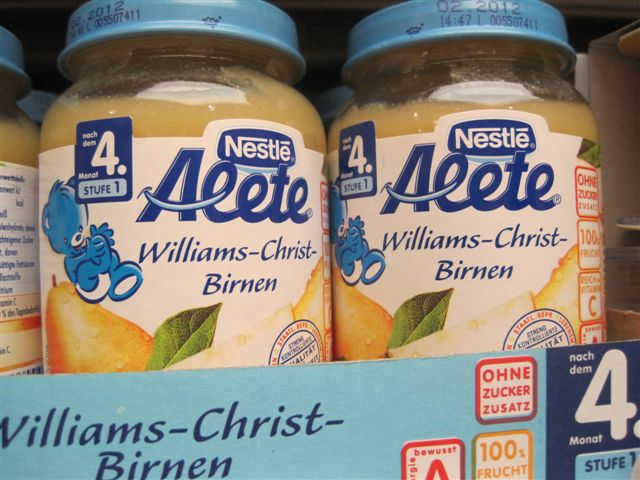
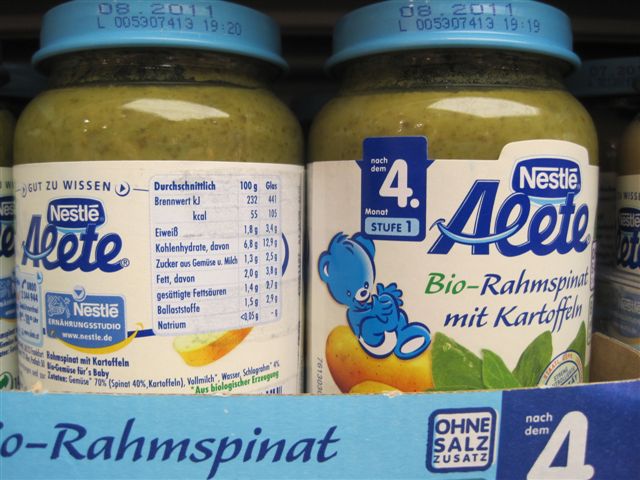
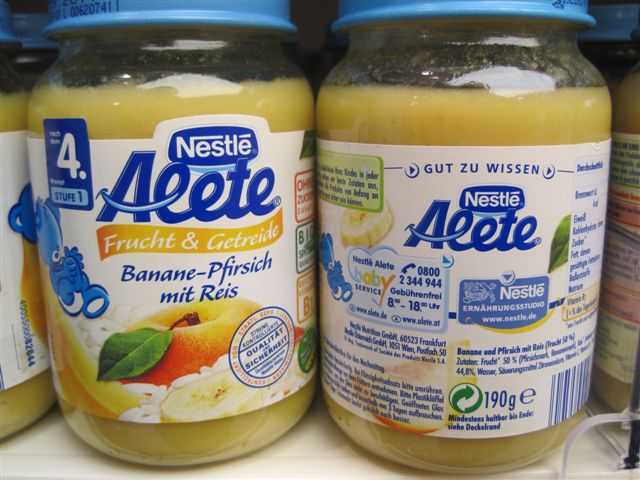
Today I was shopping at one of the largest dm Drogeriemarkt stores in Berlin. They have a huge baby food section, which includes a huge selection of Nestle Alete baby food. Most of the food (not just some of it, not just an exception, not just old stock, not just starter cereal even) was labelled as being appropriate to start at 4 months of age.
The food labeled as appropriate after 4 months included:
carrots and potatoes

Combinations of beef, carrot potato or pork, parsnips and potato.

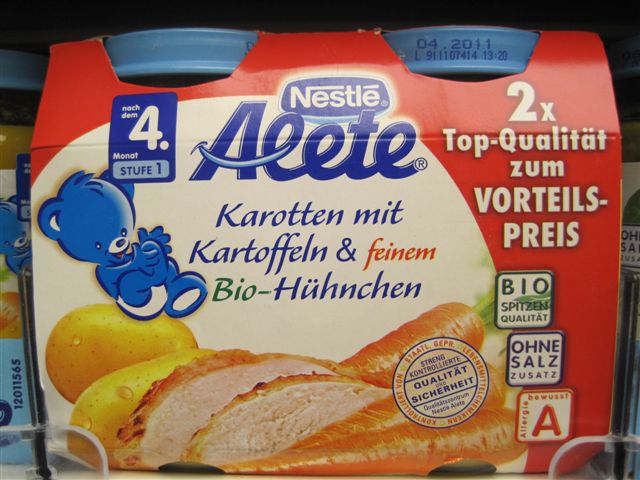
Pears
Creamed spinach with potatoes (which includes whole milk as an ingredient)
Bananas, peaches and rice
Garden fruits

Beyond the photographic evidence, Nestle Alete's German website clearly demonstrates that this isn't just a labeling issue. In its information for parents on infant nutrition, the page on Stage 1, starting after 4 months, includes the following introduction:
ORIGINAL GERMAN: Strampeln, Strecken, Greifen – je aktiver Ihr Baby wird, desto mehr Energie braucht es. Ihre Muttermilch bzw. das Fläschchen bleibt zwar erstmal Nahrungsgrundlage. Doch nach dem 4. Monat genügt das allmählich nicht mehr, um Ihr Kleines mit allem Nötigen zu versorgen. So rückt der große Moment näher: Das erste Löffelchen!
ENGLISH TRANSLATION: Kicking, stretching, grabbing - the more active your baby gets, the more energy he needs. Your breast milk or infant formula continues to provide the basic nutrition for your baby. But starting at 4 months, it is no longer sufficient to provide your little one with everything he needs. That means the big moment is approaching: The first spoonful!
The labels and the website information makes it 100% clear that in Germany Nestle has not completed label changes on complementary foods to follow the 6-months recommendation or done anything else to demonstrate its support of the this recommendation. In fact, they continue to tell women that breastmilk is no longer sufficient after 4 months of age.
Not only does this show that they clearly do not support the WHO resolution changing the duration of exclusive breastfeeding to 6 months (despite their claim that they do), but it also calls into question whether you can believe anything else that they say. If they would and have lied about something that can be so easily verified by walking into any store selling Nestle baby food in Germany, what wouldn't they lie about?




Reader Comments (74)
Wow.
I think my head exploded when I read this part: "But starting at the 4th month, it is no longer sufficient to provide your little one with everything he needs."
On their website it states from 6 months...but on the shelves of Tesco in the UK Cerelac is labelled from 4 months.
I agree.
Annie - what can we do to help?
"it is no longer sufficient to provide your little one with everything he needs"??? Unbelievable. Just wrong.
http://www.phdinparenting.com/2009/10/09/nestle-answers-help-rejuvenate-the-boycott-they-wish-ended-25-years-ago/" rel="nofollow">Boycott Nestle. Tell your friends and family to boycott Nestle.
Lobby the government to endorse and enforce the WHO International Code on the Marketing of Breast-Milk Substitutes.
http://www.phdinparenting.com/2010/02/22/how-to-report-unethical-promotion-of-formula-bottles-and-other-breastmilk-substitutes/" rel="nofollow">Report violations of the WHO International Code on the Marketing of Breast-Milk Substitutes.
Holy cow, well done inspector. So disturbing, breast milk not sufficient? Man, its like they are looking for a fight there. Wonder what the other international sites purport.
Have you seen this?
Baby Cereals Stracciatella
http://www.nestlebaby.com/ch-de/baby_nutrition/products/product_detail.htm?stage=-1&r=395&pci=5
"perfekt an die Bedürfnisse Ihres Babys angepasst"
"perfectly adjusted to your baby's needs"
With chocolate flakes!
Karin: I've seen similar things (and actually took a photo of one from Hipp the other day) and may post about that soon (collecting more stuff). Your link doesn't load properly for me, but I will seek it out when I write about chocolate baby food.
For those of you who can read German, you might want to read this:
http://www.afs-stillen.de/upload/pdf/Stellungnahme_zum_Thema_Optimaler_Zeitpunkt_Beikosteinfuehrung.pdf
Some recent studies claimed that breastfeeding for more than four months does not prevent allergies. So some people (guess who) concluded that breastfeeding after 4 months is useless.
Thanks for the link Karin. I hope to do a post about breastfeeding in Germany at some point and that post is useful information. If you have a source for good breastfeeding stats (more detail than the little bit in that article), I'd love to get my hands on it.
German speaker here - actually, the labels say "after the 4th month", so technically at 5 months of age.
Does not make it any better, but just making sure your translation is correct.
You're right. Somehow it seems odd though. It would make more sense to say "Ab dem 5. Monat" instead of "nach dem 4. Monat" if they really wanted you to wait to the 5th, don't you think? I think people focus in on the 4 and think 4th month. I'll revise the text of the post though to ensure it is accurate.
The fourth month? Don't they just spit food out until 6-8 months?
I'm unclear on how this would even work.
Actually, thinking about it again.
1st month = birth to 1 month of age
2nd month = 1 month to 2 months of age
3rd month = 2 months of age to 3 months of age
4th month = 3 months of age to 4 months of age
After the 4th month = 4 months of age +
So I think that "Nach dem 4. Monat" does mean starting at 4 months of age because the "4th month" is, in fact, done by then.
Not if you lean them back and ram it down their throats. I was started on pablum when I was 6 weeks old, as were most babies in those days. There are pics of my being spoon fed in a reclined position on my grandmother's lap before I had even reached 2 months. We know better now. But the baby food companies wish we didn't.
Here you are. :-)
http://www.geburtskanal.de/StillenVerbindet_VivianWeigert.pdf
http://www.bmg.bund.de/cln_151/nn_1168248/SharedDocs/Downloads/DE/Standardartikel/K/Glossar-Kindergesundheit/KIGGS-Studie,templateId=raw,property=publicationFile.pdf/KIGGS-Studie.pdf S.95
http://www.bdl-stillen.de/aktuelles/medizinuw/stilldauer05.htm
Thanks Karin!
You're right here.
Considering that all other baby food containers state "ab 6.Monat", "ab 8.Monat", and so on, I'm absolutely positive that they WANT Moms to think it's "AB 4.Monat".
Oh here even after at least 8 years of offical advice of no solids before 6 months, it's still very common to get 6/8 week olds on rusks (sometimes in a bottle) and rice. "Did them no harm" apparently.
Also recently there's a trend to package baby cereals in a similar way to formula.
http://www.aptamil.co.uk/products/article/aptamil-creamy-porridge from 4 months! I wish someone would put their foot down (wishes lib dems get in government, they promised they would stop this).
I think you're right about the suggestive nature of after the 4th month - yet I always thought that at least the German branding was "after the 4th month" which is better than the British "from the 4th month".
In the UK this is general branding, not just Nestle.
I agree it would be clearer to say from the 5th month, but I did notice the difference in starting dates when going between UK and Germany and commended German branding for being at least somewhat later than the UK branding.
Yeah, that made me say "WHAAAAA???"
Tell that to my youngest son, who nursed exclusively til 16 months.
When I started having kids, I learned little by little that the capitalist world is full of things marketed to us as helpful or necessary to childrearing that are in fact completely unnecessary and often counterproductive (or even dangerous). These include the enema and genital shave while in labor; baby bottles, formula, and baby food; and equipment like walkers and rockers...My babies were born when their father was a soldier. The advice given by women I met on U.S. Army posts was to start mixing baby cereals and other foods into formula and feeding it with the bottle at 4 to 6 weeks! Reasons? "It will make the baby sleep through the night;" "If the baby cries between feedings it means it is still hungry after nursing;" "It will put the baby in the top percentiles at well-baby exams." Of course, this is force-feeding and is generally regarded as too cruel even for geese. In the end none of my babies ever used bottles or pacifiers, nor did I buy baby food. Well, no--in the end, I taught all four at home, because I decided school falls into the same category--so do be careful how you follow your logic...
I know I do not believe a word they say. I know after seeing the advertisement and the formula in the grocery store in Ethiopia I have had zero respect for Nestle as a company. I will not buy their products. I was so astonished at what I saw. I was also pretty upset that the formula they offer there is not even as good of a quality of what they offer here. I mean really to offer the stuff that does not even pass the FDA is even worse than just selling their formula. They really are a scrupulous company.
And to think that here in the USA, Nestle is the formula they give at the WIC offices!!
Nestle clearly can't be trusted. Not even a little bit. :(
this is unacceptable is all about the money they can make while We start to believe what this companies wants us to believe! Please moms wake up
Unbelievable. Nestle is a vomitious company.
ENGLISH TRANSLATION: Kicking, stretching, grabbing – the more active your baby gets, the more energy he needs. Your breast milk or infant formula continues to provide the basic nutrition for your baby. But starting at 4 months, it is no longer sufficient to provide your little one with everything he needs. That means the big moment is approaching: The first spoonful!
OH MY GOSH!!!!!!!!!!!!!! I AM FLOORED! NESTLE SHOULD BE JAILED this is SICK....WRONG WRONG WRONG WRONG WRONG!!! GAH!!!
Stretching??? are you kidding me nestle???
My daughter is 10 months old and has NEVER had a single ounce of "babyfood" nor mashed or pureed home "babyfood", she is exclusively nursed, and is a chunky perfect healthy girl (95th%), NEVER an inkling of illness and is non vaccinated...."basic nutrition" my ass...how about COMPLETE NUTRITION!!!! What the heck does Nestle know about nutrition!!!!
I don't think I buy anything Nestle anyway but I will be sure from now on to make 100% sure I don't.
Thank you PHDip
I'm considering boycotting retailers who carry nestle products, and letting them know why. It makes me sick and the only weapons we have are information and money.
OH. MY. GOD! So does this mean German babies are totally different from Canadian and American babies? What a load of crap! I can't believe they can get away with this. I mean I can, let's face it, it's Nestle, but, how can they get away with following a complete separate set of guidelines (their own perhaps?) just because it's Germany?
I want to do this too! We just moved and in desperation, I went to the closest grocery store to re-stock our fridge, and I have never seen so many Nestle products in one place in my entire life! I need to find a new store, but we don't know the area well. I wanted to buy chocolate chips and the choices were Nestle or the store's brand. Nothing else. How is that even possible?
But they say they completed label changes worldwide to reflect the 6 month recommendation...guess not.
I raised that issue (not just retailers, but also the media) in my post called http://www.phdinparenting.com/2009/09/14/are-we-asking-the-wrong-people-to-comply-with-the-international-code-of-marketing-of-breast-milk-substitutes/" rel="nofollow">Are we asking the wrong people to comply with the International Code of Marketing of Breast-milk Substitutes?
Another German speaker here...I totally agree with the weasly-ness and nastiness of Nestle, but they do say "allmählich" which is "slowly", so they could try to hide behind that.
Not that that changes anything about their deceitfulness.
Yeah, but even "allmählich" insufficient is only true as of 6 months and beyond. At 4 months it shouldn't even be a consideration and not worth a mention.
They are totally trying to trick people into starting at 4 months. They think they can get away with the "after", but what jumps out at you is the big Nr. 4.
cartside:
There are a lot of other companies here marketing things for 4 months and up too. I think it is awful. But at least they aren't lying about it and telling people that they implemented a worldwide change to their labels to reflect the 6 month recommendation.
Nestle's business practices suck...and then it lies about them to boot.
It depends on where you live. Every state (maybe even every county) has their own deal with the formula companies through WIC. Where I live, it's Nestle, but in other places it is Similac or Enfamil.
Yes...there are several devils in this game.
I think I wondered over here by accident; what you describe seems to be a case of a company acting within the law of the county where it operates. Have you checked to see what the German authorities regulate in this concern? Why is this Nestles problem? Surely it is up to the German government to set the rules, or have I misunderstood. I have visited Germany, and I know they have low tolerance for rule breaking.
PZ:
The World Health Organization and the health authorities in many countries recommend that infants should be fed nothing but breastmilk (or as an alternative, infant formula) until they reach 6 months of age. The World Health Organization's International Code of Marketing of Breast-Milk Substitutes, says that no complementary foods (e.g. baby cereals, baby foods, etc.) should be marketed for infants under 6 months of age. Some countries regulate this, others do not, but it is the accepted worldwide recommendation for infant feeding.
The German authorities do not regulate this issue. I wish they would. So Nestle is not breaking a law in Germany, it is just going against the advice of the most respected authorities on infant feeding in the world. However, what Nestle is doing is lying about its business practices. That is the key point I was trying to make in this post. Nestle has said that it supports the WHO's International Code of Marketing of Breast-Milk Substitutes and that it has changed the label's on its baby food products worldwide to reflect the 6 month recommendation. Apparently, that is not the case, since its German products and German websites still say 4 months. Not only is Nestle not falling in line with international guidelines, but it is also lying about it.
Marketing first foods as suitable from 4 months is pretty much standard for all the big name brands in the UK - Heinz does it for eg. Boycotts should be consistent in my view if you are going to do them. There is no point focusing only on Nestle which just leaves all the other companies free to carry on with the same practices without any attention on them. The others have been able to get away without being questioned for a long time.
this is absolutely disgusting. i hadn't previously realized how terrible Nestle actually is. i'm ready to boycott now.
Thanks for the links. I came here today via a tweet so havent had a chance to go through your archives.
The closest you can get to official rules in baby feeding is this:
http://www.fke-do.de/content.php?seite=seiten/inhalt.php&details=60
Note that it says "breastfeeding as long as mother and child wish" in the upper part of the diagram. This has only been inserted a few years ago thanks to the AFS (www.afs-stillen.de). Until then breastfeeding ended at the 1st birthday.
I never have bought Nestle's baby food here in Canada (and never plan to) but I decided to look at the labelling at the grocery store today, just to see how it reads. Yes, the stage 1 labels state 6 months + but then why do they have "N" labels for new beginners? While they are "technically" not advocating starting before 6 months, it is obvious they are pushing the "N" for before 6 months. Especially when their Canadian website has introducing cereal between months 4 - 5:
http://www.nestle-baby.ca/en/baby/4-5months/feeding_baby/Introducing_cereal.htm (which I'm sure you have seen before).
What a crappy company!
Rae: Yeah. They are purposely vague on that starter food in Canada. I also http://www.phdinparenting.com/2009/10/09/nestle-answers-introducing-solids-maybe-kind-of-sort-of-at-6-months/" rel="nofollow">examined their Canada and US websites when I first wrote about this issue.
I would love to boycott all the grocery stores that carry Nestle but unfortunately ALL of our grocery stores carry Nestle products and I just cannot drive over an hour to grocery shop. But I will not buy their products.
Wow you really just have too much time on your hands if your goal in life is to bring Nestle down. I think you just need to find a new hobby. Good for you on breastfeeding your kid until they graduate college, why do you feel the need to knock everyone else down? Feed your children the way you want to and let others feed the way they want to.
Betty Boop:
My goals in life are many, but a lot of them focus around social justice. Part of that includes corporate social responsibility and ensuring that companies act in an ethical manner. Continuing to try to find ways to convince moms that they cannot breastfeed, that they should give up, that they need to supplement, or that they need to start giving other foods earlier than recommended by the leading health authorities in the world, AND THEN LYING ABOUT IT, is extremely unethical.
This isn't about how I feed my child or how anyone else feed's their child. It is about ensuring that companies like Nestle do not deceive and lie to mothers.