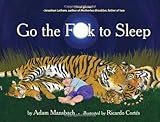










Last weekend when we were shopping at Chapters, the book “Go The F**k To Sleep” by Adam Mansbach caught my eye. I hadn’t heard about it until that moment and I was curious what it was all about. I picked it up and leafed through it, giggling a bit at some of the bedtime scenarios that were all too familiar. If you haven’t seen the book yet, you can watch this video of it being read by Samuel L. Jackson (the story starts at about 1:00 if you want to skip the intro).
All parents have been there, right? We’ve all had those times when we wished, for once, that our baby, toddler or older child would just go to sleep already. We’ve all had those evenings where we are desperate for some alone time, where we have something we need to do after the kids are in bed, or where we are just EXHAUSTED and want to go to sleep ourselves.
Everyone has thought it at one time or another, with or without the profanity. So I giggled, because I’ve been there, just like you have. However, it left me feeling a bit uneasy.
I work in a city and I like to walk on my lunch hour. Sometimes I walk along busy sidewalks. Sometimes I walk in the mall. Sometimes I cut through stores. When I am walking, my goal is to keep moving at a decent pace. Inevitably, I will end up stuck behind people who are not walking as fast as I am and who do not get out of my way. Some of those people are clueless, i.e. they are chatting with their friend and are completely oblivious to the fact that I want to pass them. Some people notice that I want to pass and just can’t be bothered getting out of the way. But there are also people who are in my way because they are in a wheelchair or using a walker, because they are elderly, because they are obese, because they have one of those huge strollers, or simply because their legs are shorter than mine.
So, I could probably write a book called “Get the F**k Out of My Way.” Maybe it would be funny when relating it to the scenarios where some jerk just can’t be bothered getting out of my way. Perhaps it would even be funny when talking about the people who are just clueless that I’m trying to pass them. But would it be funny if I was directing my “Get the F**k Out of My Way” to someone who is disabled, obese, elderly or vertically challenged? Not really.
Through the eyes of parents alone, “Go the F**k to Sleep” may be funny, just as “Get the F**k Out of My Way” would be funny if you were considering only my view point and not the viewpoint or limitations of those I was directing it at. In most cases, I don’t think our children are staying awake at night specifically to annoy us. Perhaps there may be the odd occasion where an older child is purposely trying to disrupt the parents’ plans, but for the most part, I don’t think that a non-sleeping child realizes that they are ruining your evening or keeping you from sleeping. They are thinking that they want to cuddle with you, that they are not tired, that they are thirsty, that they are scared, that they are lonely, or that they just don’t want to sleep.
Some of those are needs, others are wants, but none of them are maliciously intended actions that deserve a response such as “Go The F**k To Sleep,” even if we are sometimes thinking that on the inside.
So yes, I giggled a bit, but I didn’t feel great about it and I wouldn’t say that I endorse the book’s message any more than I would endorse a comedian who made inappropriate jokes.
“Please stay to the right.”
“Please close your eyes.”
Those are, I think, more reasonable requests, even for our inside voices, than “[blank] the f**k [anything].” Both for our own sanity and frame of mind and out of respect for the person those words and thoughts are directed at, even when they are annoying us.




{ 199 comments… read them below or add one }
Thank you for this Annie. I’m not easily offended, but something about this book made me uneasy too. I wondered if I was just being overly sensitive but I think you’ve hit the nail on the head for me.
I agree, there’s an uneasy feeling about it. Funny for a few seconds, but not something you would want to read or expose to yourself repeatedly. I try not to expose myself to negative things, and so I probably won’t buy it even though I thought it was funny at first.
But “please close your eyes” wouldn’t sell books.
I’d say I’m on the same page. I did giggle reading it too – especially the “I’ve failed as a parent” line. Taken as something a parent might say in the heat of the moment it’s definitely a “been there” type book. But yeah, I’d have to say I’m on the fence about whether it’s really funny or not. And I can honestly say I’ve never said that to or about my children. Although “Please Go To Sleep” has happened a lot
I actually found the book to be absolutely hilarious and laughed my way through the entire thing. I completely related with the frustration and in fact it reminded me of the night my son refused to sleep because we could not find his blue pacifer. We looked all over the house for over an hour and still could not find it.
I think it is good talk about the times that we are frustrated as parents because all to often the vocalization of any kind of frustration is read as a person being a bad parent. You can’t lose your temper, and you certainly cannot yell and yet we know that we all lose it sometimes. I think this would have bothered me more if parents were actively saying go the fuck to sleep but in this case, it is more a story of his inner monologue, or at least that is how I read it. Parents are human and sometimes like everyone else we may think unkind things but we don’t say them.
I agree Renee- there’s a difference between saying to a child, “Go the f**k to sleep” and reading a book with that title. We get frustrated. It happens as human beings and parents. I think that channeling the frustration by reading a funny parody of a children’s book and laughing at it is a relatively healthy way of dealing. And as the mother of three children who do. not. want. to. sleep. ever. it was great to see the book and think, “Yes! I’m not the only one who gets frustrated by my kids’ (lack of) sleep habits.” While I would never actually curse at my kids when I want them to sleep- because I understand that they are little ones who depend on me to meet their needs- my inner monologue is often vastly different from what I say out loud.
Renee:
I agree with what you have said. Perhaps the issue for me is that the “unkind things” were said in this particular case (and published too)?
I agree with both Annie’s post and with Renee’s comment. The first time I read through the book, I was shocked. I can’t really put into words why it left me feeling disturbed, but it’s something to do with the dehumanizing of children that sometimes happens among adults.
The second time, I remembered all of those awful nights of Kieran not sleeping, or rather falling asleep and then not letting me move an inch. Nighttime parenting brought out some of the worst in me, and so the second time I read it (weeks later), I did laugh, because damn it, that’s exactly what was running through my head. Just go the f*ck to sleep, kid – let me have a minute to myself!!
I’m still on the fence about it. Yes, I agree that it’s important for parents to share the frustrations of parenting and get some of those feelings out of our systems in a healthy way (and laughter is healthy!). But I can’t whole-heartedly get behind a book that just reinforces the concept that kids should automatically obey, and if they don’t, obviously it’s because they’re “misbehaving” (even if it’s not what the author intended) .
I haven’t read this book either, but it did make me feel uneasy. I admit that all books that have the F*ck in the title make me uneasy. Maybe they could’ve come up with a better title?
i also had a similar feeling..laughing along at first then feeling kind of nauseous..you are right we have all been there..but i can’t imagine buying a copy, for what? to read to my child?!
by the way, i was being sarcastic..of course i know it’s not meant to be read to a child
i listed to it this week a few times with my husband and laughed and laughed. it’s not for kids. it’s for parents. i appreciated it because i’ve been there–at least in my inner monologue. there is a reason sleep deprivation is torture!
I agree–this book is for parents, not for children. I think it’s hilarious. Of course kids (most of the time) aren’t staying up to make us angry or to purposely do something wrong; nonetheless, by the end of the day it’s hard to have patience or empathy. I think any parent who is being honest can relate to that, even if they wouldn’t use the terminology used in this book.
I’ll start off by saying that I tend to agree with about everything posted on this blog…
BUT…
In this case, although I whole-heartedly understand your logic, I disagree because I believe that it is implied that parents DO in fact understand that their child isn’t staying awake solely and simply to annoy us (parents). The book isn’t about the child, or even for a child (I hope, haha), but instead is a humorous piece geared toward making parent’s laugh. And I think it does the job (as you stated too). It’s OKAY if some parents don’t laugh, because humor is subjective and we don’t all think the same things are funny.
So, I think if anybody (or you) is to object to the book, it should simply be about the heavy use of foul language!
Anyway, sorry to disagree, I still love your work!!!!
Abby:
I actually don’t have a big problem with foul language. It is the attitude behind it that bothered me more.
If my kids want to say that something is “f*cking hilarious”, I would be okay with that (although I also try to teach them that others may find it offensive). However if they tell someone to “Go f*ck yourself” I would have a problem with that.
But the f*ck in this case is directed at the situation…not as an adjective describing the children. If the author had said, “Will you f*ing children go to sleep?”, I would follow your logic better.
Instead, I see a parent who has done everything, everything…and is just fed-up with the situation, not the child.
It is Greek theater-style catharsis for modern parents and…yes…hilarious.
Candance, The father is angrily insistent that the toddler go to sleep, placing the child in an impossible circumstance. None of us can go to sleep, immediately, by edict. A child cannot make a nuanced discrimination here about why the father is angry.
The father is failing to empathize with his child — to see things as they are from the toddler’s point-of-view. The book is black humor that has crossed a line, making it very much deserving of condemnation, IMHO.
I don’t believe anyone is proposing the book be read to a toddler…or a young child. Presumably by the time anyone reads this book, he or she is able to understand the nuance.
The father is not failing to empathize because he is not actually telling any real life toddler, or advocating anyone tell any real life toddler, to “Go the F*ck to Sleep”. It is a book for adults to laugh at their own frustrations. The laughter stems, if anything, from the very recognition that expecting a child to do anything on your schedule is unrealistic.
You can argue that it damages the dialogue about respectfully addressing a child’s needs…but the idea that this is not a parody of children’s bedtime books but is an actual bedtime book itself…or that any responsible parent would mistake it for such…is just not supported by the book, its marketing, or the discussion here.
Candace, I fully acknowledge in my earlier comment, and here again, that the book is ‘black humor.’ My concern it what effect it has on many parents who read the book and make acceptable, in their own minds, a line of thinking that they needn’t be empathetic with their children.
There’s a very short Philosophy Bites podcast with an expert on humor, found here http://philosophybites.libsyn.com/noel-carroll-on-humour that touches on the revulsion that we ought to have when our humor targets innocents. Parents should see their role as one of widening their sense of compassion and escaping the immature impulse to be selfish.
I know children are a handful. But parents are tasked with the responsibility of being adults.
Acknowledging it is “black humor” is not the same as acknowledging that it is not for children…when you say that a child cannot parse the nuances here, you are implying that my comment means that a child would need to do so.
While I accept that “desensitization” is a valid concept and topic to address in this discussion, I still argue that in this case the book is more rightly followed under “catharsis”. The book helps us release the miasma by watching someone else express the emotions in a safe way (ie, a fictional parent in a parody of a bedtime story).
Since we, as adults, can parse the difference between cursing *at* our children and cursing a frustrating situation, it is not at all encouraging abusive behavior. Rather, it is making light of our own *unexpressed* frustrations, as adults…it is not making light of verbal aggression towards children.
The message isn’t “kids are obnoxious sometimes” but rather “parents get frustrated sometimes”.
And that’s okay…as long as your reaction to your frustration is to release it in a safe way…amongst other adults.
Note that throughout the book the adult continues to use loving forms of address when describing the child.
And note that he continues to model, even in this fictional work aimed at adults, almost saintly nighttime parenting–he’s getting that upteenth glass of water, tucking the child in again, and still addressing the child with various terms of endearment.
Yes, he does start to break down a little towards the end…but still the fictional parent is remaining patient in his behavior towards the child.
This book is many times removed from actually being aggressive towards children since the fictional father in the book, intended for adult eyes only, is not even directing his more negative words *at* the fictional child.
Yes. how you frame a situation does affect how you view it and ultimately how you act…but sometimes a cigar is just a cigar and sometimes a funny book for adults is just a funny book for adults that allows them to laugh *at themselves*.
Candace, Thank you for the excellent expression of your view of the book in the comment immediately above this one. It gives me things to think about.
I do now think that in the vast majority of cases the book will be non-harmful, and even helpful, to young couples bearing the often-flustering task of tending to a needy toddler. But in a perfect world where I am the Absolute Dictator, I would still want all copies of the book to be stacked high and set ablaze!
IMHO, parents should not have a separate place, apart from their children, where they nurture their gripes about the little monsters. Parents should both want to be authentic with their kids and have their empathy always switched ON. From this will flow a beautiful parent-child relationship that can withstand the trauma of the toddler growing up to be a — gulp — teenager!!
This from The Science of Evil [ http://www.amazon.com/Science-Evil-Empathy-Origins-Cruelty/dp/0465023533/ ]: “When our empathy is switched off, we are solely in the “I” mode. In such a state we relate only to things or to people as if they were just things. Most of us are capable of doing this occasionally. We might be quite capable of focusing on our work without sparing a thought for the homeless person outside our office. But whether we are in this state transiently or permanently, there is no ‘thou’ visible – at least, not a thou with different thoughts and feelings. Treating other people as if they were just objects is one of the worst things you can do to another human being, to ignore their subjectivity, their thoughts and feelings.”
I do understand that GTFTS is *just* a fictional story — but you are right to believe that parents will take it personally. And THAT is the problem. To my mind, many bad parents are likely to see the book as ‘cultural permission’ to objectify their children.
Again, recognizing the validity of your idea, in general, I just don’t believe it is applicable here. Nothing in the book objectifies children or portrays them as little monsters or diminishes their needs as people…it is about laughing at ourselves, not others.
We can only agree to disagree at this point. To me it is obvious that everything in the book objectifies children. It is a Pollack joke or a Spic joke or a Wetback joke using humor to target people.
Toddlers are especially vulnerable to being murdered by their parents. Or, being savagely beaten up. That happens every day. The culture we are in shapes our reactions to things. Most parents, certainly, are perspicacious and ego restrained enough not to ‘lose it’ such that do something horrible and stupid, but many other parents walk a thin line.
We live in a world that, happily, is much less tolerant than it used to be in allowing attacks on blacks and Poles and Gays and the disabled. I am confounded. What in the world are we doing making room for the retched GTFTS in our culture? WTF!?
I don’t disagree with anything you say about parenting–only about the book. And you point to nothing textually in the book to convince me that this book does any of the things you say it does. You say it is “obvious” but offer no actual support.
You only make points about what happens when we do not recognize the humanity of children and that this could be done under the guise of “humor”, points with which I agree. But you may no arguments about how this *specific* book contributes to these things.
Laughter directed at others has the potential to be dehumanizing and cruel, no doubt…but this laughter is directed *inward* and you’ve provided no support to contradict this point.
I believe very strongly in gentle, respectful parenting techniques and have practiced these with three lovely children, one of which was (and to some extent still is) a very “high needs” child. I don’t see anything in this book, as it is intended or received, that negates these ideas.
If anything, it reinforces through its absurdity the idea that OF COURSE we do not express those sorts of frustrations to or at our children. The profanity takes it over the top so that parents recognize how ridiculous it is to blame the child.
This book is for the very parents who use gentle parenting–because they are the ones who have gotten up for the umpteenth time, checked the bed for monsters, refilled the water glass, etc. A person who uses “CIO” or otherwise refuse to engage their children during the nighttime would not recognize the scenario and therefore find it less amusing.
If a book actually made light of verbal violence towards children, I would share your feelings.
Interesting comparisons. My first reaction, though, was laughter, so I had to really think about why I laughed. I tend to think parents find the book funny because it speaks to darker impulses that we often repress, and that the laughter is almost a sort of release that comes with confirmation that we aren’t alone in sometimes feeling this way.
Yes, our children deserve sympathetic responses, but that doesn’t mean they’re always easy to offer. And there is a big difference between laughing at the book and actually laughing at our children.
Here’s what I posted this morning:
http://stlouissmartmama.blogspot.com/2011/06/go-f-to-sleep-my-thoughts-part-1.html
Agreed. I found the book and its rampant popularity profoundly reassuring. Most nights I feel like a miserable failure. This made me feel much less lonely about sleep stuff. (I breastfed, coslept/sleep, yes, yes, but I am only human )
I’m a little surprised to hear a blogger uncomfortable with the idea of a parent saying out loud the things that parents often think on the inside. It’s kind of what we do around here. And we save each other when we do it.
Comedians who make inappropriate jokes have also saved me from time to time.
I vote funny.
mom101:
I can think of other scenarios where I thought it was inappropriate, such as that post where the mom said that she loved her son more than her daughter and if one of them had to die the choice would be really easy.
I think that there is a way to say things out loud while also being respectful towards our children. There are certainly things that I do not share because I don’t think it would be fair to them, that includes things that they might consider private as well as things that could be hurtful.
I’m not advocating that the book should be banned and I did find it funny, but I also have reservations about it as I expressed in this post.
You know I love you Annie, and you are entitled to feel uncomfortable with the book, but I have to disagree with the implication that an adult book that satirizes children’s bedtime books is hurting any children.
The Sophie’s Choice post isn’t an apt analogy. A better analogy is any mom blog post in which we write, “oh my God, does this kid ever SLEEP? Kill me now.” And then someone else responds, “I tried everything. My last straw: duct tape.”
I could name about 100 of those.
mom101:
I wasn’t intending the Sophie’s Choice post as an analogy. I just mentioned it as an example of a situation where a blogger could be “uncomfortable with the idea of a parent saying out loud the things that parents often think on the inside.”
I laughed my ass off. I thought it was hilarious.
I think everyone I know has sent me a link to that book or commented to me about it. I have a child who doesn’t sleep well so it’s a sentiment I can certainly relate to.
I’m not a big fan of “F*ck” either – I certainly say it (in appropriate company) but I tend not to use it in my posts – but I do think it implies an understanding of/commiseration for a particular situation.
I actually haven’t even read it or listened to it – probably because I assumed everything I needed to know about it was in the title. But I can tell you that if this had been around 3 years ago I certainly would have appreciated it. Call me naive, but I really had no idea how tough it was to get kids to sleep sometimes. This might have helped me feel less alone.
My son will probably grow up knowing he tormented us with sleep – not in a blaming way, or a “you were bad” way, but we’re bound to tease him a little bit. I trust that when he’s old enough to understand that, he’ll be old enough to know that babies are hard and not sleeping was one of the hardest parts for us so I certainly wouldn’t think he’d be offended by the concept of a book like this.
As someone who suffered from postpartum depression, I think it’s really important to be able to acknowledge that sometimes we say or think or do things with our kids that wouldn’t be our first choice, and that it doesn’t make us bad parents.
That doesn’t necessarily mean this exact format is the way to do it, just pointing out an argument for the positive side of this.
I absolutely agree that we sometimes say or do things as parents, whether we have postpartum depression or not, that wouldn’t be our first choice and that it doesn’t make us bad parents.
I think it’s hilarious, I would never read it to my child but I’m going to play it for my husband later. He will laugh uproariously. The fact that Samuel L jackson reads it makes it even funnier. How many times has every parent been there? It’s probably a good idea to cultivate a sense of humor and not take everything so seriously. Some things are meant to be light-hearted, irreverent and perverse.
I loved it. Absolutely loved it, because you know what? I’ve said those things in my head countless times, and it was encouraging to know that I wasn’t a terrible mother, I wasn’t alone in thinking those things, I’m just a human being who wants my kids to go to sleep. Of course it’s not a book for children nor a book that I would buy, but I find it wildly hilarious as a joke between understanding adults – not as something anyone would actually say to their child.
I find it frustrating that in the AP world, mothers are discouraged from voicing these inner thoughts (to each other, not to their children!). Things aren’t always sunshine and rainbows, and it’s validating to have someone outright say what so many of us are thinking.
Cynthia:
I’ve been on a lot of attachment parenting message boards, facebook pages, twitter discussions and more where parents do openly share their inner thoughts and frustrations. Although I laughed at this book, I do think there are other ways to express the frustration that are perhaps better.
That said, comic relief is certainly useful as a parent. I just wonder if there isn’t a way to do that while not simultaneously being rude.
Annie, I also love your blog and can appreciate your point of view about this book, but your analysis here just isn’t reflecting what many (most?) parents experienced reading this book. I loved it. It was hilarious. Every parent I have spoken with IRL has loved it (and most are *strongly* AP). If you think there are better ways to express the frustration, then I want to challenge you to write something that is as funny as this book and meets your criteria for respect.
This book isn’t for or about kids; it’s for and about parents. It’s as selfish as a bubble bath behind a locked door. That’s fine with me. It makes it easier for me to stay in the game and act as I intend to as a parent. I’m actually somewhat uneasy with (offended by?) the idea that we should immediately question ourselves and feel guilty about blunt expressions of common thoughts and relatively small indulgences, like enjoying a funny book. Sometimes I don’t need to soul search, I need to fucking laugh.
Lisa:
I don’t expect my analysis to reflect what many (most) parents experienced reading this book. I don’t think that makes my opinion less valid though.
I also don’t think that others should immediately question themselves or feel guilty. I was just trying to understand and explain why the book made me feel uneasy.
I understand that your analysis is your own, and completely understand your reasoning, but when you concluded:
“Please stay to the right.”
“Please close your eyes.”
Those are, I think, more reasonable requests, even for our inside voices, than ‘[blank] the f**k [anything].’ Both for our own sanity and frame of mind and out of respect for the person those words and thoughts are directed at, even when they are annoying us.”
In using “our inside voices” and “our own sanity” etc, I felt that you were excoriating those who found this book to be very funny and not at all offensive to somehow do better, rise above, keep ourselves pure of thought, take the high road. I’m really chafing at that conclusion. It crosses over from what *you* as a mom choose to do into prescribing what *we* as “good parents” should do. I wish you had used singular pronouns instead of plural.
I’d still like to see a good, funny satire that speaks to parental frustrations but is adequately respectful of the children.
“I’m really chafing at that conclusion. It crosses over from what *you* as a mom choose to do into prescribing what *we* as “good parents” should do. I wish you had used singular pronouns instead of plural.”
That is a very fair point Lisa. I probably should have used singular pronouns.
I know that for me, anger escalates. If I get angry at a situation, then other things that annoy me are that much more likely to make me angry. With time, that anger builds up and I end up having completely inappropriately angry reactions and my blood pressure rises far beyond where it should be. So when I find myself in a situation that makes me angry, I need to find ways to deal with that anger, rather than letting it fester. If I start thinking “Go the f**k to sleep” or “Get the f**k out of my way” or “shut the f**k up”, then I am more likely to blow up at that person or at the next person who happens to get in my way.
Thanks; I appreciate your response.
Perhaps the difference for those of us who don’t find it offensive is that thinking these things (or even muttering them to ourselves) actually releases the anger instead of fueling it.
If you hasn’t heard about this book before last week, you are obviously not spending enough time on Facebook.
It has gotten lots of press including a big pre-publication push when some of it was leaked.
I think it is hilarious. I completely miss your point. Really. I just don’t get why this would be offensive to entirely unrelated classes of people who irritate you. This is about being free to bitch about your kids. I read it to my now teenage kids and they thought it was hysterical. We had a discussion about which one was the hardest to get to sleep and the fact that while I would never ever have said “Go the fuck to sleep” to them when they were babies or toddlers, I do it fairly regularly now. They totally get it.
My only reservation about this book (and I took some grief about it when we discussed this book on my FB Fan page last week) is that it seems to assume kids all sleep in cribs or otherwise separately from their parents. I asserted that kids who co-sleep are less likely to make you want to say “Go the fuck to sleep.” That was my experience – that past infancy they fell and stayed asleep more easily than kids who sleep in cribs. My kids absolutely never would sleep anywhere but next to me. I heard from lots of people who also co-sleep and still wanted to say “Go the fuck to sleep.” So I learned something. I still do think the book assumes crib sleeping but it strikes a chord in parents regardless of where their kids slept.
I don’t think this book is offensive, I think it is hilarious. And, despite its beautiful illustrations, it is obviously not a children’s book. It is parody.
Jake:
I’m not sure if I’ve misunderstood your comment or if you misunderstood my argument.
I don’t think this book would be offensive to entirely unrelated classes of people who irritate me. I think this book might be offensive to my children, in the same way that it would be offensive for me to say “get the f*ck out of my way” to someone who was making it impossible for me to pass them on the sidewalk.
Hmm. I may still be missing your point but the book isn’t intended for your kids and my now older kids thought it was hilarious. They enjoyed my dramatic reading but the Samuel L. Jackson reading left them rolling. Between Star Wars and the whole riff of YouTube videos parodying “Snakes on a Plane,” he is an icon to teen boys. Anything he says is gut-busting to them. So if my kids are any judge, kids of an appropriate age are not offended by it. They don’t view it as an expression of real hostility. They can laugh *with* and not view it as being laughed *at.*
I’m on the funny side of this one. I’m not offended. It’s obviously not for kids. It’s just a book that expresses how we’ve all felt. And I don’t think any of us think our babies or kids are being malicious in their intent.
As always, a well-written and thoughtful post. But nah. I’m not uneasy.
I was linked to this from an unschooling/natural learning attachment parenting super mum. And even she could see the funny side. I personally LMAO, no one would ever say that to their child but it totally appeals to your dark side as a parent, it can be soooo frustrating sometimes. I love the ending where mum is sleeping on the couch hehehe! Poor daddy so tired but still stuck with a not asleep kid.
I laughed my ass off when I first saw this shared on my FB page. I cosleep with a little one who goes to bed a couple of hours before we do and just hates to miss out on the fun, so whenever he realizes he’s nodding off, he bolts awake and does a few “butt dive-bombs” (as we call them) on me, and giggles uncontrollably. Then he either crawls off the bed (if he’s awake enough) or lies down and tosses in a seemingly neverending circle, stopping to nurse for a second or two as he passes the boob. I have definitely laughed and said, “Come on, kid, go the fuck to sleep! You’re tired, I’m tired, and while you’re funny now, we’re all gonna regret it if you stay up.” Yes, I swear in front of my one-year-old, all the time, and so far, I’m not sorry. There’s nothing all that unkind in the book, and having Jackson read the audio version was GENIUS. Perhaps I’d feel differently if we’d had very real sleep issues in our house (comparable to your account of disabled people getting in your way while walking) and not just a super-social kid who hates to wake up by himself if Mom and Dad are hanging out in the other room (more comparable to able-bodied people moseying along without thinking about the effect on others).
Melissa:
I’m not particularly anti-profanity, so that wasn’t my beef with the book. With regards to your statement: “Yes, I swear in front of my one-year-old, all the time, and so far, I’m not sorry,” my guess is that you will be sorry when he starts using those words inappropriately in public.
(Again, I’m not anti-profanity, but I’ve just seen the looks parents get when their 2 year old is swearing like a sailor!!)
No problem with looks! I’ll probably get them when my son decides he likes a pretty pink T-shirt, or tells his friends in kindergarten that there’s no Santa Claus (we may actually work on that one–not out to hurt anyone’s feelngs), or explains sex to his seven-year-old pals. Just because the rest of society feels that something is bad or that a certain gender, moral, or mythological standard must be enforced, that doesn’t mean that I have to enforce it in my relationship with my kid. And yeah, I’m probably going to regret that in a few areas, but I feel strongly that I should live my life honestly in front of my kid, not candy-coat it so that he “fits in” with what other children’s parents have laid on them. That include using all elements of my language that I feel are expressive.
Sorry–off-topic, I know, and also idealistic, but at the moment, that’s where we are on the swearing issue.
Melissa:
We work on balance when it comes to things like that. Room to be yourself, while also understanding the need to respect others. Neither is easy, both are important.
I think you probably already know my opinion, but no, I don’t think it’s at all offensive. We’ve all been there, done that, and the book injects some humor into a situation that does not at all feel funny in the moment. Parenting is hard, …the book isn’t intended as a read for children, it’s intended as a tongue-in-cheek commentary about a scenario all of us have experienced. When I had a baby shower in anticipation of my first baby, I received a card that had a picture of a baby with a bowl of spaghetti on her head, and the sentiment was something along the lines of “From now on, all your meals will be cold”… 11 years later, and I still chuckle at that card… it can bring a smile to my face in an otherwise not-at-all-funny situation — that’s the spirit of this book!
I thought the book was hilarious, and really enjoyed it. Renee summed up perfectly just how I feel about it
I personally think it’s hilarious. But, then again, my oldest (a co-sleeper, to boot) didn’t sleep longer than an hour and a half at a time until he was about 3.
I’ve been there, I just never thought to publish it as an adult humor book.
As parents, our sense of humor is often the only thing that gets us through the day — I vote “funny” and will be gifting this to friends who are expecting as a “you just WAIT!” sort of gift.
Hmm, I can’t help but feel like the point of the book is missed in this particular blog post and in most of its comments. It’s not just a parody- it’s cathartic. The extreme foul language, the attitude, the fact that Samuel L. Jackson (who can drop the f-bomb like no other) narrates juxtaposed with the illustrations and presentation of a children’s book that is often requested at night before sleeping, is what makes this book worth reading, sharing and eventually buying.
There are some cultural needs this book satisfies as well. One is the need to connect with others and be validated for being human. I horrify myself when I use the f-word in relation to a kid (in my head, only!!) It’s embarrassing, certainly not funny (at the time). This book is a reflection on those “it seems really bad now, but later it will be funny” moments, when you and your spouse joke, when the kids aren’t around, exaggerating your frustration just to get it out!
Also, I don’t feel like we should feel bad about being angry with our kids. Anger, like all emotions, serve a purpose. It’s anger that makes you hop on the internet to look for a better solution instead of living the same thing night after night. We shouldn’t take it out on our children, who have no idea what strife they are causing. If sucking it in until they are asleep and then letting my exact thoughts flow in front of my partner later successfully refreshes me, adds perspective and helps me move on, I consider it a triumph.
Annalisa:
I don’t think that we should feel bad about being angry with our kids. Emotions are normal and healthy. But we do have choices about how we react to those emotions. It sounds like you have made some good choices in terms of how to deal with your anger.
I completely agree with Annalisa.
Yeah, I’m also not really getting your point here. It’s satire for adults.
M:
I understand that it is satire for adults. There is plenty of offensive satire out there. This is certainly not among the worst of it. However, just because something is satire, doesn’t mean that anything goes.
OK – I think the writer of this post gets that it is an adult book and it isn’t meant for children. So let’s stop telling her it is meant for parents/adults only. Most of us get that & for those of you who really thought this might be a REAL children’s book – wow!
Now I think it is TOTALLY funny!!! I read it when a friend sent it to me by an email and LAUGHED!!! I have so many time thought this & have ranted about it. When my babies were small & couldn’t understand what I was saying I’d actually say it out loud. It was said all sweet and loving, but it was said. In my head I was thinking it more sinisterly, but wouldn’t say it that way. I have begged my kids to go to sleep, without the F word, but yes I’ve begged! My older child usually goes to sleep with no issues & the little one is off & on.
It is a fun take on what most parents think & feel & is just a release for pent up frustration. I can see if you put it into everyday thinking such as your example that it would make a person uncomfortable, but again I see the book more as funny play on words. But it is just a funny book! That’s all.
Count me as another “hilarious” vote.
I don’t use a lot of profanity, not even in my head. Yes, the language is a little strong, and I can understand that some people would find THAT offensive. But as a former non-sleeping child myself, I’m not bothered by the way that it pokes fun at kids and their antics. And as a parent who’s felt the bottled up frustration of seeing an entire evening disappear to a non-sleeping child, I appreciate the chance to blow off some steam.
I think there’s an important difference in your two examples. If someone suffers from a challenge that makes them permanently incapable of complying with your demand, and you’re rude about it, it’s discriminatory. But we love our kids. We HAVE to love them, if we’re going to spend an hour plus some nights trying to coax them into sleep. We’re not attacking a stranger for something beyond their control, we’re poking fun at the frustration we feel. At least, that’s my read.
You analogy feels like a bit of a reach. When I get slowed down by someone walking in front of me regularly, it does not contribute to my exhaustion. It does not happen at the end of a sometimes very long day. It does not contribute to me questioning my ability as a parent. It does not erode my sense of self-worth. Endless sleep deprivation does. At 3 in the morning, it totally can feel like your kid is waking you up on purpose, just to f**k with you. In the light of day, you might never think these things. I was lucky to have a prenatal instructor give us a heads up to the feeling that you may want to put your screaming baby in a basket on someone else’s porch at 3am. I pass along that same message to first time parents.
I, for one, am thankful that I can both feel some comfort at not being alone in these dark thoughts and enjoy some much needed comic relief thanks to this book. Not everything in life, and certainly not in parenting, needs to be so serious or so deep. The point was to cause a quick, knowing smile and then move on.
Karen:
Regular exercise, me-time, and sleep are all pretty important to my own mental health.
Annie, I have to ask if you had a really, really “bad” sleeper — I’m guessing not.
My first of four did not sleep more than an hour at a time until he was almost 4, and didn’t sleep the night until past 5. During that time, my DH went away to basic military training for 5 months. I was at home with a 4 1/2 year old, a two-year old and a 5-month-old baby in the far North in the dead of winter. I co-slept with all of my kids, but the older two were in beds in a shared bedroom at that time.
I dreaded bedtime. It was hell. I often cried from exhaustion and sheer absolute frustration — I needed them all asleep by 8:30 so I would have time to do chores and shovel the driveway before midnight. I would sometimes find myself begging for the boys to go to sleep, thinking terrible black thoughts about how they were all trying to drive me crazy. I have never experienced anything like it before or since.
So when I read this book, and read the line about “as I quietly weep” I laughed myself sick. It was so wonderfully validating to read my own thoughts in someone else’s writing.
One last thought: when I was a child, my absolutely amazing dad worked shifts and was often exhausted. He used to play his guitar and sing us Brahm’s lullaby – but after an hour he would sometimes quietly add his own lyrics to see if we were still awake: “Go to sleep,you little braaat, because I am exhausted…”
We always knew he was joking (he loved us to bits) and it is now an oft-repeated and much-loved family story.
I think we need to give our kids a bit of credit — sure, don’t swear at them, but it is OK to be human in front of them. To cry. To show frustration. To not be perfect. They won’t be scarred for life, and I honestly think we serve them much better in their adulthoods if we are fairly honest about the frustrations of parenting in their childhoods.
Cin:
I did have a really bad sleeper. Not quite as bad as yours from your description and I did have the help of my partner. But I did feel the frustration on a regular basis and still do. Last night we thought our kids would be exhausted and fall into bed. Instead, it took close to two hours to get them to sleep.
For me, it is particularly during the difficult times that I need to fight the urge to think/say “go the f*ck to sleep”, because that would make it even more difficult to bear.
Isn’t the point of the book to give parents who are having a hard time with sleep a release- away from their kids- of that frustration? That way when you ARE in the middle of it you will have less of an urge to curse or rage, because you know you can (or already have) laugh about it in a different moment. That’s how I see the book.
My apologies for assuming — I have to learn to stop doing that. Fatal flaw.
Things are better here now, and DH is not sailing right now — but I also have a 12-month-old nursling in a growth spurt, so I am once again wishing he would just sleep some nights, instead of popping on and off the breast every 20 minutes.
Cin, your father sounds wonderful!
He is amazing — and is now planning to record a version of his lullaby for posterity. He and my mother laughed until they cried when they listened to the Jackson reading of this book.
I think a “Get the f@#k out of my way” would be funny to disabled and elderly etc, that irreverence is liberating and they would laugh at the stereotypes including the “impatient type”. I would read this to my kids …and the tone would count for SO much in the way they *hear* it. Its great for kids to catch glimpses of their parents, in a way thats not judging them but parodying the shortfalls in our patience and frustrations we endure. Kids *get*parody, the book is facetious, kids get that too.
I actually found this quite cathartic in one huge way. One of the things I often hear from non-AP (or whatever) parents or parents who don’t cosleep or CIO is the “your child will never learn to [fall asleep/stay asleep] on his/her own if you [cosleep/don't CIO].” (Anyone else heard this? I thought so.)
Anyway, it reminded me that with all of those people who say that, who are devout Ferberizers or whatever, many of them at some point have a hard time getting their kid to go to bed, regardless. So just because I struggle with my daughter’s epic bedtimes now doesn’t mean that what I’ve done the past couple of years has wrecked her for life… rather it means that I’m fighting a battle that’s been fought since time immemorial. And that’s soothing in and of itself.
And the book is hilarious.
I was uneasy by this book too. I agree, it is funny. It has gone viral. It is everywhere. It is selling. I hope that the author is making good royalties… even with it on YouTube for the world (and our children) to see.
And, yes, for the record, I have bad sleepers. My first didn’t sleep more than 45 min for the first six months of his life. My girls still wake at 2 and 4 years old. My youngest is a bad sleeper. So, I get it. I get the expression of frustration. Been there and wear the badge.
But… I suppose it is use of profanity everywhere that is starting to bother me. It is infiltrated literature in a blatant way that bothers me, personally. It is representative of a growing lack of respect that I see more and more. It is bothersome.
We all have our right to our opinions and it was nice to read all of yours.
I have to say I’m really surprised at the number of parents who say they’ve never dropped the f-bomb to their kid…especially a really rough sleeper. I mean, at some point I was having auditory hallucinations. That first year, man…whoah.
For me, personally, cursing is a real stress release. For example, I cursed as pain management in both my labors.
I am another “hilarious” vote.
I should be clear that I don’t cuss on a regular basis around my kids, as I think is evidenced by the fact that my three-year-old isn’t cursing like a sailor.
I’m replying from my phone and haven’t read the other comments, so I might end up repeating what others have already said…
I spend my entire day being respectful and attentive to my childrens’ needs. I understand that they are not manipulating me, but are simply trying to deal with the world the best way they know how. I do my best to remain calm and centered as much as possible.
But just because you cen understand, relate to, and empathize with a situation, does not mean it still doesn’t sometimes annoy the living daylights out of you.
I’ve read of studies that show that shouting curse words after, say, stubbing your toe actually help relieve pain over shouting anything else. I wonder if curse words might have a similar effect in relieving frustration somewhat, even when just thought in your head.
I would never curse at my child (or my husband, or parents, or friends, etc). I doubt many people would honestly consider even showing this book to their kids. But occasionally, yes, I’ve gone on curse-word-heavy rants inside my head over a particularly frustrating situation. When we work so hard to be calm and present, it is a relief sometimes to see others say the same things we think and feel even if only on occasion, in the silence of our thoughts.
I was sort of meh about it (yeah, yeah, had my share of sleep struggles, I get it, probably thought it more than once). But hearing Samuel L. Jackson read it makes it MUCH funnier to me. LOL
I don’t think the book advocates actually saying this stuff to your kid, and the fact that the parent in the story seems to actually be staying with the child (that is, it’s not poking fun at a kid crying alone, THAT would be disturbing to me), I kind of like. Because I know even those of us that nurse to sleep as long as necessary, stay with our kids until they go to sleep, co-sleep, have an open-door policy in our rooms etc., we still get frustrated from time to time, even when we wouldn’t do things any other way.
I do find this book funny but not hilarious maybe in today’s world the “f” word just doesn’t make me laugh because it is so overused.
A parent who has had a sleepless night with a child might appreciate this piece of “literature” but the “f” word just kind of makes it more worthy of a “Saturday Night Live” skit to me rather than a book.
I love this book, but I think in contrast to Samuel Jackson’s reading of it, I want to hear a bright, sunny reading. Kind of like how you’d read it to a kid, but even more over the top cheerful.
I’ve listened to the audio ebook about 11 times so far. I cry with laughter every time.
For me, it’s helpful when my son needs 2 hrs before he goes to sleep. When I’m getting REALLY frustrated (usually an hour in), I replay it in my head. That makes me laugh(=cool down), and I can focus more on meeting his needs (whatever they are at the moment – *MORE* nursing, snuggles, whatever). I’d never say “go the eff to sleep” to him; it’s just knowing that others feel this way that puts it in perspective for me, I think.
(Although I was a little uncomfortable with Jackson’s ebook intro, I will admit.)
I thoroughly enjoyed the book but then again, satire is one of my favorite genres. I tend to appreciate humor that asks the reader to laugh at themselves.
I’m not really disagreeing with you, per se, as I think you have raised a valid concern about the story. I would suggest, though, that how it’s taken depends greatly upon the reader. that’s one of the beautiful thing about books of any kind: the writer starts it, but the reader is really who finishes the book, who defines it and gives it a framework to live in. I cannot claim to know what the author’s intention was with this book, other than to provide a story every parent on earth can relate to. I can say, however, that for me, the book invited me to laugh at my own inadequacies as a self-centered human being and to laugh with the author about a state of frustration we, as parents, get into. I don’t think the book is about making fun of a child or making them out to be malicious. I think the book is about a parent’s tendency towards being unable, at the end of a long day, to relate to the child in any other way than the parent’s own perspective. the book is really asking us not to take ourselves too seriously and reminding us that parenting is funny, if frustrating.
the teddy bear bit killed me.
That was a very thoughtful comment, Rebekah. Thank you.
I agree that it isn’t a mindset that we want to indulge (stinkin’ thinkin’, especially directed at our own children) but I wouldn’t say that it crosses the line to offensive. I say funny.
I am thinking about a lot of your points though on why it’s a poor mindset. On one hand recognising disruptive behaviour as an expression of want or need that is not (likely) intentionally manipulative or malicious does make it easier to live with and address constructively. On the other hand, even if it is not malicious, it can certainly be inconsiderate. As my kids age and mature I do expect them to show increasing capacity for consideration. Even for me. So yeah, when there’s an ongoing pattern of inconsideration of me and my boundaries, especially when I’m at my most tired and/or busy, then yeah, I’m pissed off.
So if you’re looking for post ideas, I’d love something on character development around consideration – teaching kids to balance their own needs and wants with consideration for how they express themselves affects others.
I completely agree with you. I think it’s interesting that everyone who has commented that they think it’s hilarious somehow thinks they have a right to their opinion but you don’t? We all get to decide for ourselves what we find appropriate and inappropriate – you published this, I’m assuming, not so people could try to talk you out of feeling a bit uncomfortable, but to express how you felt about it. I personally think it went just a bit to far for my taste, and AGAIN, that’s just one person’s opinion. I don’t think everyone should agree with me (or believe that anyone will), but I would hope we could all respect each other enough not to slam Annie for her ideas!
I don’t get that sense at all, maybe I missed something but I don’t think anyone here that thinks it’s hilarious said Annie should think so too? Or that she has no right to find it *not* funny? Certainly she does (esp. considering it’s her blog…) Though I’m also fairly sure Annie expects readers to agree to disagree with her opinion at times. Otherwise the discussion would be pretty short!
When I first saw this circulating on Facebook, I didn’t find it funny at all. I thought I was just being an overly sensitive grieving mom, but am glad I’m not alone. Are parents really thinking as their child is anxious or restless, “go the fuck to sleep?” Thoughts are powerful, and intention means everything.
This book really made me uncomfortable so thanks Annie for putting into words a feeling I was struggling to explain to others.
I had a terrible sleeper (both day and night) so I do get the sentiment. The frustration and exhaustion.
Neither do I have qualms about the use of ‘foul language’. At least not most of the time.
I think what affected me was the constant repetition and a feeling of casual violence that built up over all the pages. I laughed at the first few, recognised myself in the I am a failure and shitty-assed parent comment but, like you say, I don’t appreciate humour that is based in this mythologised idea that infants and toddlers are always deliberately manipulative and that their needs (thirst, toilet) are not real.
During my (too recent) terrible sleep years I remember lots of tears, lots of internal Fuck! Please, please, please go to sleep! conversations. Lots of desperate nights and days of wondering what I was doing wrong, why wasn’t it working for me when it was for (apparently) everyone else. Never did I think that my child was purposely contriving to make me miserable and sleepless.
Culturally we are (I think wrongly) encouraged to view infants and, probably all people, as manipulative and untrustworthy. With their own agendas. If you are coming from a baseline of distrust and othering it is easier to ascribe evil intent to others. And maybe that social conditioning is partly why the humour in this book works for so many.
While I don’t think the book in and of itself is horrendously offensive, what I do find problematic is the way this kind of humour can further entrench this socio-cultural idea of the child as manipulator.
There’s also a clip on YouTube of Australian comedian Tim Minchin performing a lullaby which is very popular in my circle but similarly makes me feel uneasy. (http://www.youtube.com/watch?v=ESFANzZTdYM)
You know, I hate the apparently common parental sentiment that babies are manipulative too, esp. the idea that babies wake in the night just to make parents crazy. I have always argued that by staying with my kids until they were asleep (even at age 3.5 and 6.5 currently), we’ve avoided the “I’m not tired/I need a drink/I need…” and up and down the hall bedtime stuff I’ve heard others complain of. Because we’ve made bedtime a positive thing, going TO sleep has never been the biggest issue here (or, maybe that’s one area we lucked out in and it has nothing to do with our parenting — probably this is the case! LOL) But — I think even parents who don’t believe their children are manipulating them, who believe in meeting their children’s basic needs even during the night, can sometimes get so completely exhausted that they no longer think logically about such things. They can really be asking themselves “seriously?! another drink?!” even when they wouldn’t deny their child that drink. It’s only human, esp. when you are *that* tired and are waiting on the kids to sleep so you can have a few minutes to relax/clean the house/do work/be with your spouse/sleep yourself. I still don’t think that means those parents will speak to their children in that way.
We also stay with our kids, but they do frequently tell us that they are not tired, need another drink, have to go to the bathroom, etc.
Yeah…our current arrangement is that DH sleeps with the preschooler and I sleep with the baby. The preschooler does not have good awareness of when he is tired, and also is worried he’s going to miss something – so he repeatedly asks for stuff he does not need. He just doesn’t want to sleep. If that’s not manipulation – saying things purely so he can get his way – I don’t know what is? I’m not saying he’s a bad kid, that we don’t try to meet the underlying need, etc. But he *is* trying to manipulate us.
I would agree with the statement that, culturally, we are encouraged to view children, and particularly infants, as manipulative. Probably a lot of people who subscribe to this theory are laughing at this book. To that end, I can see your point that “social conditioning is partly why the humor in this book works for so many.”
But many of us who have commented that we find it funny DON’T believe our children are manipulating us, so I don’t think that is always the issue. Children have SO many needs, and it can be difficult to learn to balance meeting their needs while still meeting our own. There’s an inherent struggle there, and it only gets more difficult as children grow out of infancy and many of their needs become wants, and we’re left trying to distinguish between the two while still maintaining some sense of self.
The struggle can elicit strong emotions, and I think that’s okay. It’s okay to be really angry, because often that anger is what leads you to realize that what you’re doing isn’t working and that you have to find a better way. And it’s okay to laugh about being angry, because otherwise you might have to cry. Using laughter as a way to express and work through our emotions is valid, I think, as long as we’re certain why we’re really laughing.
Haven’t read the 67 comments before me so I don’t know what the prevailing opinion is, but I vote funny.
Would I ever say anything like that out loud to my kid? Of course not. But it didn’t feel malicious to me; it felt real.
I think I may be in the minority here. I really don’t care one way or the other about it. I can read the title or hear the book being read and give it a courtesy smirk. On the other hand hearing profanity repeatedly tends to take something away from the original intent.
For example, this blog post (http://bit.ly/iyLfGr) on Good kids and total F*cking A**holes is a good mix of emphasis and an appropriate f-bomb for my preferences. On the other hand, here is Pulp Fiction cut down to only its swear words (http://bit.ly/kNJr0N) 420+ swear words in about 3 minutes and 20 seconds. Way too much for my taste.
For me, the book goes past the funny use for emphasis into the over the top 3 minutes of nothing but swearing type of category.
I don’t think it says much about me or others who like it or don’t like it as parents or as people. I can imagine thinking that in my head at one of my more desperate moments, but I know for a fact my kids have never heard me say f*ck.
I think there is a genre of comedy which some people love and makes others extremely uncomfortable. Some of the time that’s because of what it says about society, but other times it is about us and our own “baggage.”
Also, in your title you ask “funny or offensive?”. I think for some people there is room for an answer of yes to both.
“Also, in your title you ask “funny or offensive?”. I think for some people there is room for an answer of yes to both.”
Absolutely. That was the case for me.
After reading all the other comments, I want to add this– most of us do seem to have found this book more on the “funny” side, but NO ONE can say conclusively that it is *not* offensive. As long as it’s offensive to one person, it is offensive (at the very least, for that one person). We don’t all have to agree, but there’s no need to try to gloss over other’s opinions or feelings (one way or the other).
I hear what you’re saying — but the libertarian in me must make this comment: who cares if it’s offensive? What does it mean if it truly is? That it should never have been written?
Here’s the thing: in Western democracies, there is NO right to not be offended.
As a professional writer, I have a very big problem with anything that smacks of censorship. And the idea that “as long as it’s offensive to one person, it is offensive” is, I would argue, at the very heart of almost all forms of modern-day censorship. People argue the offended card to get Harry Potter banned from school libraries, to ban “Heather Has Two Mommies”, etc.
I completely respect Annie’s opinion (and yours) on this, and am happy you expressed it, even if I disagree. I like that Annie asks us to think about this stuff. I am happy people are respectful in Annie’s space. But whenever anyone says the wod “offensive”, I always ask “so what? Waht does that mean to you? Should offensive things not exist?”
I vote funny, but then I’m Australian and our sense of humour is way innappropriate and we’re very big on swearing, too.
(You know I was dying to throw an eff word into that comment just for kicks, and I restrained myself because that’s how much I like you, Annie).
No need to avoid swearing for my sake. I have no issue with profanity and would have written f**k out in full in my post if I wasn’t concerned about some of my readers being offended by it.
I just don’t like being sworn at or swearing at others.
I felt it was overkill, overdone and was immature. By the time I got the end I was slightly offended by the use of f**ks … I personally love the f-word and use it a lot but in context … and I obviously know when to use it.
I wrote a post reviewing to book – for me it was the story that SURROUNDS the book that is so fascinating – it’s a movement, it’s striving for cult status … it will probably achieve it too. Most people will get swept up in the wave that it’s now causing and proclaim their love for it without actually thinking about it. I love the way it’s written, I just find the excessive use of f**ks ruined it.
When I saw this on facebook, my reaction was similar: funny, but…. I elected not to “share” it because my feeling is that far too many parents buy into the notion that our little ones are manipulating us (as Matilda said above). My 4 year old has always been super-challenging with sleep, and while, yes, my temper has gotten the better of me at times, I find the support from connecting w/supportive moms at LLL meetings on this issue (sharing frustrations) to be qualitatively different from the experience of “venting” or connecting by reading this book, mostly because we come back to a shared understanding of the needs & developmental processes that underly our children’s behavior, however exhausting/maddening it may be for us at times. That compassion for where my child is at is my #1 tool for moving past my own (acknowledged, not repressed) anger.
Huh, that’s an interesting way to look at it. While I can get a chuckle out of it, I received it from a friend who has a newborn — and I chose not to pass it on either, even to others that KNOW and share my feelings about nighttime parenting.
As a new parent of a 5 month old, I get asked one thing all the time: how does the baby sleep? Parents and non-parents are fascinated by baby sleep and you can’t really “win” the conversation. Some times she sleeps great, other times (the past three nights) she sleeps horribly. Worse, I think some parents feel obligated to bend the truth a little bit regarding sleep because we think that somehow our child’s natural sleep habits are our doing when in fact, they aren’t. I think that’s why it’s so popular….it’s about the one topic that everyone focuses on with babies.
I’m not sure if I find it all that funny but then again, my baby is little. Maybe when she’s older it will resonate more.
I think the difference is that the people who annoy me as I walk down the street (and I’m a fast walker too, so I KNOW whereof you speak!) are not people I love. The love of the parent for the child is the subtext that makes the book funny. As you pointed out, a wakeful toddler is not, in any way, trying to spite his parents or ruin their evening – and our realization of that is what makes the book funny. You start with innocent, loved child, add exasperating behaviour (that everyone can recognize), then take a normal, loving parent, and when that combination leads to Samuel L. Jackson-level profanity – that’s hilarious.
I agree that it’s love that makes the difference but for me, it’s the opposite: I think it’s ‘funnier’ to think a profanity against someone not loved e.g. slow walkers but I can’t find anything funny about swearing at someone you love, who loves you and is dependent on you to help regulate their feelings.
I know I’m in the minority about this book but I just don’t think “it’s a joke” is an acceptable excuse for something that celebrates adult emotional immaturity and inability to empathise.
I vote funny.
I have had these thoughts in my head many, many times. I don’t blame the kids. I don’t think they’re doing it on purpose. I know they’re just kids being normal kids. But I think that frustration — even for the most AP, patient, nurturing parent — is also very normal.
I have been in the car in traffic, frustrated, thinking “Ugh, what the fuck! Come ON people!” even though I know that is not the fault of the people in front of me.
I have also been in the grocery store, behind a little old lady who dumps out her wallet and starts slowly counting her change thinking “Oh, you are KIDDING me! Grrrr!”
But you know what? When that little old lady looks at me and smiles apologetically, I absolutely give her a smile back. And I wait patiently while she counts her change, making small talk, being friendly.
We ALL get frustrated. We ALL think things we would NEVER say out loud.
My oldest is nine and he is going through a phase right now — he is learning (and I’m trying to teach him) how to deal with his anger and frustration. I’m trying to teach him that there are just things you cannot do when you’re angry or frustrated (like hurt your siblings, break things, throw things around) and he said to me recently “WHAT?! I’m not allowed to be ANGRY?!” And I said of course you’re allowed to be angry, but you’re not allowed to hurt people.
Feelings are feelings, and I think allowing ourselves to be angry or frustrated sometimes, to honour those feelings, goes a long way in helping us deal with them.
Yes, I have been frustrated with my kids and sleep. And I have thought “go the fuck to sleep” often. But I do this as I lay down with them, as I co-sleep with them and as I nurse on demand.
Is it any different that someone has written these words down in a book? Not as far as I’m concerned. This kind of humour helps lots of people through trying times.
Amanda
I work as a parent coach and received an email copy of this book from a client many weeks ago. I forwarded to one other client who I knew would appreciate the sentiment and understand that it was not a recommendation for directing children to return to their beds.
I find that parents need to know that other parents have high levels of frustration and dark thoughts. Just realizing the normalcy of the experience releases tension and if it can be furthered relieved by laughter, even better.
This book is not a recommendation for parenting, but a validation of the parenting experience.
I think I was kind of in-between as well. I listened to Samuel Jackson’s reading, and giggled at least a few times (if not without a bit of guilt). I saw it kind of as a caricature of the rough evenings any parent has. No, I would never say that to my child–or even think it in those terms–but a small part of me identifies with the tone, assuming the book is only for grownups, of course! After all, the tone (I felt) is not of really being angry with the child, just of really, really, really wanting a bit of a break at the end of the day, and feeling near the end of one’s reserves of empathy and caring.
That being said, I giggled a bit hearing the story once (and I think that Samuel Jackson’s voice helps the story along a fair bit), but I wouldn’t bother with buying the book. Being a bit crude about things that we don’t feel crude about can be cathartic now and again, but I’d prefer to save the space on my bookshelf for things that nurture a more empathetic response–the one I actually want to be able to find in myself at trying times.
Perhaps I should add that while I wouldn’t buy the book, I also wouldn’t be inclined to judge another parent who DOES have it on their shelves–provided it’s not at child level
This story is not offensive (unless someone is offended), it’s just mildly surprising entertainment. The supposed funniness is the fairy-tale talk and pictures sprinkled with eff words, so parents who haven’t seen that before would be all “Ooh, that’s titillating. I see the nice pictures and story, but he’s boldly cursing at his child.” But it’s BORING. I looked at it in Chapters as well, but it was not funny past the first or second page and has no re-read value.
People who want to see this kind of comedy done well, and can handle it, then a few of my favorites:
Maddox’s Masterpiece: I am better than your kids where he critiques and grade kids artwork by real standards — there are two pages so be sure to check page 2. Get in the right state of mind, just like for the “go to sleep” book: Your child gives you a drawing she may be so proud of, or spent a lot of time on … you say it’s great, but really. Hilarious, but you may be offended. The rest of his site is also gold.
Kick-Ass: A movie about a high school kid who decides to wear a costume and fight crime like a superhero, but he’s ineffective and gets into big trouble, then is saved by a 12 year girl who, with her father, also wear super-hero costumes to fight crime but they are very good. Led by the 12 year old, they eventually take out the major crime group laying waste to tens if not a hundred bad guys in adult-style battles. It’s so cool to see a little girl playing the part of a batman hero.
Team America: World Police — this movie has some definite rudeness but it gloriously makes fun of all action movies, actors, sterotypes, the americans, terrorists, etc. And it’s all done with marionettes to expose the stupidity of all the serious business of movies and politics with all the millions spent and lives affected.
Alex,
That was my partner’s reaction too. He thought it was boring.
I was originally in the funny camp and then i was listening to npr interview the author when one of the callers was rosemary wells. she made a pretty compelling argument against the book, basically saying that in these times when so many children are exposed to violence/harsh speech, this book was not a positive contribution to helping improve the situation/advance the dialogue of this important area, and i have to say hearing her thoughts made me think, i’m with the rosemary wells of the world – whose books i’m guessing will stand the test of time better then go the eff to sleep
if that makes me judgey and humorless i’m ok with it.
I agree. Saying that this book is a comfort to struggling parents scares me because it sends the message that thinking these thoughts is okay. That it’s okay to (secretly) verbally abuse your child. That it’s okay not to empathise with them.
Of course the book makes people uneasy, even as it prompts laughter. That’s what good satire is *supposed* to do.
The form of each quatrain—beginning as soothing lullaby verse but devolving into profanity by the fourth line—suggests how disturbingly close tenderness and hostility exist during moments of parental exhaustion. It articulates the anger that “good” parents are not supposed to admit, but it does so in a safe form (i.e. a book for adults, rather than real life swearing at kids) and in so doing functions as a safety valve for parental frustration, one that offers reassurance and relief.
Yes, exactly.
I did want to make a couple of observations that may be missing although I could be wrong, given the thoughtful original post and the 95 comments!
Although I understand–and share–some of the reservations about this book, one of the humorous elements for me is how it skewers this entire treacly genre of “good night baby” books. I probably own 20+ board books with forest animals lovingly tucking their baby animals into various nests, holes, and hives accompanied by a sing-songy rhyme about how much Mama bees love their baby bees and Mama snakes hiss lullabies to their baby snakes and other anthropomorphic projections not supported by zoological science. If there were a whole genre of books about walking patiently behind slow, elderly people–accompanied by drawings of hedgehogs walking with canes in the forest–and rhyming verses about how wonderful and peaceful slow walking is, it WOULD probably be a relief to have a “speed the eff up, hedgehog!” book out there.
I also wanted to make an observation about lullabies. Although this book was written by a man–and there has been some discussion about how a mother’s writing would have been received–folk lullabies are a woman’s genre. And, oddly enough, while there are many “promise” lullabies where the singer promises the baby something wonderful for going to sleep–a golden ring, rich fruits, rosemary, cake–there is also a whole lullaby genre of “threat” songs. Fall asleep or ELSE–the cradle will fall, the white devil will eat your foot, the naked bear will eat you, I’ll make you a little coffin and bury you in a little grave (*these are all actual lullaby lyrics from folk songs.) Lullabies have always allowed women to give voice to the frustration/fear/exhaustion/darkness that accompanies putting a child to sleep…and those songs were from days of exclusive breastfeeding, cosleeping, and much more community support than we have now…and from cultures with a variety of perspectives of the nature of babies and children. It’s just tough (period) to be a mom with a baby/child who is dependent on you for such a long period of time, and it makes sense that sometimes this feeling surfaces in lullabies…or satirical board books.
One more thing about lullabies: I think it’s the author of “What Mothers Do, Especially When it Looks Like Nothing” who makes the point that lullabies are a valuable source of cross-generational/community knowledge for women, and the fact that most women only know 1 or a handful from a world lullaby CD cuts them off this history. Perhaps if more women could sing these beautiful and sometimes dark songs, we would have less of a need for Samuel L. Jackson audiobooks.
Really enjoying this discussion!
really love your comment! and so appreciate this conversation!
Thank you for this link to lullabies. The one I sing the most was sung to me by my mother. It is about Jesus not going to sleep and Mary crying as she tries to put him down and Jesus taking pity on her and finally falling asleep. I do remember, as a very young child, trying to fall asleep before Jesus, as my mom was singing the song to me (and not always succeeding). Now my son sings it either with me or to himself when it’s time to go to sleep. And he rarely falls asleep by the end of the song.
I actually received this link a few weeks ago and decided against forwarding to others. Nothing major, just that although I found it hilarious and absolutely resonated with my experience, I just thought meh good for a laugh but that’s it. (especially in nights like tonight when I had a 5 yr old, a 3 yr old and a 7 week old to put to sleep, and it’s hot and the fan isn’t where it should be apparently, and they older ones are both chattering, and the 3 yr old is doing summersaults in the bed and putting her feet on her sister’s head and the 7 week old is feeding feeding feeding, and I thought oh geez, 3 yr old, please just go to sleep! and I wasn’t enraged but I just thought gee it’s been 45 minutes since the light was turned off and finally the 3rd one went down). My husband and I laughed and laughed reading this book. Like I said, I think it’s good for a laugh, read it once and then move on, had the release and catharsis of that and that’s enough.
But here’s a couple of more thoughts:
Allergies. 3 years ago we took out dairy and egg from our children’s diet because our oldest was having respiratory problems. The first improvement we saw is that bedtime was no longer a screaming hell (am I allowed to say that?) of over 1.5 hours and exhaustion. Bedtime wasn’t instantaneous, but it became civil. (And later major respiratory improvements too.) We now know that one of the signs that some egg or dairy has snuck into their meals on a particular day is that bedtime becomes super awful again. As I read this book I wondered how many children may be out there who have an unidentified food intolerance and allergy that also has that sleep-robbing effect on them, and if the offending food was removed everyone would be much happier.
And Western culture. As I read the book I felt the book was distinctly focused on Western culture. I wondered how many parents in the majority of the world focus quite in the same way as portrayed in this book on getting young kids to sleep. I am no expert on child behaviour all over the world, but my guess is that in the majority of the world children are not put in a separate bed at a particular time and etc. (I don’t, for example, remember such things from being raised in Central America) Anybody know more about this?
Oh, and also:
I get your uneasiness with the book, we all have our own opinions of books. But I don’t think comparing it with getting annoyed with people in front of you etc. is adequate. Maybe if the comparison was with getting annoyed at your parents or other people you love. I think that the ‘go the f88k to sleep’ we think in our heads in frustration with our heads is tempered in a special way by the love we have for our kids, and I don’t know about you but I sure don’t have that same love for random people on the street
, and it’s thinking ‘get the f88k out of my way’ about people you don’t know would be more annoyance, less love.
“Maybe if the comparison was with getting annoyed at your parents or other people you love. ”
They read my blog, so I have to be careful what I say.
I thought it was pretty funny, even though we don’t really try to get our daughter to go to sleep at any certain time. (She sleeps when she decides to sleep, even if it’s not until 2 a.m.) I guess I just mainly enjoyed the juxtaposition of the familiar kids book style with the F word, heh.
I vote funny.
In light of some of the comments that say ‘i’d never say that to my kids’, I have to admit that the main reason I found it funny is that I have sung the same words in lullaby form to my awesome, non-manipulative, eight-long-years-fought-for, ten month old daughter.
I have sleepily sung to her that there is no good reason for her to fight sleep by arching her back in my arms, nor pop-off every five seconds after a sip to sleep crawl around the bed between my husband and I… ‘you’re not going to miss anything!’ I whisper-sing to her often. She’s not manipulating me, I know that, but my emotions are frazzled by that point nonetheless, and I do find that my emotional state is soothed by making myself giggle a bit by saying something terrible that she can’t understand yet in a soothing, loving (if off key) voice.
Maybe this makes me a horrible parent (so the line about being a terrible parent is even more funny to me), but I do it, and I don’t love her any less for it. She just doesn’t quite know how to go to sleep easily all the time – that’s all. I know that, and I am happy to help her learn, but sometimes…oh my…I just want her to go the eff to sleep already!
So maybe some will think I am a bad parent, but oh well. She’s sleeping now, and it only took about 10 minutes, without my swearing this time
I can see why some are made uneasy, but I think when it’s approached from a loving, silly perspective, it makes more sense. I don’t dislike my baby because she won’t sleep sometimes, I don’t think she’s trying to control me, and I am not trying to control her with sleep either – I know she needs it and I am trying to make sure she gets it, even if she doesn’t (or can’t yet) understand that.
I’m also pretty sure I ramble in comments when I haven’t had enough sleep…
Precisely my point about saying to my child, “Go the fuck to sleep,” while laughing at his antics. You aren’t a bad parent. We can josh around with our kids. And their hilarious antics are also mildly maddening (and vice versa).
Isn’t this book for parents and not children? I think as long as it’s just for the entertainment of parents, there’s nothing wrong with it. I’ve certainly thought, “Go the f@#k to sleep” about my toddler, and have even said, “For christsakes just go to sleep!” Not my most proud parenting moment, but sometimes we get exasperated with our loved ones. I’m not threatening her with violence (or anything really), it’s more like begging (again, not proud of that).
I think it’s pretty funny, but also, I thought it was a parody of children’s books more than anything. I mean, kids books about sleep are always the same, the same sickeningly sweet ridiculous peer pressure examples (the lions are sleeping, now it’s your turn kiddo!), and parents say offensive things about their kids out loud all the time (although usually not the Sophie’s Choice sort, I would say), so I thought this was making fun of parental culture. I (almost) always love things that make fun of other things.
I thought it was hilarious. I actually think there’s nothing at all wrong about this book. My son goes to sleep whenever he chooses…sometimes it’s 8pm, sometimes it’s 5am. And, there are times when my internal monologue might go a LOT like this book…particularly when he was younger and we were still struggling about what to do about ‘bedtime’.
It’s a book meant for adults.
And, the parenting demonstrated in the book is beautiful. (if I’m remembering correctly; I only peaked at in the bookstore)
I think this book is an excellent way to illustrate that although we might parent with a strong emphasis on attachment, respect, and empathy, we are still only human. Children require a lot of attention from us, and it’s only natural to wish that they would go to sleep already. lol.
I’m surprised to see anyone disappointed with this book.
As one of the folks in the “it’s hilarious” camp, the overall sociological message isn’t lost on me. I realize discomfort comes from “what are we telling parents about their children” in this book? First, this book is a work of art, as all books are, and censorship is more horrifying than the “f-word” in my opinion. This book has gained popularity because it speaks to parents in a way that no other media (as far as I know) has. Any misconceptions about children manipulating, or purposely causing grief, or being responsible for adults swearing is not relevant, nor is it the responsibility of this book.
As an advocate for the rights of children and their parents, I recognize this piece as addressing the elephant in the room in order to process it and move on. American parents are displaying a symptomology that needs to be addressed: we are frustrated and pissed off at how we are expected to get our children to sleep. This might be a step in the direction of more advocacy and support for bed-sharing and co-sleeping. The book isn’t a problem, it’s a (hilarious) symptom of a problem and humor breaks the ice.
I see your point but I think you’re being kind in your interpretation. The book’s popularity isn’t sparking a debate on sleep practices, it’s sparking support for a backlash against children’s rights. People are responding positively to the relief they feel that the book is giving them permission to give up on trying to empathise with their children. The book celebrates adult abuse of power and the inequality of children.
Reverse the points of view – for the slow walker it is: “Back the fck up and stop walking up my butt”. A relatively equal response and potentially funnier than the child in this book who is thinking: “I’m finding it hard to sleep. You have mummy to help you and I don’t even have my small bear. I’m young and don’t have much experience doing this yet so I wonder if a drink will help. Or going to the toilet. Why won’t you help me? Why are you getting angry with me? Calm the fck down and love me like you should.”
The only reason the book is popular is because it’s crude and vulgar, and our culture celebrates the crude and vulgar. It also seems to be a positive reinforcement of the selfishness that runs rampant in our society. Gee, I’m sorry you can’t go off and do what you want, because your kid won’t go to sleep.
You know what? Your kid didn’t ask to be born. When he’s pestering you for another glass of water or jumping on you in bed, that’s the only way he knows to tell you that he needs something from you. Our children need our love and compassion, and to think that such dark thoughts are running through parents’ minds is more than a little disturbing. It’s not a celebration or affirmation of anything constructive.
I know, I know, if you don’t like it don’t read it. That’s the knee-jerk comeback. Here’s the thing. I acknowledge that the author has every right to publish his book. But I also think that in the name of civility, consumers have a responsibility to reject it. Embracing it as something wonderful only adds to the prevailing attitude in our culture that debasing everything beautiful and sacred is OK.
oh yeah. that’s right. I only like it because it’s crude and vulgar. Not only am I a bad parent, I’m a bad person for liking the book.
Think of the Children!!!
I appreciate your taking a civil discourse on the positive and negative aspects of this book, how it can make us all examine ourselves as parents and why we might find it funny, offensive, unsettling, uneasy, hilarious, or neutral and turning it into a ‘anyone who likes this is awful and this is the indicator of everything that I think is wrong with society’. way to go!
This isn’t a how-to book put out by professionals. It’s entertainment. No one believes their child is manipulating them. We all understand how it works (you made them, your responsibility, you will sacrifice), but even the most forgiving, patient parent gets annoyed with their child.
Sorry these thoughts disturb you, but I think you’re a lucky minority who doesn’t think them.
I think “no one believes their child is manipulating them” is a huge exaggeration. Plenty of parents do believe that and there are entire child-rearing strategies built around that.
What age child are we talking about here? My kid (3 years old) manipulates me. He’s learning reasoning skills and figuring out what is a good reason and what isn’t – he knows if he can come up with a good enough reason for whatever it is he desires, or he can strike a deal, or whatever, he’ll get what he wants.
That’s manipulation, right? I mean, sometimes he outright makes stuff up. Yes, I know, “experimental lies.” Normal. But still…Am I missing something?
That said, I think it’s normal and healthy and my kid isn’t “bad” and I encourage the reasoning and respect the feelings and all that wonderful AP jazz.
But I’d still say he’s manipulating me.
Brea:
Does your partner ever use reasoning or strike deals to get what he wants? Is that manipulative or is it just normal give and take in human relationships?
I do think there is a difference between a baby who clearly has strong physical and emotional needs (which people often characterize as manipulation) and a three year old who wants to read another book, but I wouldn’t call either one manipulative.
I’m a bit late to the party! I think this discussion of manipulation is really interesting. It seems to me we need to agree on the meaning of the word “manipulate” because people seem to be using it differently. According to the dictionary.com it means “to negotiate, control, or influence (something or someone) cleverly, skilfully, or deviously “. So, it has a negative connotation, the intended outcome is to achieve something which is to the other person’s detriment, and the manipulator is aware of this. Brea’s 3 year old is not “manipulating” according to this definition.
Thank you for your opinion Chris. I couldn’t agree more.
On the surface, I think it’s funny. I’ve been there, done that. In fact, I’m currently going through it. So I get how frustrating, irritating, etc. it can be, but it does make me uncomfortable.
The reason it makes me uncomfortable is because I grew up in a neighborhood where the parents didn’t just say it in their head. It was outloud to the child in a voice loud enough for the whole neighborhood to hear. That and other extremely insulting things said directly to the child about him/herself. I am uncomfortable because this books makes light/funny of actually thinking about your child in such ways. Yes, I’ve thought things (and occassionally said) I’m not proud of in regards to my child when I’ve been frustrated, impatient, etc., but I don’t want to make light of it or think it’s okay. I want to move on and do better next time.
I realize for many, this is just a way to laugh at one’s self as a parent and the frustrations we have to deal with, but for me I have seen to many demoralized children because their parents spoke/thought of them in this way.
Good point Cassie.
Thank you Cassie. I think many victims of abuse would share your opinon. I do.
What’s interesting to me is how much the book has resonated with people. It was sold out in Amazon before it was even released. Everyone I know is talking about it. Tt’s supposed to be a joke, as many others out there. We could be offended by most things in the world, depending on how we choose to interpret them.
I don’t think the authors could have predicted how much people would relate. The book’s success makes me feel less alone in my frustrations when my baby won’t go to sleep. Everyone is dealing with this. I was beginning to think I was one of the few with a baby that enjoyed life so much that we had trouble putting her down. The fact that so MANY people are relating to this book just shows how Ferber and Weissbluth (and friends) haven’t actually solved that many sleep problems. If you believe their books, by 6 months kids should be sleeping through the night and gently soothing themselves to sleep (after the initial CIO, of course). And sometimes it began to feel like everyone else had perfect sleepers. This books success proves that things aren’t perfect all around, and we all struggle.
And that’s a big part of the books appeal. This collective release of frustration, not at our kids, but at society’s expectations of how easily they *should* be going to sleep. To me it didn’t feel like the attack was at the child, but rather at how we’ve all been conned into thinking that if we just read the kid a book, they will drift to dreamland. And we all know that’s not true, though people don’t want to admit it to others. This book puts it all out in the open.
I worry about “bad parents” getting hold of this book and it inflaming their annoyance with their toddler’s behaviors. The third-leading cause of death in children five or under in the United States is homicide.
This is from the Juvenile Justice Bulletin, Oct 2001: “Most homicides of young children are committed by family members through beatings or suffocation. Although victims include approximately equal numbers of boys and girls, offenders include a disproportionate number of women. Homicides of young children may be seriously undercounted.”
From Merck Online: “Physically mistreating or harming a child, including inflicting excessive physical punishment, is physical abuse. Children of any age may be physically abused, but infants and toddlers are particularly vulnerable. Physical abuse is the most common cause of serious head injury in infants. In toddlers, physical abuse is more likely to result in abdominal injuries, which may be fatal. Physical abuse (including homicide) is among the 10 leading causes of death in children. Generally, a child’s risk of physical abuse decreases during the early school years and increases during adolescence.
“More than three fourths of perpetrators of abuse are the child’s parents. Children who are born in poverty to a young, single parent are at highest risk. Family stress contributes to physical abuse. Stress may result from unemployment, frequent moves to another home, social isolation from friends or family members, or ongoing family violence. Children who are difficult (irritable, demanding, or hyperactive) or who have special needs (developmental or physical disabilities) may be more likely to be physically abused. Physical abuse is often triggered by a crisis in the midst of other stresses. A crisis may be a loss of a job, a death in the family, or a discipline problem.”
Apparently a “kid friendly” version of the book is coming out (i.e. without the profanity, but with the same message).
http://gothamist.com/2011/06/17/kid-friendly_version_of_go_the_fck.php
How do you all feel about that?
A big part of the enjoyment of it for me is the taboo-breaking juxtaposition of the F-word in a child’s book context. So that one would be boring to me. I also don’t try to protect my kids’ ears from ever hearing certain words. What I teach them is that it’s wrong to say mean things, with or without taboo words (“F**k you”, but also “I hate you” or “you’re ugly”). By the same token, I don’t have a problem with their using such words in a sympathetic way (“Wow, I’m sorry to hear that–that’s really f**ked up that he treated you that way”) or just as exclamations (“Sh*t, that pizza was so f**king hot I’ve got a flap of skin hanging down from the roof of my mouth!”).
HA! You made me laugh, Alan. And thanks for articulating what I’ve been trying to think about RE: language and my kid. Good stuff.
Yeah, the story would be boring without the F-bomb, frankly.
Thanks, Melissa!
If it is without the ANGER found in the profanity blasts, that would be better. But “with the same message?” What message? That a child is in a heap of trouble for not going to sleep?
I vote funny.
We need a release. We need to know we’re not alone. But most of all, sometimes we just need to laugh.
Meh. I thought it was meh & I didn’t finish it. (the video clip you have posted is not available any longer, BTW – I was able to d/l & listen to the audio only on amazon)
When I first read it – maybe it was a month ago, I can’t remember…. I tweeted it. Then, I remember immediately feeling badly about tweeting it – feeling like I was endorsing the idea of saying “go the ___ to sleep!” to your kids. People responded to me saying, it was awesome, and they were going to get it for every new parent they knew… and I remember recoiling at that thought. I wouldn’t want all new parents to believe that bedtime is always a struggle! Of course, I remember back to my own days of struggling through some really long, tough bedtime nights. On one hand WANTING to yell something like that, yet on the other hand, finding extreme comfort in “this too shall pass”.
The thing is, I think there are personalities which are anger diffusing, and those which are anger increasing. I’m one of the increasers. Harboring negativity & anger in my mind or saying it out loud only increases my level of agitation & anger. Cursing or yelling or feeling badly doesn’t release or diffuse; it simmers. I can see how this book might help someone who feels a release when they say or think “grumpiness” (as my kids call it). But for me, this only makes me feel grumpier. I prefer to focus on the positive; believing simply that what we are is what we believe we are.
In otherwords, if you believe bedtime will be or is a struggle, or a waste of your own time, it will be. If you can get to a place of seeing bedtime – even the longest most drawn-out bedtime – as a time to settle and relax and reconnect with your children, that is what it will be. And I much prefer spending most of my time in a place of positivity than negativity – within my mind as well as without.
Thought-provoking post & comments.
Whilst I can see it could be possible to take offence at this book I think it is the author’s vehicle to express, in a humorous way, the sheer frustration we parents sometimes go through with our children. Whilst we treasure our children dearly, sometimes parenting isn’t easy and in our sleep deprived moments it is indeed very challenging.
This is not the same as making fun of people for walking slowly or mocking someone with a disability for one simple reason: We were all children once.
Twenty-five or so years ago, my mother and father were going crazy trying to get me to go the f*ck to sleep. In all likelihood, my now-infant son will someday struggle to get his own children to sleep. It is a rite of passage for parents of infants, timeless and true. Similar to a mother telling her teenage daughter, “I hope you have a daughter just like you.” The cycle goes on and on. We were all babies once ourselves, frustrating our parents.
As a former-child, I take no offense at this book at all. For what its worth though, I also don’t think it’s all that funny.
Honestly? I find the book to be pretty comforting in a way. The author is expressing his frustration at having to sit in his kid’s room, fulfill endless ridiculous, stalling requests, and he eventually falls asleep in the room with the kid. Does he leave the kid to cry himself to sleep? Nope, he sits there, grudgingly, thinking all sorts of hideous things in his head, yet he is there for his kid because his kid needs him. My husband and I just sat, listened, and laughed our heads off.
I’ve been there. I want to spend time with my husband (we worked opposite shifts so one of us was home with the kids all the time, which resulted in us having a grand total of a half hour a night together after we got the kids to sleep), and one or the other of my kids just would. not. go. to. sleep. It’s mind-poppingly frustrating (for me), it’s a little boring.
It’s humor. I happen to find it hilarious. It echos the stuff I think in my head and don’t ever get to say out loud. Maybe that makes me uncouth or unenlightened or unsomething, but good humor is whatever makes me laugh and gets me through the day.
I just find it not that funny. The first page, yes, somewhat. From then on it’s the same joke over and over again. Reminds me of SNL in the last few years. Boring! Yawn …
I am a pediatrician with a specialty in child abuse pediatrics. I am also mom of two sets of twins – and have certainly faced sleep issues! I laughed at the title at first, but am unsettled at the implications of this language related to parental perception and stress management. I’m an open minded lady with a sense of humor – but this crossed the line for me.
Dr. Jen
http://www.playthisway.com
http://www.twitter.com/PLAYTHISWAY
Dr. Jen,
Hooray for your comment. I know the homeless in Sacramento and have to say that there, and among other impoverished Sacramentans, you will find cases of terrible parenting. Today, in our local paper, a front page article is about a mom who killed her baby by roasting him in the microwave. Parents get stressed and project their anger toward others close to them. Many parents who “don’t have it together” abuse their children as a projection of their anger. This book, GTFTS, adds to a sense of permission to ‘blame the kids’ for noise, or money problems, or the limitations a child can “impose” on a parent’s life. It’s a uniquely horrible book that is likely to be in the chain of events that brings misery to many toddlers. The book is not literature; it should not be in public libraries — for one thing. The Sacramento Public Library has just ordered ten copies of the book, and I think that is terrible.
Tom, who gets to decide what literature is? You?
Sorry, but as a writer, this attitude bothers me enormously. “I don’t agree, so it should not be availalbe/should never have been written/ should not be in the library.”
Censorship is more damanging to society than any one book ever could be — I believe that with all of my heart and soul.
If a library can (and honestly should) have copies of “Mein Kampf”, why not this? Surely Hitler is a hell of a lot worse.
It’s not a book I’d choose to spend library money on, because it’s a novelty book, but I also don’t have an issue with some library stocking it in the adult part of the library under satire.
Cin,
I’m not “deciding” what literature is, but my guess is that GTFTS isn’t literature any more than it’s a tuna sandwich. And I didn’t mean to suggest that much that is not literature shouldn’t be in public libraries. But GTFTS is an interesting extreme case, if, as I believe to be the case, it likely will bring misery to some toddlers.
NOT having the book in the Sac County Pub Library does not exempt it from being borrowed. The library’s LINX system allows for that: It can be borrowed AT SPL from another library. So, nothing is being censored.
But the library DOES not buy some books that are popular. As a matter of choice, the library doesn’t buy every Brittany Spears bio that is out there. And it does have a policy of buying far fewer celebrity-gossip books than had been the policy.
I think GTFTS is a book the Sacramento Public Library could do without. But certainly, it could use less than the TEN it has ordered. For one thing, the current rage for the book will dissipate. And for another thing, our poor county has slashed the budget for police and elsewhere. This is no time for buying this mean-spirited one-joke book.
I agree that this book should not be available in public libraries. It’s a danger to public health. I know Karen Spears Zacharias’ response was unpopular but I agree with her: a book that incited hatred against any other minority group – even in the guise of ‘a joke’ – wouldn’t get this reception.
Thank you Dr Jen for your comment.
I think you have written something so beautiful that speaks to the tone of of culture. I appreciate that you considered the view point of a handicapped person and their limitations and compared that to a child who does not go to sleep. I agree that our children do not stay awake on purpose. They are in need of something…even if it’s just a little extra love and attention.
As a special education teacher to emotionally disabled children, your words have such meaning, understanding and love. I see many children treated with such ill-regard and cruelty.
I think there is a problem in our society with simple lack of kindness. It bothers me when people callously disrespect one another or show no empathy.
Thank you insight and for the beautiful example you set. I will be stopping by again!
Hi Annie, thank you for this post. I did think the book was funny (and incredibly timely in our house), but I appreciate your perspective. Sometimes its good to get a reminder that our children aren’t intentionally trying to ruin our evening, even after their 47th glass of water (and the corresponding 47th trip to the bathroom). Thanks for sharing your thoughts!
Annie, I think this is the first time I have ever disagreed with you.
I just loved that book. And it was sent my way by attachment-parenting folks who parent their kids to sleep with great respect and devotion. And we all found it funny.
I have a rant against people who slow me down at the pharmacy, selfishly talking to the pharmacist as if they were at a private dinner with their best friend while the line gets longer and longer. And I fully agree that my rant is not funny, is even disrespectful, and I don’t tend to share it publicly. The difference is that I don’t take care of the people who slow me down at the pharmacy. I don’t know their circumstances.
I do, however, put my son to sleep every night, without ever skipping a night, whether it takes two minutes or three and a half hours. I do it sometimes with exasperation, most times with tenderness and affection.
And I think that gives me the right to laugh at the situation. I understand your discomfort and am aware that it’s a tricky balance. Kids get immensely frustrated at very minor things, and I try to be careful not to mock my toddler’s desperation over his bowl of rice being empty, or the banana not being peeled the right way. It’s important to be considerate towards a child’s emotional state of development (the banana not being peeled the right way IS a serious problems for my son and causes him intense suffering).
When I laugh at the Go the f— to sleep story, though, it’s not my child I’m laughing at. It’s my own impatience and exasperation, and the vast array of situations I go through when I put my toddler to sleep. I also laugh with relief, knowing that I am not alone and that my child’s sleep challenges might not be a consequence of my poor parenting skills, after all.
Also, and that might play a part: English is not my first language, so the f word doesn’t sound offensive to me. I have learned not to use it (I don’t in this post), but this avoidance feels contrived and precious to me. So maybe I don’t get the intensity of the insult.
For English not being your first language, you said that beautifully. I wholeheartedly agree with you.
Just saw this CNN article. You aren’t alone.
http://edition.cnn.com/2011/OPINION/06/27/zacharias.kid.book/
And the Globe and Mail picked up on it too — and Annie, you got a mention!
(http://www.theglobeandmail.com/life/the-hot-button/does-go-the-f-to-sleep-deserve-the-backlash/article2079963/). I have to say, I think I’m with “Away from your crazy mom” who puts it perfectly: “When I laugh at the Go the f— to sleep story, though, it’s not my child I’m laughing at. It’s my own impatience and exasperation, and the vast array of situations I go through when I put my toddler to sleep. I also laugh with relief, knowing that I am not alone and that my child’s sleep challenges might not be a consequence of my poor parenting skills, after all.”
Thanks for letting me know, Anemone.
I think there’s a huge difference in your comparisons. We know our children, intricately. We spend day after day with them, in many cases. We go try to put them to sleep night after night after night. That speaks to a whole different level of familiarity, comfort, love and consequently frustration than walking behind an elderly person with a cane for 5 minutes. I think the reason I didn’t find this book offensive is because (1) it was surely never meant to be said aloud to children, purely to commiserate with adults, and (2) my finding this book funny has nothing to do with the way that I actually treat my child. I will still nurse her to sleep and tell her stories and speak in a calm but firm manner and it will not resemble anything like what the book parent actually says, though my internal dialogue might have similar wording. I think the book is a great gag gift for new parents. I’m happy it exists. I don’t need to own it.
p.s. There is a facebook group called “I secretly want to punch slow walking people in the back of the head”.
Thank goodness! I found this blog through another one that was refuting it…I’m just glad to find other people who were as put off by this book as myself and a few friends were. It’s not about having a sense of humour or not – it’s about respect for our kids who have simple needs and wants for such a short time. To all the “go the f*k to sleep” lovers out there – tonight when you hop into bed, and every night for that matter, just “go the f to sleep” yourself and stay there until morning, regardless of if you’re thirsty, think of something you want to write down, want to chat with your spouse about something, have to pee, can’t sleep, want to read a little, etc… best of luck.
Hooray you, “we all have amateurs as parents.” There is a new book out by researchers on Empathy which has this stunning title: “The Science of Evil: on empathy and the origins of cruelty.” Letting lapses begin to build up in our sense of seeing things BOTH from our own eyes and those of people we interact with is the very origin of evil. That is a heady claim, but it is certainly backed up by the research in this book. GTFTS is pretty damn terrible, and while we all understand that children can be exasperating, it just is NOT ok to *feel* the way the father does in Mansbach’s picturebook. The book is ‘black humor’ that has crossed a line. Toddlers cannot become ‘objects’ for dark humor or the goodness in us withers away.
Thanks for the book info – as a teacher, I see lack of empathy as a big issue with many behavioral issues (i.e. general lack of kindness towards others who need/deserve it). I have the book on hold at my local library and look forward to checking it out.
Parent-teacher meetings are always quite telling (i.e. so here is the tree from whence that apple came) so parents should be mindful of how their attitudes will shape who their children become.
I completely agree with this train of thought – thought inform beliefs and behaviours. It isn’t okay to even think “GTFTS” because as soon as you do, your thoughts are letting you know that you are becoming disconnected from your child’s needs. And your child needs you. As soon as this thought enters your head, you need to step back from it. Not walk straight into it laughing!
I read it, and then bought it for a friend who has a toddler and a newborn. I thought it was hilarious, and just the kind of black humour that has, over the years, helped me get through the day (or night) raising my kids.
I thought that it was warm, and funny, and shows that even those of us who will not allow our kids to “cry it out”, and those of us who try and be mindful and understanding in our parenting are not always candidates for sainthood. I know that I have had occassional foul-mouthed thoughts at having to read “Pat The Bunny” one. more. time.
I think this book is a one-trick-pony (page after page of the same joke-that-was-only-funny-once). And it was wincingly funny, meaning it made me uneasy, too. I was glad to find a completely opposite book to balance it out: Check out the book Twice Just to be Sure, by Uncle Pea http://unclepea.com, which you can read online. It has so much earnest respect for the kid’s feelings and thoughts, it deserves to be prescribed by docs as the antidote of “Go the Fuck…”
In what is currently comment 23, Candace made a bit of a D.A.’s Final Statement re my point of view. I would like to retort for the Defense
She made these claims:
ASSERTION: Tom points to nothing textually in the book to convince me that this book does any of the things you say it does. [Tom says] says it is “obvious” but offer no actual support.
You only make points about what happens when we do not recognize the humanity of children and that this could be done under the guise of “humor”, points with which I agree. But you may no arguments about how this *specific* book contributes to these things.
RETORT: Throughout the book THE CHILD is being derided. The cussing, with one exception, is directed AT THE CHILD. I say this is obvious because it is only [but fully] self-evident. I understand that readers who love the book interpret the book as being evidence of THE THOUGHTS of the father. But, quite literally taken, the father is expressing his annoyance AT the child, within the rhyme-scheme of the text.
ASSERTION: Laughter directed at others has the potential to be dehumanizing and cruel, no doubt…but this laughter is directed *inward* and you’ve provided no support to contradict this point.
RETORT: HA! The aggression is directed toward the child and her [off-stage] expressions of what she wants/needs. You choose to assess the book differently than what is literally there. Many parents — not all — will take a demented pleasure in the story as it literally is written.
ASSERTION: I believe very strongly in gentle, respectful parenting techniques and have practiced these with three lovely children, one of which was (and to some extent still is) a very “high needs” child. I don’t see anything in this book, as it is intended or received, that negates these ideas.
RETORT: Again, you are choosing to disregard the story that was written. That’s fine, I prefer the fantasy of the fantasy. But many people respond only very literally to what they are presented with. Less mature people, in particular — think Red Meme in Spiral Dynamics — will see the book fully or near fully as a literal, straightforward expression from the author.
ASSERTION: If anything, it reinforces through its absurdity the idea that OF COURSE we do not express those sorts of frustrations to or at our children. The profanity takes it over the top so that parents recognize how ridiculous it is to blame the child.
RETORT: You appear to have no idea how ‘the other half live.’ Children get battered quite a lot in this country. Cuss words are some of the first words millions upon millions of youngsters learn. Over a thousand todders are murdered each year; most by a parent, usually the mother. The book presents the absurdity of what family life near-literally is for many. It is the furthest thing from over-the-top un-lived fiction.
ASSERTION: This book is for the very parents who use gentle parenting–because they are the ones who have gotten up for the umpteenth time, checked the bed for monsters, refilled the water glass, etc. A person who uses “CIO” or otherwise refuse to engage their children during the nighttime would not recognize the scenario and therefore find it less amusing.
RETORT: “Bad Parents” crack up the most at instances of incongruity, when bad-ass manners confront the snooty. A book with lots of fucks in it will be their cup of tea. The book is getting culture-wide attention. It’s not going to be the private joy of the Debutante Class.
ASSERTION: If a book actually made light of verbal violence towards children, I would share your feelings.
RETORT: The book is wholly unacceptable on sooo many levels. We don’t place toddlers in dangerous situations. Since this book is a mock picturebook, it is personal, and it erodes the respect we should have for young children. Even in our culture pre-GTFTS, we were not adequately attuned to the dangers that confront the very young.
I get responses emailed to me and have been following this…
I just want to say, aren’t there other books we should be worrying about? Books that preach CIO and are still on library and book store shelves. How about religion slipped into seemingly harmless children’s books? When I was stocking up for my son’s arrival, I had the damnedest time finding kids’ books without Christian undertones.
Bottom line, this is a joke book. If you find it unfunny, that is fine, but this one book alone is not going to make anyone a worse parent. The types of people who will misconstrue the content are likely shitty parents anyway.
I agree that some people are being too kind in their interpretations of the book to explain their own amusement by it. The book is literally about a father who is verbally abusing his child. That’s not funny to me.
My husband is the DA, not me
But I still have yet to see you point to anything specific in the text. The profanity, the frustration, is at the situation, not the child. You can’t just say something is “self-evident” or “obvious” because you think it is so.
As to the audience…I disagree strongly. This book is for the hipsters…perhaps you do not have them where you live but I assure you this is exactly that sort of humor.
“Bad parents”–truly bad parents–are not reading any sort of parenting book. They may watch/listen to the Samuel L. Jackson reading…but it will still be a foreign matter to them. Unless you have actually tried EVERY single gentle means of getting a child to sleep, only to have that child pop up at the first tiny noise from outside…it just makes no sense at all.
And if your argument is that books/videos, etc. like this are going to increase violence, you would have to argue that this is reaching not the “good” parents who “get it” or the “bad” parents who already are not nurturing their kids but some group of “in between” parents who are unsure of appropriate parenting, are unable to parse a text, seek out a book that everyone is telling them is humor, and will still somehow register the text as a license to act violently…
You are the one who is going outside the text, imagining an audience that is not reading the book, intentions the author never had, and events that are not happening in the book.
Your insistence on “schooling” me in “how the other half lives” is as patronizing as it is misguided.
Spouting statistics at me that I already know (not to mention am very familiar with in the concrete and personal sense) only reinforces that there are horrible situations for children today–something which I have never denied. You seem to be having a different discussion.
I sit here with ‘the book’ — shutter — in front of me. I am, first off, amazed at how tiny it is. It’s the puniest monster that ate Japan I ever saw.
First off. I reject any issue of “what the author intended to write” or “it’s a joke book” or all these absolutist claims of what the book is to everybody. I, happily, am the egalitarian, appreciator of people having differing worldview. The book is what it is. I submit that the minds of people differ rather extraordinarily, and VIVA the differences because variety benefits our species.
Read literally, the book is the story of a father expressing anger at his child. AT HIS CHILD as the CAUSE of the situation. His anger is inappropriate and becomes increasingly extreme. Candace, you say I don’t offer evidence of that!? I can quote you the whole of the book, I suppose. Or ask how in the world you could think differently. Here’s evidence, from an arbitrary page: “It’s been thirty-eight minutes already. Jesus Christ, what the fuck? Go to sleep.” The situation isn’t being asked to go to sleep; the child is. THE CHILD is the target; it ain’t nuthin else.
It is IN THE STORY. It is in the meter and rhyme. I suppose — maybe you don’t — that the angry-sounding words are said/read to the child. A reading of the picturebook that the child is ‘under attack’ — in a sense — by the father is, to my mind, certainly a reasonable/sane understanding of the book. Indeed, I would say it is the ONLY literal understanding of the text. And, I would claim, the dominant way the book will be understood by non-initiated readers — who, for example, see it on the library shelf, know nothing prior about it, and take it home.
Of course, worldly people will come to understand that it is black humor.
But really, either way, the book erodes something — the one thing, perhaps — that should be retained. The special restraint we have on behalf of children. That they are protected and that it is culturally unacceptable to mess with them. We need these protections, in law and culture, to be sacrosanct.
As for the last half of your post, Candace: It touches, perhaps, on a massive philosophical argument. But my view, as succinctly as I can make it, is this: Everything in our lives affects us. Indeed, we are empty (as the Buddhists say) except for the myriad influences that steer us between anger and love and madness. GTFTS is boundary busting and damaging. We will never know because statistics to tell us could never be gathered, but I believe children will get beat up more severely and some will die because this book, in massive numbers, is now among our things. It’s a bad direction. Woe.
I disagree this is the only literal understanding of the text. Even the passage you quote shows the profanity directed at the situation, not the child. It is not “go to sleep you little f*er”.
The father, if he were truly abusive, would have abandoned the child on page one. The situation is only recognizable to parents who actively help the child to sleep.
I think one could develop a study to see if the book desensitizes anyone…and perhaps someone will. Until then, we can only speculate on its effect.
However, I strongly disagree with your analysis of the text, even on a literal level, and with how you suppose some people may interpret it.
You say this is the “only way” to read the text literally. You claim to be open to differences of opinion…but clearly you are not.
“The father, if he were truly abusive, would have abandoned the child on page one. The situation is only recognizable to parents who actively help the child to sleep.” I strongly disagree with this. You’re describing neglect as abuse. Many “truly” abusive parents tormet their victims for lengthy periods without “abandoning” them.
Neither abusive nor neglectful describes a parent who sticks around reading, singing, and otherwise parenting a child to sleep for nearly an hour.
I don’t know what to say. [But of course I don't mean that LITERALLY since here I am posting a comment, again.]
I’m not disparaging other readings of the text. Finding things aswirl in the ulterior message and subcontext is GOOD. But a “literal” understanding takes things literally.
From a google search: “define literal”
Taking words in their usual or most basic sense without metaphor or allegory: “dreadful in its *literal* sense, full of dread”.
in accordance with, involving, or being the primary or strict meaning of the word or words; not figurative or metaphorical: the *literal* meaning of a word.
Being in accordance with, conforming to, or upholding the exact or primary meaning of a word or words. 2. Word for word; verbatim: a *literal* translation.
“Go the fuck to sleep” is a command. If somebody tells me to “go the fuck to sleep” it isn’t, in its literal sense, a cogitation on angst. It is a directive. It is simple. It isn’t bundled up in a universe of other interpretations.
This is English we’re speaking [well, literally, writing in]. “Literal” is not a squishy word. It should be possible to understand its meaning, l-i-t-e-r-a-l-l-y.
Your attitude is so condescending and patronizing that I LITERALLY have nothing else to say to you after this setntence.
People don’t get offended for those things they ought to. And, at other times get offended for next to nothing. That is assuredly NOT written as an attack or in competition — but just the opposite. We should all be giving each other Wake Up calls.
wow. some people seem to have read a different book than I did.
I heard a dad stick with it, give his child every opportunity to explore getting to sleep, tell his kid they did ‘everything else’ perfectly, and make fun of himself more than anything else. I guess you hear what you want to hear. I heard inner dialogue, and sometimes saying fuck to a kid that doesn’t know the difference between the words fuck and duck, others heard abuse.
I guess they would think I abuse my 10 month old breastfeeding, co-sleeping, in-my-arms-or-sling-90%-of-her-waking-hours, sung to sleep every night/nap since her birth kiddo. And, wait for it…I have cursed in front of her, about her. ‘fuck me! you did NOT just poop thru your diaper for the third time today, ha ha ha, mommy gets to clean up poop again! Thanks love!’
Lighten up folks, adults swear, and sometimes it CAN be done without anger or malice. Intent and context are very important. My daughter knows more from my actions about my love for her rather than a few expletives peppering my language. come over to my house for five minutes and you will either walk away saying -’wow, I was wrong. fuck is so not that big of deal as far as words go, ‘hate’ is much worse’ or you’ll call cps for my use of the word fuck, GASP, in front of my kid. you won’t call cps because I am abusing my kid though. seriously, lighten up. I know parents that would rather die than use the word fuck, but don’t hesitate to smack their kid for the slightest infraction.
I pretty much agree with this. As I think I mentioned upthread, I make a big distinction with my kids as to whether someone is saying “fuck you” or “wow, that’s fucked up, sorry to hear it”. Admittedly, this case lies somewhere in between: the dad is expressing irritation, but not directly namecalling. Which is why I’m a bit ambivalent about the book, but I can’t agree with those who unequivocally denounce it.
I agree – “fck you” is my most hated expression of the word (to me, it’s a threat to rape). And I agree that direct name-calling is undoubtedly abusive. But I think that the humour of this book lies in the fact that it blurs those boundaries, and there’s a danger in that.
I think the title and concept is funnier than its actual execution. Whether it gets boring or offensive, most of the humour gets lost in the lengthy verse. Tim Minchin’s Lullaby is funnier because it develops the concept with only one use of the F-word (that I still don’t like). It’s also to a baby and I understand the humour in that more. Whereas GTFTS is about a young child who is old enough to ask for her small bear, a drink, etc. She’s old enough to engage in an exchange that nurtures mutual empathy. I don’t think it’s funny to extend the faux-abuse to withhold love and help in the form of e.g. not retrieving her small bear: ” F— your stuffed bear, I’m not getting you s—” Really? That’s just cruel and not funny anymore.
P.s. I have a problem with the F-word in general because it refers to sex. What are we saying about sex when we use it to curse with? In contrast, I don’t have a problem with using the word “s—” to curse with!
Those who find this book offensive aren’t saying you’re wrong or an abusive parent if you find it funny. It’s just about point of view. If you’re a parent who is almost always loving and identifies with that moment of exasperation being expressed by the title of this book, then of course it’s funny. But if you’re someone who works with at-risk children or who was a child of abuse (as some of the people above who find the book offensive are) – and even if they’re also parents – they identify with something else: the cruelty of the (fictional) father’s attitude toward his daughter. Victims of abuse become acute to the warning signs of an abusive tirade and being told GTFTS sounds like just that. When you come to this book with that in mind, you just can’t find it funny. You’re not wrong to find it funny but nor am I wrong to find it offensive.
The thing is, people always think abuse is what the next person does (worse). He who swears at his kids thinks, “At least I don’t hit them.” She who hits her kids thinks, “But I don’t beat them up!” To many people, the book is harmless. They’re the ones who wouldn’t abuse their children even when they think “GTFTS”. To others, we can see the danger in becoming too complacent about ‘the thin edge of the wedge’ because there ARE parents who, when they think “GTFTS”, are on a slippery slope toward abusing their child.
I think it’s important to keep that in mind while we’re laughing at the book.
My point is that we just will never agree. We are reading two different books. i hear tenderness and love in this book – you hear rage. and btw- don’t jump to the conclusion that you speak for all adult children from abusive families. you certainly don’t speak for me, thanks.
I guess some people will be abrasively and unpleasantly defensive esp those whose own experiences of abuse shade into normal. And that only goes to prove the concerns of others.
I was the victim of severe emotional abuse (I actually have a reactive attachment disorder) but as the frazzled mother of a very frequent night waker I find this book hilarious. I find that this book doesn’t make any sense at all if you imagine it in a context of abuse. It’s all about the contrast between the outward restraint shown by the father and the exasperation in his inner monologue. Granted, I would never say anything like that to my child nor would I read this book to him, but as an adult read, I see nothing disrespectful about it.
Oh gosh.
As if you (and most of your readers) already didn’t have enough cause to be irked by me…. guess what? I dated Adam Mansbach for a little bit in high school.
Personally, this book totally fits my sense of humor, but I see what you’re saying, Annie. I appreciate you making me think a little deeper about it.
But um, regardless of what you think of his book…. He was a really good kisser. (***feminist blogger sheepishly running out the door***)
FFF, Lucky for you and any offspring that your romance with Mansbach didn’t go further — because, no doubt, the severely abused children would have carried their rage into their adult life, married and had kids of their own [thanks to inheriting the amazing kissing ability], which would have been severely abused. And all this would have gone on for generation after generation, resulting in the end of the human race.
LOL. And we’re both pretty cute, too. Lethal combination.
FFF:
I think most of my readers loved the book and disagreed with my opinion of it. So you’re probably okay.
Ha, it’s a small world after all. Weird.
I think it’s funny.
My kids are 16, 15, and 9. I’ve been through the “lie or sit with the baby/small child until he or she is sleeping” phase. Yes, there were wonderful bonding times at night, and seeing how secure and independent my 3 “big kids” are now, I wouldn’t have done it any differently.
But there were times when I was overwhelmed, and I just wanted the kid(s) to go the @#$% to sleep so I could get up and have an hour to myself. This book was clearly written by an attached parent, because a “non-attached” parent would have gotten up and let the kid cry herself to sleep, rather than stayed there with the child, even though Mom was frustrated and touched-out.
I think it’s good for new and expectant parents to know that these occasional negative feelings are normal and can be laughed about.
I did think it was funny when I read it, perhaps because I was in the middle of a few weeks of very exhausting bedtimes. It did rub me the wrong way a bit though and I chose not to read it again. While i appreciated the laugh I strive to be positive and relaxed during bedtimes and an aggressive inner dialogue would probably not help!
I recently read your post on what you do when you’re about to snap. Those are REAL parenting moments and so many comments thanked you for talking openly about a difficult subject. As a mother who refused to do CIO I had many nights of sitting in a chair rocking a baby in an INCREDIBLY sleep-deprived state myself, and although this was no where near yelling or being abusive, the desperation I felt in that state was totally a F*** moment, a go the F*** to sleep moment.
Its uncomfortable that parenting involved those moments but it DOES and this book is funny because it’s true. Uncomfortably true.
This article instantly caught my attention, and I didn’t think I would find an all out endorsement considering the subject matter. I’m a new father, and own this book, and feel that there is nothing inappropriate at all with it… simply inappropriate situations that could arise from it (ie. when my son is learning to read, this will not be the book I’ll be teaching him with lol). I think the whole debate surrounding this book is not so much it’s appropriateness, or even who’s been targeted and at who’s expense as the author of the post suggests, but whether swearing itself around a child is okay. In my opinion swearing and swear words for that matter have histories, genealogies, contexts, and even the dreaded “c” word can have an empowering use (please refer to http://www.phdinparenting.com/2012/02/06/teaching-a-child-to-refer-to-her-genitalia-as-the-c-word-guest-post/#.T0McVnLrSSo). I think when swear words are used it’s the tone of voice and it’s intended use that are the potential danger areas, like using it in a hateful or aggressive way, or using a word to demean someone, or it’s percieved effect, like someone feeling demeaned by the use of a word. There is no direct effect that the utterance of a word injects into the recipient audience, instead a hermeneutic process of interpretation, meaning and internalization. If I’m reading a bedtime story to my son with the intention of lulling him to sleep, I certainly won’t be yelling at him in an angry way and subjecting him to an unfair barrage of of frustrated ‘F*&#’s (despite Sam Jackson’s hillariousness). I think sheltering children from words, actions, people, world scenarios/realities, etc. is almost a form of fettishism in reverse, like an innocence fettishism, and creates a pedestal for children that life can rarely live up to… like Disney movies. I’d much rather introduce the not so innocent and sometimes downright naughty aspects of life (swear words, historical events, times people, and actions) in a much less taboo-esque manner rather than removing it from the bag of experiences until my child reaches age whatever. The book is a hilarious piece of work, and whether it is for you is a subjective decision. We should all feel okay to make that decision for ourselves and in doing so we’ll be exercising real parenting skills… like deciding what’s appropriate for your child based on who you are and who they are.
Josh, I agree that the context and tone used with “swear words” (or without them, for that matter) is paramount. I have taught my own kids that such words can actually be used very tenderly: for example, if a good friend lost their job, saying “oh man…that’s really f**ked up”. I’ve told them that there is no prescription against the use of those words per se, although they would be in trouble if I heard them saying “f**k you”. For that matter, though, they would also be in trouble for saying “I hate you” or “you’re ugly”.
All that said, though, the F word in question IS used here in a “hateful or aggressive way”, which is what bothers me. Maybe some of the people who have a problem with the book are simply concerned about associating profanity with children; but I sense that’s not the main concern for most on this thread.
Agreed.
{ 8 trackbacks }