













10 Gentle Baby and Toddler Sleep Tips
 Saturday, February 28, 2009
 This post provides tips for sleep deprived parents that want their babies to sleep better and, like me, do not want to use the cry it out approach. Some of these things I have learned through experience and others I've learned through reading research. I should note that I have not necessarily tried all of these things because I do not consider my children's sleep to be a problem. That doesn't mean that they never wake up and it doesn't mean that there are not tough nights here and there, but on the whole I get enough rest and my kids get enough rest.
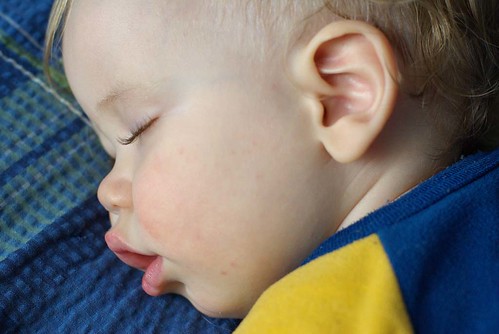
1. Calming Bedtime Routine
Children need time to calm down and prepare for sleep. Having a consistent bedtime routine can be useful in giving the child cues that sleep time is coming. There are likely things that you do each night before bed, such as putting on pajamas, brushing teeth, reading bedtime story, nursing or rocking, and so on. Try to do those things in the same order to help your child understand what is coming next and learn to calm down through that process. You may also want to have a few routines that you alternate. For example, one routine for bath night and another one for other nights. One for weekdays and one for weekends. One that involves Daddy and one that involves Mommy. Having these alternate routines can help keep things smooth on nights when things need to change up a bit (e.g. one parent isn't there, you are visiting friends, a favourite book is missing, etc.) Also, create a calming environment during the bedtime routine. For example, turn off any bright lights (dimmers are great), television, and loud noises at least an hour before bedtime (ideally no television in several hours leading up to bedtime if you allow television at all). Consider building a massage into your bedtime routine.
2. Lots of Fresh Air and Exercise
With my kids and with lots of other kids I know, this is the single most important factor in determining how well they sleep at night. When our son was going through a really rough period with sleep as a toddler he was spending several hours outside each day running around. When we doubled the amount of time he was spending outside his sleep improved exponentially. Even in cold climates (we live in Canada), I recommend finding a way to get outside with your kids every day (bundle them up and go for several short trips outside if need be) and finding places for them to get exercise (playgroups and indoor playgrounds are great for this, but other options include going for a walk around a museum or a mall or other place where your child can walk for a long time). So if you're spending 2 hours being active with your baby or toddler, try 4 hours instead and see if that makes a difference. Our kids need that exercise and fresh air anyways, so even if it doesn't help with sleep, it is a good thing nonetheless.
3. Watch your Baby's Diet
It is possible that something the baby is eating could be contributing to sleep problems. Some babies that are on formula have sensitivities to certain types of formula. For babies that have started solids, food allergies or sensitivities can impact sleep. Also, certain types of foods consumed too close to bedtime can prevent good sleep. This includes anything containing caffeine (chocolate, sodas, etc.), foods high in sugar, artificial colourings and preservatives, foods high in protein and simple carbohydrates. You should replace those foods with foods that promote good sleep, such as whole grains, fruits and vegetables. In addition there are certain foods that contain tryptophan (a sleep inducing chemical) that are good evening food choices (despite many of them being proteins). These include turkey, tuna, certain types of nuts (not for babies), cottage cheese, hard cheese, yogurt, soymilk, tofu, soybeans, eggs, bananas and avocados.
4. Watch for Irritants in Mom's Diet
If you are breastfeeding, then it is also worth considering whether something in your diet could be contributing to poor nighttime sleep. Usually breastfeeding mothers can eat whatever they want, but some infants are sensitive to certain things in mom's diet. Dairy is a frequent culprit and can be difficult to cut out (it is an ingredient in so many things, so finding all that hidden dairy can be tough). Kellymom has a great article on dairy and other food sensitivities in breastfed babies. Beyond food, caffeine and alcohol can be other culprits. Both of these are safe in moderation for breastfeeding. However, they can impact your baby's sleep. Your caffeine intake can make your baby more wakeful (this is of course a catch-22 because if you're not sleeping well, you're more likely to reach for a coffee). With regards to alcohol, a study on sleep disturbances and alcohol has shown that infants had poorer sleep in the 3.5 hours after being exposed to even very minor amounts of alcohol in a mother's breastmilk.
5. Consider Co-Sleeping
Co-sleeping isn't for everyone, but for a lot of families (mine included), it is the best way for everyone to get a good night's rest. There are many benefits to co-sleeping and also important co-sleeping safety requirements to consider if you do decide this is right for your family.
6. Consistent Napping
Good sleep promotes good sleep. A lot of parents whose children do not sleep well at night mistakenly think it would be a good idea for them to give up naps. Instead, parents should try to institute a consistent nap routine. The baby's last nap should not be too late in the day either to ensure that it doesn't interfere with nighttime sleep.
7. Comfortable Sleep Environment
Wherever your baby sleeps, ensure that it is comfortable. That doesn't mean adding all sorts of blankets and pillows (which can be dangerous). Instead, it means making sure that your baby is dressed appropriately for the temperature in comfortable pajamas. It may mean using things like white noise to help your baby to sleep. It certainly involves ensuring a smoke free sleep environment, not having smokers sleep in the same room as the baby, and ideally a smoke free home altogether.
8. Adjust Your Expectations
I hate all of the chatter about sleeping through the night. Our society puts way too much pressure on parents in this regard and completely discounts information on what normal infant sleep is. Be reasonable and patient with your child and understand that not every child is the same and also that a child that did once sleep well, may not always sleep well. If a child is teething, going through a growth spurt, sick, working on a developmental milestone, hungry, didn’t get enough exercise or fresh air, is preoccupied by a scary situation during the day, or any list of other things, that can wreak havoc on their sleep. Try to be understanding in these situations and help them get through those tough times.
9. Read, Read, Read
Nothing in this post helped you? Have you done all of these things already? This is just a start and only hits on a few key issues. But people have written whole books on this topic and maybe you could benefit from reading some of them. Elizabeth Pantley's "No-Cry" series, including the The No Cry Sleep Solution, the The No Cry Sleep Solution for Toddlers and Preschoolers and the The No Cry Nap Solution (also my review) offer great tips and ideas. I have used these books extensively for myself and to help others. I should note that I didn't do the logs or the formal plan that she suggests. I think it is too easy to fall into thinking of your sleep plan like sleep training, when really the idea is to create an environment that is conducive to healthy sleep. So don't throw away the ideas in the book just because the idea of the logs sounds too complicated or inappropriate to you. Just use the book to choose tips and ideas that are a good fit for your family and your child.
Other books that promote gentle approaches to sleep include:
- The Happiest Baby on the Block: The New Way to Calm Crying and Help Your Newborn Baby Sleep Longer (by Harvey Karp)
- Three in a Bed: The Benefits of Sleeping with Your Baby (by Deborah Jackson)
- Good Nights: The Happy Parents' Guide to the Family Bed (and a Peaceful Night's Sleep) (by Maria Goodavage and Jay Gordon)
- Sleeping with Your Baby: A Parent's Guide to Cosleeping (by James J. McKenna)
Links to some videos and articles with sleep tips can also be found on the Parenting Baby To Sleep blog's I Need Sleep Now page.
I think it is important to note though that no book or blog provides the solution to infant or toddler sleep. Each baby is unique and each family is unique.
10. Recognize that This Too Shall Pass
Our kids are only little for such a short period of time. It isn't always easy dealing with night wakings or sleep deprivation and I know it is frustrating for a lot of parents. I think it is important though to realize that it will pass, things will get better. You do not need to teach your child to self-soothe using cry it out. Your child will learn that skill with time on their own. In the meantime, if these tips are not working and you are frustrated, get some help. Certainly spouses/partners should help each other and find a way to share nighttime parenting wherever possible. Beyond that, find someone that can help you out during the day so that you can take a long nap when things are really rough.
Photo credit: Lab2112 on flickr


Reader Comments (91)
I totally agree with adjusting your expectations. I find it really helpful to hang out with like-minded moms, who have roughly the same approach to parenting that I do. That way, I'm not being inundated with stories and advice that is really not helpful, and just contributes to the frustration.
And with my second child, I'm finding it much easier to recognize that these days will not last forever. Although right now, in the middle of what I think is a growth spurt, I would appreciate it if they passed sooner rather than later. ;-)
You know, I really think you are onto something with "fresh air and exercise".
I'm never sure how helpful - or not - the old "it could be something in your milk!" advice is, because I think so many women believe they must eat like a rabbit in order to breastfeed... and that puts some women off it. But I think you temper it well here.
@ Ruth: That really is a tough one. The great majority of women do not need to watch what they eat or drink at all (except alcohol and caffeine in moderation) and being careful about some herbs. However, for the small minority of babies that do have sensitivities to something in mom's milk, it can wreak havoc on their health, mood, and their sleep. That said, switching to formula is often not the answer because the same babies that have sensitivities to something in mom's milk are just as likely to be sensitive to something in the formula. The better (but tough) approach is to do an elimination diet and then slowly introduce things back in to diet until you are able to pinpoint what the culprit is. Or if you have an idea what it could be (dairy is a frequent culprit or any known allergens in the family), then just eliminate that first and see.
@Amber: I completely agree with hanging out with like-minded moms! One of the reasons that I choose not to frequent mainstream parenting message boards and regular playgroups for the most part. I try to go to places like the kellymom and Mothering message boards, go to babywearing or LLL play groups, and so on.
Another fantastic article. Thank you. I will be sharing a link to this with my clients. It is SO important for new and expectant parents to know that sleep problems are solvable and, more importantly, that sleep problems are more often in the minds of the parents than with the baby at all. They are a result of societal expectations that get projected upon parents and generate weeks, months and YEARS worth of anxiety in parents who, if they had never had the unrealistic sleep expectations placed upon them in the first place, would be just fine and would help their child learn to sleep in a pattern that works well for their family.
Can I suggest something else though. This is something that has come up for many past clients and now I make this recommendation to all new and expectant parents. Your #1 suggestion is having a "Calming Bedtime Routine." It is a GREAT idea. That said I strongly recommend that you don't make it the exact same every night. Have perhaps two or three that you cycle through. I say this mostly due to the routine of nightly baths specifically but the two big reasons for me to say this are: 1) bath time on a daily basis is not only unnecessary but it can be quite drying and irritating to the skin of a young baby and 2) if you do bath every night and then end up with an occasion to visit a cottage or friend or go camping where a bath isn't an option then you are not only in a new location for sleeping - making it harder to settle - but you also miss the chance to employ that particular part of the routine.
As an aside and as a retired LLLC Leader - after almost 10 years leading - I love that you go to LLLC playgroups with other like minded moms. My very closest friends in the world are women I know through LLL and I still attend local meetings when I can. (It's a great way to find babysitters who are familiar with AP parenting and babies who are still nursing beyond a year, BTW.)
Thanks again for an inspiring post!
@babyREADY: I agree that a bath every night isn't necessary and isn't advisable. I'll look at editing the text slightly later to make that clear. We bathe our kids every second or third night. We also have slightly different weeknight versus weekend routines. Also, our routines are very portable (its easy to drop a few books in a bag if you're going to visit friends!). Thanks for sharing this with your clients!
Thanks for this. I found it helpful!!
My pleasure!! Every new parent needs to know where to access good advice. The bad is far too pervasive!!
[...] Annie at PhD in Parenting gives lots of tips for improving babies’ and toddlers’ sleep - without crying it out [...]
[...] 10. Gentle Baby and Toddler Sleep Tips [...]
We've had some really challenging nights with Madeline, but I've found that she's a baby who really needs to be "parented to sleep." (I can't remember where I read that phrase). We have a routine that we stick to no matter what, alternating parents throughout the week. Now that she's a year old, by the time she's through with her bath she's rubbing her eyes. She knows what comes next!
She sometimes chatters or fusses a bit as she settles in, but is an overwhelmingly good sleeper. I think your tips here are spot on!
Oh - and about the bathtime issue mentioned above: We do give her a bath every night (she loves it and hasn't had skin issues, so we go with it) but we make the bath a shorter part of the routine. For us, we've found that a quick bath with some play followed by a more-involved massage/rubdown with lotion is easily transferable for nights when we're not home.
With this routine, we've made the bath more about focused playtime/singing songs/talking time with Mommy or Daddy rather than the water. Other non-water play can be substituted quite easily, and you can give a baby a massage/rubdown with lotion anywhere.
I think your final tip is the most important one. I remember when my daughter was just a couple of months old and she would only nap in my arms. People said to me that it was making a rod for my back but I used it as an excuse to spend most of the day sitting on the couch or at the computer and held her delicious body close. If I had to do stuff, I used a sling. Sometimes it felt like a drag but I'm so glad I did it instead of leaving her to cry. Now, I almost never get to hold her when sleeping. She's a 'good sleeper' and prefers to sleep alone and go to sleep alone, and for up to 12 hours at a time. I know that's a blessing (and kind of weird at only one year of age!) but truth be told, I miss nighttime parenting. I don't miss sleep deprivation though!
I could not agree more with #8, adjust your expectations. I remember one parent came to me and said she would keep her twins in their cribs for 3 hours in the afternoon because that's how long she expected them to sleep! Yikes! I also find people who expect their 3 or 4 month old to sleep all night without a feeding a bit off base. There are plenty of adults who can't go 12 hours without eating, so I don't know why we (and I don't mean me) expect our babies to do it. I fed both my babies at night up through a year and even my almost 13 month old woke up last night to eat because his appetite has been off all week due to illness. All babies are so different that I don't like how many people have blanket ideas about what your baby should or should not do at the right age, weight, etc.
Great tips!
[...] Do you need some gentle sleep tips? Gentle Baby and Toddler Sleep Tips [...]
I was so stressed about sleep caved and did some CIO ( I think I cried more than him ) and then about a year ago I just accepted my son isn't a sleeper. He never was , I can't change who he is but thriving so he is getting enough sleep, and naps well. Once my expectations changed stress was gone.
Great advice !
[...] the doors and let your kids out. Get them out of the house.In my post on gentle sleep solutions, I mentioned how much better my kids sleep when they have spent hours upon hours outdoors. This is [...]
This is a wonderful, wonderful post. I will be passing this on- shorter to read than Pantley's book and I don't recall her mentioning the food issue.
I had forgotten how obsessed the rest of the world is with baby's sleep in the 9 years between my daughters. Other than nodding and smiling, I have no quick answer for "does she sleep?"
[...] finally gives in. Same with sleep. If someone is obsessed with sleep, it is appropriate to use gentle, loving techniques to try to get your baby to sleep so that you can get more sleep too. It is not appropriate to force a baby to sleep using methods [...]
[...] It could be avoided if more people were knowledgeable about normal infant sleep and how to promote good sleep habits. [...]
I'm tempted to cut out L's midday nap, he consistently goes to bed a t 10 p.m. But your article makes me think that I should hold on to it. Thanks for all the great info!
#10 was the only thing that really helped me take a few deep breaths and deal with the 2 years of sleep deprivation we had w/ our son. In spite of working on all the other suggestions as well, including full-time co-sleeping, recognizing that Ethan would be a big boy sooner than we'd like was the only thing that gave me the patience to get through it. He still doesn't sleep 12 hours a night (does anyone? really?!), but the 5-6 hour stretches we get are blissful. And as he gets older, I miss that quiet time at night with him when it was just the two of us.
And I agree w/ you 100% that the idea of sleeping through the night and the urgency to make our babies "independent" are awful. Our society's obsession with it is a huge disservice to our babies.
An excellent post! My almost 2.5 year old twins have never been good sleepers, that was one reason that co-sleeping was such a blessing!
I second Amber's suggestion to hang out with likeminded parents. I am "crunchiest" mom out of the other twin moms I hang out with and that can definitely leave me in situations where I start to feel defensive about my parenting choices.
I really notice how much better my duo sleeps when they've been playing outside. We are trying to find more fully fenced parks because two toddlers plus one adult at an open park on a busy street is stressful!
Thanks for a great post! I'll have to check out the resources you listed to see if we can make nap time better.
i am so delighted to discover your site and read the above post and others!
i am one of those nursing mothers (my son will be 3 in Nov) who's child has always been highly sensitive to my diet. alcohol, carbonated beverages, sugar, caffeine, beans and other 'gassy' legumes.. the reaction was so strong when my son was a newborn that he'd literally throw up my milk. my intense interest and love for my son has led me to have a never-ending interest in breast-feeding and the benefits and effects of breast-milk on a childs growth and well-being. i spend my nights between my husbands and son's bed, but mostly with my son and that is where i wake up. he sleep well till about 1:30am and then wants to nurse often and will search for my body in the bed. i am constantly trying to come up with solutions to improve his sleep. i do drink white wine in the evenings and i'd thought only beer was a culprit but i may have to re-evaluate after reading your article. my son loves to eat meat (chicken mostly, some fish, beef once a week) and white rice (i try to get brown rice into him but he doesn't like it). he eats pumpkin and sweet potato on occasion but otherwise doesn't like vegetables yet. he recently enjoys mango, kiwi fruit, a little orange or apple. he drinks only water. and my breast-milk of course.
pls let me know your thoughts.
[...] This chap placed an observative post today on Gentle Baby and Toddler Sleep Tips | PhD in ParentingHere’s a quick excerpt [...]
None of the tips really helped me although i am down to no choice but CIO. I have been co-sleeping and feeding my baby to sleep EVERY night for 15mo. and now when i wean her down to 3 feedings a day, i put lemon juice on my breasts and told her i had an Owee, and i couldn't feed any more... (it tasted so nasty that she didn't want it) i was so proud of her, but that night she just screamed... i tried everything from paci like a nipple, sippy, rocking, singing, tv, snack, finally she passed out with her hand in the snack bowl... she wasn't hungry cause we just ate spegetti... and tonight the same thing... but she passed out on the floor! i want to help her soothe herself.... but HOW??? she is doing the CIO on her OWN!! and i am NOT ok with it... please help?
@Cassondra: Have you read any of the No Cry Sleep Solution books by Elizabeth Pantley (see my http://www.phdinparenting.com/my-parenting-library/" rel="nofollow">Parenting Library for a list of her books and other sleep books I would recommend)? They offer gentle and gradual suggestions for things like night weaning, teaching your child to go to sleep on their own, etc. I'm not sure that I can help you directly because I have never weaned or sleep trained a child. I create an environment conducive to good sleep and then just let it happen on its own. It isn't an overnight solution, but it is what works for our family. I still nurse my 2.5 year old to sleep at night and will continue to do so until she is ready to give it up (my son self-weaned at 2.5 years).
Crying with loving parental presence is different than crying alone in a dark room.
Gentle Baby and Toddler Sleep Tips | PhD in Parenting...
Check out these 10 gentle sleep tips to help your baby or toddler sleep better without using cry it out or other strict sleep training methods.
Photo credit: Lab2112 on flickr....
Annie- these are great tips. I think the fresh air & exercise is a big one here, it's just so cold (20 degrees today.) But I'll see what I can do. Great post- thank you for sharing it!
Steph
I love this post, Annie! We're a no crib/no CIO house...and it's always refreshing to find likeminded mamas! I especially agree with point #2. Fresh air truly makes all of the difference. We try to go biking, walking, or running outdoors every single day. :)
Hi just discovered this blog and love it! WRT "This too shall pass", I had a funny sleep-deprived thought today. My 8 month old woke up twice on Saturday night, and 5 times last night. My husband said, "This is a bad trend." I said, "If this keeps up, he'll be waking up 1,000 times a night by the time he's 4!"
My 4 year old still wakes up at night, sometimes. My 2 year old STILL wakes up. At least once a night, although just to be brought to my bed from his crib. Which I love. Still. Yup, no regular sleep patterns in our household, that's for sure!!
I just wanted to say that I love your blog. I've found lots of helpful stuff on here. The fresh air and exercise idea is something we need to work on. It's a good idea and I'm going to keep track of how it helps. We are still going through rough nights with our 18-month-old daughter. She is up many times every night and I haven't been able to bring myself to push anything with her. I've been reading that nightweaning is the solution, but I'm loathe to try it when if she's going to scream for hours. She still just seems to really need to nurse A LOT. I keep hoping it will taper off a bit before I work on some changes. Maybe a little more language will help, too, so we can communicate about what is going on with the changes.
Yes! Radmama, thank you for adding that!
Although I appreciate much of this advice, parents should never feel that they are failing because a baby cries. When a baby's needs for sustenance have been met, she should be allowed to cry in our comforting presence. Allowing a child to cry is loving, not ignoring. Although crying for extended periods of time can create stress in a baby, most crying RELIEVES stress. Babies will never (and should never have to) be "No Cry." If an adult friend cries we provide loving support and comfort, but don't attempt to 'fix' them with food, a nipple in the mouth, rocking or "shushing." Sometimes we all need to cry, and we need the expression and release of our feelings to be allowed and accepted.
I wholeheartedly agree that babies need lots of exercise and fresh air for good health and better sleep. But when a baby is kept in a carrier or stroller, the baby gets the air and the parent gets all the excercise. I encourage parents to allow a baby lots of time for unrestricted movement in a playpen or other safe area outside with a few simple toys. Babies are kept occupied for long periods of time this way, involved in self-initiated play. Parents can watch, and enjoy, trusting the baby to daydream, move and play as he wishes. It's a healthy, blissful way to spend the day for everyone!
I agree that http://www.phdinparenting.com/2008/07/12/ill-hold-you-while-you-cry/" rel="nofollow">crying in arms is the appropriate response when a child just needs to express emotions. It can be a great way to teach them how to voice their emotions and to express their feelings.
That said, I also believe in meeting a baby's physical and emotional needs. That means that if my baby needs something, I do not think it is an appropriate response to withhold that and hold her while she cries instead. For example, a lot of parents will say "I just fed her she can't possibly need to nurse again". However, nursing is not just about feeding. Nursing is about comfort and it is a lot of babies' preferred source of comfort. To draw a parallel, if you are upset and just want your husband to hold you, but he instead decides to just pat you on the head while you cry because "he just gave you a hug, so you can't possibly need another one", he wouldn't really be responding to your needs and you would reasonably get frustrated and annoyed at being patted on the head.
I agree wholeheartedly on your points around exercise.
Thanks for these tips. I've been doing most of them already, but I suppose I need to practice patience. :) Perhaps paradoxically, the biggest challenge for our family (both of us work from home, too) has been to establish consistent naptimes. We've let our daughter just sleep when it comes naturally to her, but her own natural naptimes have made bedtime quite late.
Thanks for your reply!
I still believe we give parents (and babies) the wrong message when we suggest 'nursing away' tears. Many parents cannot nurse a baby for various reasons (like adoption). Are you suggesting they use a bottle or a pacifier every time a baby cries?
A nipple usually stops the tears instantly, because it goes in the mouth. If parents are encouraged to nurse for the purpose of arresting cries, why would they ever NOT do that, and allow a child's feelings? Are you suggesting they only allow a child to cry as a last resort?
Should babies learn that when they are upset they need to eat or drink to feel better? Ask the overeaters or alcoholics you know about eating and drinking for comfort!
I occassionally have toddlers in my parenting classes who run to their parents every time they have the slightest disappointment and ask to be nursed, and I work with those parents to send a healthier message to the child. The child does not feel capable of handling situations that others her age can, because the parent has taught her to seek a nipple every time she is upset. We must give children the message THAT WE BELIEVE they are capable of coping with feelings, with our calm support. Quieting them on the breast is much easier for us than hearing their feelings. Sometimes, truly loving a child means allowing her to cry, supporting her when it is excruciatingly hard for us.
Janet:
1) Babies that are not nursed have other preferred ways to be comforted. But generally babies that do nurse prefer comfort at the breast.
2) Nursing is not always "eating".
3) Do you also have toddlers in your parenting classes who run to their parents every time they have the slightest disappointment and ask to be comforted in some other way? What makes that other way better/worse than nursing? I agree that all parents need to teach their children to handle situations in an age appropriate way, but I don't think that means saying no to nursing or other methods of comfort necessarily. You can comfort your child and then talk about what they could do next time to handle the situation. You can offer suggestions before offering to nurse and see if they are okay with that.
3) No. Children who are not trained to nurse whenever they are upset express their feelings openly, either in the parent's arms or not, as they choose, and then move on, eager to engage in play again. But the toddlers who nurse on demand seem to be distracted by a need to test those boundaries with the mother. They play for shorter periods of time; have shorter attention spans, and have not developed coping skills. That is what I have observed in the 15 years that I have taught parent/infant and toddler classes.
Thank you for allowing me to express my views!
Interesting Janet.
My experience (supported by the research that I've read) has been that children who are not given the opportunity to develop a secure attachment to their parents tend to be more insecure and clingy by about preschool age. Nursing an infant on demand, with reasonable limits given as the child grows, helps to foster a secure attachment (as does responding to the child at night instead of doing cry it out), which helps them to build their confidence and become more independent as they are ready (as opposed to being pushed into false independence and experiencing severe insecurity as a result).
You are correct that secure attachment is vital for a baby! Secure attachment is fostered by a sensitive response to a baby's, physical and emotional needs, and is (THANKFULLY) very possible for babies who are not breast fed, as well as those who are. Breastfeeding is a wonderful way to nourish for those lucky enough to be able to do so, but becomes problematic when used as a quick fix, and a feeling stuffer. A baby needs emotions to be allowed and accepted, not a breast in the mouth as soon as she cries, to make her "be quiet." Obviously, the parent does not mean to send that message, but that is the one the child receives.
Parents should not feel pressured to go to any length to stop a baby's cries. Crying is not to be feared; it is a healthy release. I don't understand the expression "cry it out." What are babies "crying out"? I do know that babies need to cry sometimes, as we all do. And they need support for crying, not parents rushing to plug their mouths.
Sir Richard Bowlby, son of John Bowlby who originated Attachment Theory will be the keynote speaker at the 2010 RIE Conference (Resources for Infant Educarers, a non-profit organization) in June, at the Skirball Center in Los Angeles. I recommend this conference for anyone who would like to learn more about "secure attachment" and the research behind it, from the source of the theory. This is the theory "attachment parenting" borrows its name from, but one has little to do with the other.
Janet: The expression "cry it out" refers to letting babies cry themselves to sleep. I don't agree with it, yet people were looking for alternatives to it, which is the reason I wrote this post.
I think a variety of parenting is practiced among parents of nursing toddlers. Mine have had days where they run to me at slightest upset to nurse, but most days nursing was comfort for BIG upsets and smaller ones involved talking, hugs, kisses, etc.
Usually nursing for comfort as a toddler involved discussion of feelings as well. For toddlers and teens, parents are the strong base to fall back on as they explore the world.
I read Bowlby before I had children and his work did influence my "attachment parenting" choices.
I will suggest amber teething necklaces. They've been super. It might be too early to tell, but both of the kids have been way less irritable today. They sleep much better. I haven't given them any tylenol for teething pain, but they seem happy and pain free with the necklaces. Plus, the necklaces are adorable. I took the kids strolling in the mall today and got many compliments.
Emma:
Thank you for your comment. Unfortunately, I cannot recommend amber teething necklaces. They present a choking hazard for small children.
Initially, I was very nervous about using an amber teething necklace. My son started wearing his when he was 5-6 months old and has been wearing it ever since (he is now 12 mos). I still feel nervous about him wearing it when sleeping. So, I put it around his ankle under his sleeper. I may have to reassess than when he gets older, especially if he starts taking his sleeper off. But for now, this works for us.
On a different note, thank you for this blog. I wish I had come across it earlier on. We've used many ideas in the Pantley book (but not before reading some other books that offer less gentle advice).
I need some clarification about crying at bedtime. My husband & I do not agree with CIO and we work to ensure that the bedtime routine is calm and relaxing. However, when we put our son into his crib, he sometimes protests when we leave the room. His upset is communicated by fussing, which we generally wait out because he will often settle down. But other times, the fussing turns into crying, which elicits a prompt reponse from us. There have been other times, however, that his crying subside even in the few moments that it takes us to get upstairs to his room.
So, here's my question: when his fussiness turns into tears, do we give him a couple of minutes to see if he will settle on his own or do we respond right away? I obviously don't want to let him CIO, but I also don't want to rush in at every fuss.
This is lovely but I really, really, really wish there was an emergency list of things to try for AP practicing parents whose children still have significant sleeping problems. Every time I google I get the same answers, and they are all the things I am already doing with my 2 year old, who nightwakes 2-4 times every night. I absolutely do not want to do CIO **because it does not work for her** but it seems like there are 2 brands of nighttime sleep solutions: the standard ones that work for MOST kids really well (bedtime routine, etc) and CIO. I seriously wish there was something out there I haven't tried that isn't CIO that I've never heard of before because THEN I would have some hope.
- one tired cosleeping, extended/tandem nursing AP mama
I hear you. My toddlers always woke, well nursed. They didn't always wake fully up, but if they did I would have lost my mind.
Have you read Elizabeth Pantley? I think her gentle sleep solution book has an "if nothing else works" chapter. Perhaps her gentle sleep for toddlers one does, too.
[...] stay asleep, and to put yourself in a better frame of mind to deal with night-waking. Some of those ways [...]
[...] that advice being endorsed by a shoe company. I’m not saying that they should endorse my sleep recommendations either, I just think that they should stay out of the business of sleep altogether and stick to [...]